The Wood Duck (Aix sponsa): A Living Jewel of North American Wetlands
Few sights in the natural world rival the breathtaking beauty of a Wood duck in full plumage. Known scientifically as Aix sponsa — a Latin phrase often translated as "waterfowl in bridal dress" — the Wood duck stands as one of the most visually striking waterfowl species on the North American continent. With its iridescent feathers, bold geometric facial markings, and vivid palette of greens, purples, chestnuts, and whites, the Wood duck has long captured the imagination of birdwatchers, wildlife photographers, hunters, and conservationists alike.
Beyond its remarkable appearance, the Wood duck holds a special place in American conservation history. Once threatened by overhunting and widespread habitat loss in the late 19th and early 20th centuries, this resilient species made a dramatic comeback — a testament to the power of thoughtful wildlife management, habitat restoration, and the dedication of hunters and conservationists working together. Today, the Wood duck thrives across much of the eastern United States and beyond, including in the Mid-Atlantic state of Delaware, where wetlands, wooded swamps, and tidal marshes provide ideal habitat for this remarkable bird.
Whether you're an avid waterfowl hunter hoping to add this species to your season bag, a naturalist eager to understand the ecology of eastern wetlands, or simply someone who appreciates the wonder of wild creatures, the Wood duck rewards attention and respect in equal measure.
Biological Traits
The Wood duck (Aix sponsa) belongs to the family Anatidae, the broad family of birds that includes all ducks, geese, and swans. Within this family, the Wood duck is placed in the perching duck tribe, a group distinguished by their strong claws and ability to perch and even nest in trees — a behavior that sets them apart from most other duck species.
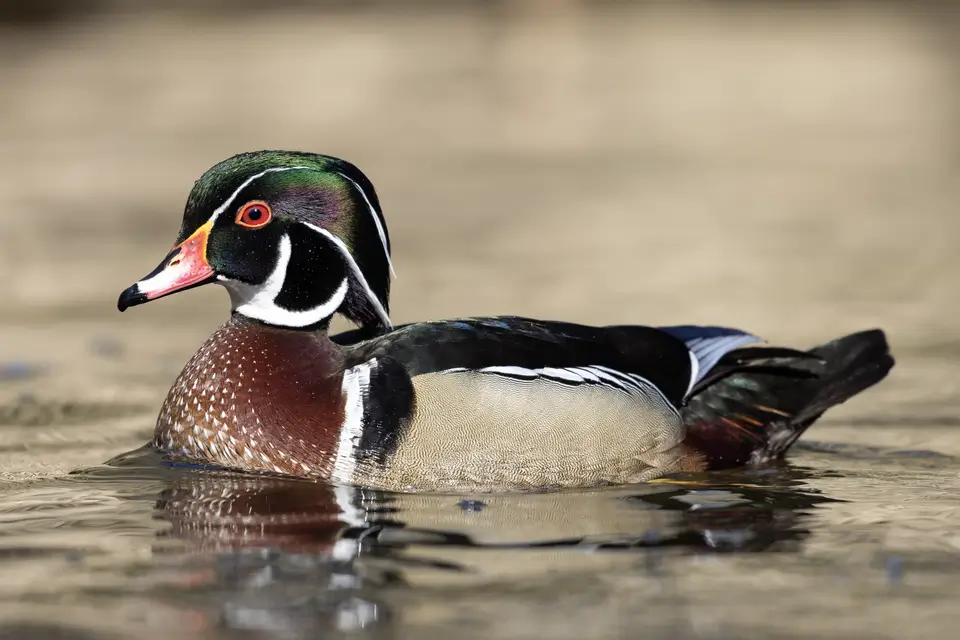
The male Wood duck in breeding plumage is arguably the most ornate duck in North America. His head gleams with iridescent green and purple, accented by bold white stripes that trace the face and throat. A distinctive swept-back crest adds a regal, almost theatrical quality to his appearance. His chestnut breast is flecked with white spots, transitioning into rich tan and white flanks, all set against a deep, dark back. A vivid red eye and a red-and-white patterned bill complete the striking portrait.
The female, while less flamboyant, carries her own subtle beauty. She is dressed in soft browns and grays, with a distinctive white teardrop-shaped eye ring that makes her instantly recognizable in the field. Like the male, she possesses an iridescent blue-green patch on the wing known as a speculum, which flashes brilliantly in flight.
One of the most fascinating biological traits of the Wood duck is its nesting behavior. Unlike most waterfowl, Wood ducks are cavity nesters, meaning they raise their young inside hollow trees — sometimes at considerable heights above the ground. After hatching, the ducklings face an extraordinary challenge: they must leap from the nest cavity to the forest floor or water below, often from heights of 30 feet or more. Incredibly, their light weight and downy feathers allow them to survive this dramatic tumble essentially unharmed, after which they follow their mother to water.
Wood duck hens are also known for a phenomenon called "egg dumping" or brood parasitism, where a female will lay eggs in the nest of another Wood duck hen. This behavior can result in nests containing surprisingly large numbers of eggs. Once the ducklings hatch and reach water, they are highly precocial — meaning they are relatively developed and mobile almost immediately — and are capable of feeding themselves within hours of their first swim.
The diet of the Wood duck is broad and opportunistic, consisting of a mix of plant and animal matter. Acorns, seeds, aquatic vegetation, berries, and insects are all important food sources. Their ability to exploit the rich mast crops of wooded bottomlands — particularly acorns from oak trees — gives them a nutritional edge during the fall season.
Wood ducks are also notable for their vocalizations. The female produces a loud, rising "oo-eek, oo-eek" call, particularly when startled or in flight. The male's call is softer and more wheezy by comparison. These distinctive calls often alert observers to the presence of Wood ducks before they are even seen.
Habitat & Range
As their common name strongly suggests, Wood ducks are intimately tied to wooded aquatic environments. They favor forested wetlands, swamps, beaver ponds, wooded streams, and river bottomlands where mature trees provide both nesting cavities and food in the form of mast. Unlike many duck species that gravitate toward open water, Wood ducks are most at home where forest meets water, navigating through timber with surprising agility in flight.
The Wood duck's range encompasses much of the eastern United States, with a separate population along the Pacific Coast. Across the eastern portion of their range, Wood ducks can be found from southern Canada south through the Gulf States, wherever suitable wooded wetland habitat exists. They are generally considered short- to medium-distance migrants, with northern populations moving south in winter while some southern populations remain year-round.
Delaware, situated in the heart of the Mid-Atlantic region, offers excellent habitat for Wood ducks. The state's varied landscape — encompassing tidal marshes along Delaware Bay, freshwater wetlands, wooded swamps, and the slow-moving, tree-lined waterways of its interior — creates ideal conditions for this species. Delaware's position along the Atlantic Flyway, one of the major migratory corridors of eastern North America, ensures that the state sees significant Wood duck activity throughout the fall migration season and beyond.
The Division of Fish and Wildlife within Delaware's Department of Natural Resources and Environmental Control (DNREC) oversees wildlife management in the state, including the stewardship of the wetland habitats upon which Wood ducks depend. Delaware's commitment to managing its natural resources reflects the broader regional effort to maintain and improve habitat quality for waterfowl and other wildlife along the Atlantic Coast.
Hunting Information
The Wood duck is a prized game bird among waterfowl hunters throughout its range. Its striking beauty, challenging flight patterns through timber, and excellent table quality make it one of the most sought-after ducks in the eastern United States. For hunters in Delaware and across the Atlantic Flyway, pursuing Wood ducks in the intimate setting of wooded swamps and flooded timber is a cherished tradition that connects sportsmen and women to the region's rich waterfowling heritage.
Wood duck hunting typically involves working the edges of wooded waterways, beaver ponds, and flooded bottomlands early in the morning or late in the afternoon, when birds are most actively moving between roosting and feeding areas. Calling can be effective, with hunters using vocalizations designed to mimic the hen's distinctive call. Decoys placed on calm, sheltered stretches of water can also help draw birds into range.
In Delaware, waterfowl hunting is regulated by the DNREC Division of Fish and Wildlife in coordination with federal frameworks established by the U.S. Fish and Wildlife Service. Hunters are required to follow all applicable state and federal regulations, which include licensing requirements, season dates, and bag limits set to ensure sustainable harvest. Because regulations can change from year to year, hunters are strongly encouraged to consult the current Delaware hunting regulations published by DNREC before heading afield to ensure they are in full compliance.
The pursuit of Wood ducks in Delaware takes place against a backdrop of stunning autumn color, as the wooded swamps and bottomlands of the state come alive with the hues of fall foliage. For many hunters, the experience is as much about the setting and the tradition as it is about the harvest — a sentiment that speaks to the deep cultural connection between waterfowl hunting and the landscapes of the Mid-Atlantic region.
Conservation
The story of the Wood duck's conservation is one of the great success stories in North American wildlife management. By the late 1800s and early 1900s, populations had declined dramatically due to unregulated market hunting and the widespread clearing of forested wetlands. The species was considered by some to be in serious danger of extinction.
The passage of the Migratory Bird Treaty Act of 1918 provided critical federal protection for Wood ducks and countless other migratory bird species, bringing an end to the era of commercial hunting and establishing a framework for regulated harvest. Equally important was the recognition that Wood ducks were being limited by a shortage of natural nesting cavities, driven by the loss of old-growth forests and large-diameter trees.
The response from the conservation community was innovative and highly effective: the widespread deployment of artificial nest boxes. Constructed to mimic the natural tree cavities that Wood ducks prefer for nesting, these boxes — when properly installed over or near water — were enthusiastically adopted by breeding pairs. Programs to install and monitor nest boxes spread across the eastern United States, involving wildlife agencies, sportsmen's organizations, and private landowners in a collaborative effort that proved transformative for the species.
Today, the Wood duck is considered a conservation success story and is one of the most abundant duck species in the eastern United States. Continued efforts to protect and restore wetland habitats, maintain nest box programs, and manage harvest sustainably through science-based regulations have kept the population robust. Organizations such as Ducks Unlimited and state wildlife agencies like Delaware's DNREC Division of Fish and Wildlife continue to play vital roles in preserving the wetland ecosystems upon which Wood ducks and countless other species depend.
The Wood duck's recovery is a powerful reminder of what is possible when habitat protection, regulated hunting, and active wildlife management work hand in hand. It stands as an inspiration not just for waterfowl conservation, but for the broader effort to maintain North America's extraordinary biodiversity for future generations.
Conclusion
The Wood duck — Aix sponsa, the waterfowl in bridal dress — is far more than a pretty face in the wetlands. It is a biological marvel, a conservation triumph, and a beloved quarry of waterfowl hunters from Delaware to the Pacific Coast. Its remarkable nesting behavior, stunning plumage, and intimate association with the forested wetlands of eastern North America make it one of the continent's most iconic wild creatures. In Delaware and across the Atlantic Flyway, the Wood duck's presence in misty autumn swamps and along wooded waterways remains one of the great privileges of the outdoor experience.