The Virginia Opossum: North America's Only Marsupial and a Fascinating Resident of Delaware
Few animals in North America are as misunderstood or as biologically remarkable as the Virginia opossum (Didelphis virginiana). As the continent's only native marsupial, this creature occupies a uniquely fascinating place in the natural world — a living relic of an ancient evolutionary lineage that predates many of the modern mammals we know today. Found across a sweeping range that extends from Central America through Mexico and across nearly every corner of the continental United States, the Virginia opossum has demonstrated an extraordinary capacity for adaptability, resilience, and survival.
In Delaware, a small but ecologically diverse Mid-Atlantic state bordered by Maryland, Pennsylvania, New Jersey, and the Atlantic Ocean, the Virginia opossum is a common and well-established resident. Whether encountered shuffling through a suburban backyard at night, foraging along the wooded edges of a rural farm field, or spotted crossing a quiet country road in the early morning hours, opossums are a familiar presence in the Delaware landscape. Yet despite their abundance, many people know surprisingly little about these extraordinary animals. This article aims to change that — exploring the biology, habitat preferences, hunting traditions, and conservation status of one of the most underappreciated wildlife species in the region.
Biological Traits
The Virginia opossum is a truly singular animal from a biological standpoint. As a marsupial — a group of mammals characterized by giving birth to relatively undeveloped young and completing their early development in a maternal pouch — opossums belong to an ancient mammalian order that has existed for tens of millions of years. The order Didelphimorphia, to which the Virginia opossum belongs, represents the largest order of marsupials in the Western Hemisphere.
One of the opossum's most distinctive biological features is its reproductive strategy. Females give birth to a litter of tiny, underdeveloped young after an extremely short gestation period of approximately 12 to 13 days — one of the shortest gestation periods of any North American mammal. At birth, the young, called joeys, are no larger than a honeybee and must immediately crawl from the birth canal into the mother's marsupial pouch, where they latch onto a nipple and continue their development for several weeks. A female opossum typically has 13 nipples arranged in a circular pattern with one in the center, meaning litter sizes are naturally limited by this number. Opossums commonly produce two litters per year, and sometimes three, contributing to their healthy population numbers across their range.
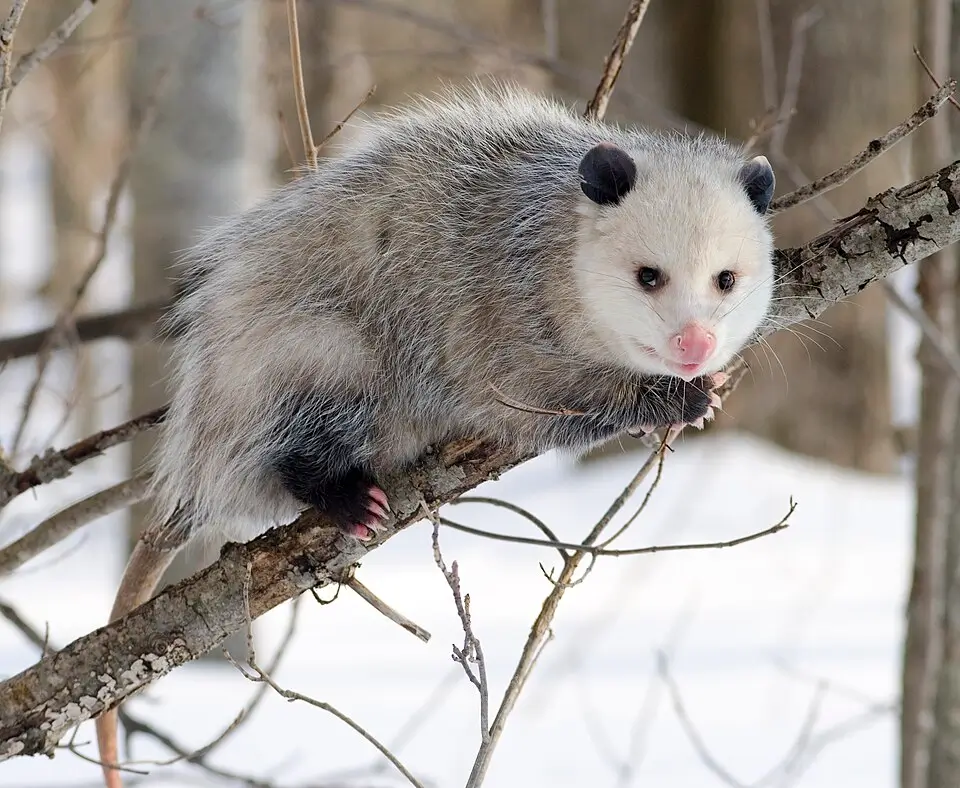
The opossum's physical appearance is immediately recognizable. Adults are roughly the size of a domestic cat, with coarse, grayish-white fur, a long, pointed snout, naked ears, and a distinctive prehensile tail that is largely hairless. The tail, often mistakenly thought to be used for hanging upside down for extended periods, is primarily useful as a gripping aid when climbing — an activity at which opossums are surprisingly adept. Their feet are also adapted for gripping, with an opposable "thumb" on their hind feet that functions similarly to a human thumb, providing excellent purchase on tree limbs and branches.
Perhaps the most famous behavioral trait of the Virginia opossum is its well-known defensive behavior commonly called "playing possum." When threatened by a predator and unable to escape, an opossum may fall into an involuntary catatonic state that mimics death. The animal rolls onto its side, becomes limp, slows its heart rate, and emits a foul-smelling secretion from its anal glands designed to further simulate the appearance and odor of a dead animal. This state can last anywhere from a few minutes to several hours. Many predators, instinctively preferring live prey, will lose interest in what appears to be a dead animal, allowing the opossum to eventually recover and escape.
Opossums also possess a remarkable resistance to certain snake venoms, including those of pit vipers such as rattlesnakes and cottonmouths. Research has identified a peptide in opossum blood serum that neutralizes venom components, making these animals highly resistant to bites that would be lethal to most other mammals of similar size. This trait has garnered considerable scientific interest for potential medical applications.
Opossums are opportunistic omnivores with a broad diet. They consume insects, small rodents, birds, eggs, frogs, fruit, nuts, carrion, and even ticks in significant numbers. Their tick consumption, in particular, has drawn ecological attention — studies suggest that opossums are highly effective at grooming ticks from their bodies and consuming them, potentially reducing tick populations in local environments and decreasing the risk of tick-borne illness transmission in areas where they are abundant.
The lifespan of a Virginia opossum in the wild is notably short — typically just one to two years — due to predation, vehicle collisions, and the physical demands of their environment. In captivity, they may live considerably longer. Despite their short individual lifespans, the species as a whole thrives due to high reproductive rates.
Habitat & Range
The Virginia opossum is among the most habitat-flexible mammals in North America. It occupies a strikingly wide range of environments, from tropical forests in Central America to suburban neighborhoods and farmlands in the northeastern United States. This adaptability is one of the key reasons the species has expanded its range significantly over the past century, moving steadily northward as human development has altered landscapes and created new food opportunities.
Opossums are found throughout Delaware in a variety of habitats. They favor areas that offer a combination of woodland cover, access to water sources, and proximity to food. Deciduous and mixed forests, brushy field edges, stream corridors, marshlands, and even suburban and urban green spaces all serve as suitable opossum habitat. Delaware's diverse geography — encompassing coastal wetlands, inland forests, agricultural fields, and suburban developments — provides a mosaic of habitats that supports healthy opossum populations statewide.
Opossums are primarily nocturnal and solitary. They do not hibernate, though they may remain inactive for short periods during cold snaps, relying on fat reserves to see them through. Because they lack thick insulating fur and have naked ears and tails susceptible to frostbite, opossums in northern parts of their range sometimes show signs of frost damage on their extremities. Their range expansion northward, however, suggests they are far more cold-tolerant than once believed, particularly as milder winter conditions become more common.
Opossums are not territorial in a rigid sense. They are nomadic within a home range, moving regularly between denning sites such as hollow logs, brush piles, abandoned burrows dug by other animals, rocky crevices, and even spaces beneath human structures like porches and sheds. They do not dig their own burrows.
Hunting Information
The Virginia opossum has a long and legitimate history as a game animal in the United States, particularly in the South and in rural communities of the Mid-Atlantic region, where opossum hunting has been a traditional activity for generations. Opossum hunting is often conducted at night with the aid of dogs trained to track and tree the animals, and it represents a cherished part of rural hunting culture in many states.
In Delaware, hunting activities are regulated by the Delaware Department of Natural Resources and Environmental Control (DNREC), specifically through its Division of Fish and Wildlife. Hunters interested in pursuing Virginia opossum in Delaware should consult the current Delaware hunting regulations published by DNREC for the most up-to-date and accurate information regarding season dates, bag limits, and licensing requirements. Regulations can change from year to year, and it is always the responsibility of the individual hunter to verify current rules before heading afield.
Opossum hunting in Delaware, as in other states, typically requires a valid hunting license. Hunters are encouraged to visit the DNREC Division of Fish and Wildlife's official website or contact the agency directly for specific season information and regulatory details applicable to the current season.
Conservation
The Virginia opossum is not a species of conservation concern at either the national or state level. It is abundant throughout its range and has, if anything, expanded its territory over recent decades. The species is listed as a species of Least Concern by wildlife authorities, reflecting its healthy, widespread populations across North America.
The opossum's ecological role is genuinely valuable. As an omnivore and opportunistic scavenger, it contributes to nutrient cycling and helps control populations of insects, small rodents, and other invertebrates. Its tick-consuming behavior offers a potential benefit to broader ecosystem health, including potentially reducing the prevalence of tick-borne diseases such as Lyme disease in areas where opossums are present.
In Delaware, as in other states, coexistence between humans and opossums is generally straightforward. These animals are non-aggressive by nature and pose minimal risk to people or pets when left alone. Public education about the opossum's ecological benefits can help foster greater appreciation for this often-overlooked species.
Conclusion
The Virginia opossum is far more than the shuffling, wide-eyed creature that startles homeowners when discovered rifling through trash at night. It is a biologically extraordinary mammal with deep evolutionary roots, a fascinating behavioral repertoire, and a genuinely positive role in the ecosystems it inhabits. From the wooded river corridors of western Delaware to the suburban neighborhoods along the state's northern border with Pennsylvania, the opossum is a quiet and beneficial neighbor — one that deserves recognition, respect, and perhaps a bit more admiration than it typically receives.
Whether you are a wildlife enthusiast, a hunter carrying on a time-honored tradition, or simply someone curious about the natural world outside your window, the Virginia opossum offers a compelling story worth knowing.