Sandhill Crane (Grus canadensis): A Majestic Icon of North American Wetlands
Few sights in the natural world capture the imagination quite like a flock of Sandhill cranes in flight. With their wide wingspans, distinctive bugling calls, and graceful movements, these birds have inspired awe in human observers for thousands of years. Among the oldest known bird species on Earth — with fossil records stretching back nearly 10 million years — the Sandhill crane (Grus canadensis) represents a living connection to an ancient world. Today, they remain one of North America's most recognizable and celebrated wading birds, drawing birdwatchers, hunters, and wildlife enthusiasts alike to witness their spectacular migrations and elaborate courtship dances.
Whether observed soaring in tight formations over the marshes of the Midwest, striding purposefully through open grasslands in search of food, or performing their breathtaking dancing displays during breeding season, Sandhill cranes command attention wherever they appear. Their story is one of resilience, adaptability, and conservation success — a testament to what dedicated wildlife management can achieve.
Biological Traits
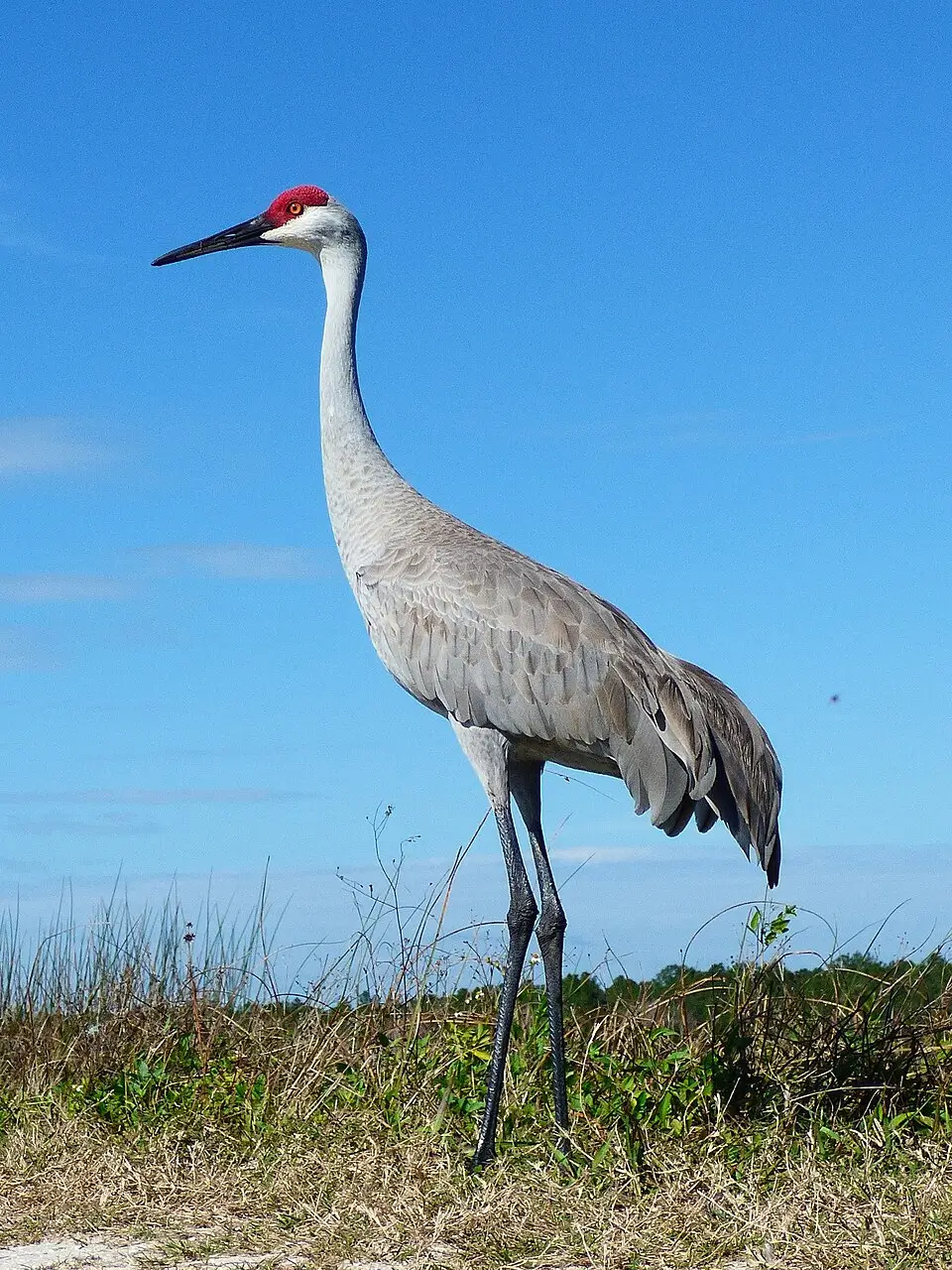
The Sandhill crane belongs to the family Gruidae, the true cranes, and is classified under the genus Grus. It is one of two crane species native to North America, alongside the endangered Whooping crane (Grus americana). Sandhill cranes are large, stately birds characterized by their long legs, long necks, and broad wings that make them unmistakable in the field.
Adults are predominantly gray in plumage, though their feathers may often take on rusty or brownish tones during the breeding season. This coloration occurs because Sandhill cranes engage in a behavior known as "preening with mud," in which they rub iron-rich mud or vegetation onto their feathers, imparting a reddish-brown stain that serves as natural camouflage in marsh and grassland environments. One of the species' most distinctive features is the bare, red patch of skin on the forehead and crown, which is characteristic of adults of both sexes.
Sandhill cranes are powerful fliers, capable of soaring on thermal air currents at impressive altitudes during migration. They are also well-known for their remarkably loud, rattling calls — a sound produced by an elongated trachea that coils within the sternum, allowing the crane to generate vocalizations that can carry for miles across open landscapes. This call is used for pair bonding, territorial communication, and flock coordination during migration.
One of the most celebrated behavioral traits of Sandhill cranes is their elaborate courtship dance. Both males and females participate in displays that involve jumping, bowing, wing-spreading, and tossing objects such as sticks or grass into the air. These dances strengthen pair bonds and are not limited to breeding season — Sandhill cranes may dance throughout the year in social contexts. They are monogamous birds that typically mate for life, with pairs often remaining together for many years.
Sandhill cranes are omnivores with a broad diet that includes plant material such as seeds, grains, tubers, and berries, as well as insects, small mammals, amphibians, reptiles, and invertebrates. This dietary flexibility contributes to their success across a wide range of habitats.
The species is divided into several recognized subspecies, which differ primarily in size and geographic range. These include the Greater Sandhill crane, the Lesser Sandhill crane, the Canadian Sandhill crane, the Florida Sandhill crane, the Mississippi Sandhill crane, and the Cuban Sandhill crane. The migratory subspecies undertake some of the most impressive long-distance migrations of any North American bird.
Sandhill cranes are known for their longevity. In the wild, individuals can live for two decades or more, and captive birds have been recorded living considerably longer. They typically reach sexual maturity at around two to three years of age, though many do not begin breeding until they are older. Pairs generally raise one to two chicks, called colts, per breeding season.
Habitat & Range
Sandhill cranes occupy a remarkably diverse range of habitats across North America, from the Arctic tundra to the subtropical marshes of Florida. Their broad habitat tolerance is one of the key factors behind their population success. During the breeding season, they favor wetland habitats including marshes, bogs, wet meadows, and the edges of lakes and ponds. Open areas adjacent to these wetlands are important for foraging and nesting, as the birds prefer to have clear sightlines to detect approaching predators.
During migration, Sandhill cranes concentrate in vast numbers at traditional staging areas, with the Platte River valley in Nebraska being among the most famous stopover sites in North America. Hundreds of thousands of cranes may gather there during the spring migration, creating one of the most spectacular wildlife spectacles on the continent. In winter, they occupy agricultural fields, grasslands, and wetlands in the southern United States and Mexico, where they feed heavily on waste grain left in harvested fields.
The range of the Sandhill crane extends across much of North America, with migratory populations breeding in Canada, Alaska, and the northern contiguous United States, while non-migratory populations reside year-round in Florida, Mississippi, and Cuba. The species has shown a notable capacity for range expansion and population growth in recent decades, with flocks now regularly observed in areas where they were historically absent or uncommon.
In the Mid-Atlantic region, including the state of Delaware, Sandhill cranes are considered uncommon but are observed with increasing frequency, particularly during migration periods. Delaware, situated along the Atlantic Flyway — one of the major migratory corridors in North America — serves as a potential transit point for cranes moving between their northern breeding grounds and southern wintering areas. The state's diverse landscape, which includes coastal marshes, agricultural fields, and freshwater wetlands, can provide suitable stopover habitat for migrating birds. Birdwatchers in Delaware have reported sightings of Sandhill cranes with greater regularity in recent years, reflecting broader population trends across the eastern United States.
Hunting Information
Sandhill cranes are considered a migratory game bird in the United States and are managed cooperatively by the U.S. Fish and Wildlife Service and individual state wildlife agencies. Hunting seasons for Sandhill cranes exist in a number of states, particularly in the central and western United States, where populations of the species are robust and well-established.
Hunters who pursue Sandhill cranes often describe the experience as among the most challenging and rewarding in all of waterfowl and upland bird hunting. The birds are wary, possess excellent eyesight, and can be difficult to decoy effectively. Successful crane hunters typically employ large, realistic decoys, skillful calling, and careful concealment in blinds situated near feeding or roosting areas. The meat of the Sandhill crane is highly regarded among hunters and has been described as exceptionally flavorful, earning the informal nickname "rib-eye of the sky" in hunting communities.
With respect to Delaware specifically, the Delaware Department of Natural Resources and Environmental Control (DNREC) Division of Fish and Wildlife oversees hunting regulations in the state. Based on available information, Delaware does not currently list a specific Sandhill crane hunting season among its regulated seasons, which is consistent with the bird's status as an uncommon and irregular visitor rather than a resident or regularly staging species in the state. Hunters and wildlife enthusiasts in Delaware interested in Sandhill crane opportunities are encouraged to consult directly with the DNREC Division of Fish and Wildlife for the most current and accurate regulatory information, as regulations can change in response to population data and management objectives.
Conservation
The conservation story of the Sandhill crane is widely regarded as one of wildlife management's genuine success stories. During the late 19th and early 20th centuries, Sandhill crane populations across North America declined significantly due to habitat loss, market hunting, and egg collection. Several subspecies, particularly the non-migratory Florida and Mississippi Sandhill cranes, were reduced to critically low numbers.
Thanks to the protections afforded by the Migratory Bird Treaty Act of 1918, along with subsequent habitat conservation efforts, wetland restoration projects, and carefully managed hunting programs, overall Sandhill crane populations have recovered remarkably. The migratory populations — particularly the Mid-Continent population, which is the largest — have grown substantially and now number in the hundreds of thousands. This recovery has allowed wildlife managers to open regulated hunting seasons in appropriate regions while maintaining healthy, sustainable populations.
Efforts to protect and restore wetland habitats have been central to crane conservation. Organizations dedicated to wetland preservation, along with federal and state programs that protect critical staging and wintering habitats, have helped ensure that Sandhill cranes continue to have the resources they need throughout their annual cycle.
The more vulnerable non-migratory subspecies, such as the Mississippi Sandhill crane (Grus canadensis pulla), continue to receive intensive conservation attention. Captive breeding programs and habitat management efforts have helped stabilize these smaller, localized populations, providing hope for their long-term survival.
The Sandhill crane's recovery also has broader ecological significance. As large omnivores that feed across multiple habitat types, these birds play a role in seed dispersal and invertebrate population dynamics in the ecosystems they inhabit. Their presence is often an indicator of healthy wetland and grassland systems.
For residents and wildlife enthusiasts in Delaware and throughout the Mid-Atlantic region, the increasing visibility of Sandhill cranes in recent decades serves as an encouraging reminder that wildlife populations can recover when given appropriate protections and habitat. Whether spotted from a distance as a small group passes overhead during migration or observed more closely at a wetland stopover, each Sandhill crane sighting is an opportunity to appreciate one of North America's most enduring and magnificent birds.