The Muskrat: A Remarkable Aquatic Mammal of Delaware's Waterways
Few animals are as deeply woven into the fabric of North American wetland ecosystems as the muskrat (Ondatra zibethicus). This semi-aquatic rodent has thrived across the continent for thousands of years, quietly going about its business in marshes, ponds, streams, and coastal wetlands with an industriousness that has earned it both the admiration of naturalists and the respect of generations of trappers and hunters. In a state like Delaware — a Mid-Atlantic gem bordered by the Atlantic Ocean, Delaware Bay, and an intricate network of tidal marshes and freshwater wetlands — the muskrat holds a place of particular ecological and cultural significance.
Whether you encounter one paddling purposefully across a still pond at dusk, spot a dome-shaped lodge rising from a cattail marsh, or simply notice the telltale ripples left in its wake, the muskrat is a creature worth knowing. This article explores the biology, habitat, hunting tradition, and conservation status of one of North America's most fascinating and resilient small mammals.
Biological Traits
The muskrat (Ondatra zibethicus) is the sole member of its genus, Ondatra, and belongs to the family Cricetidae — the same large family that includes voles, lemmings, hamsters, and New World rats and mice. Despite its common name and rat-like appearance, the muskrat is more closely related to voles than to true rats.
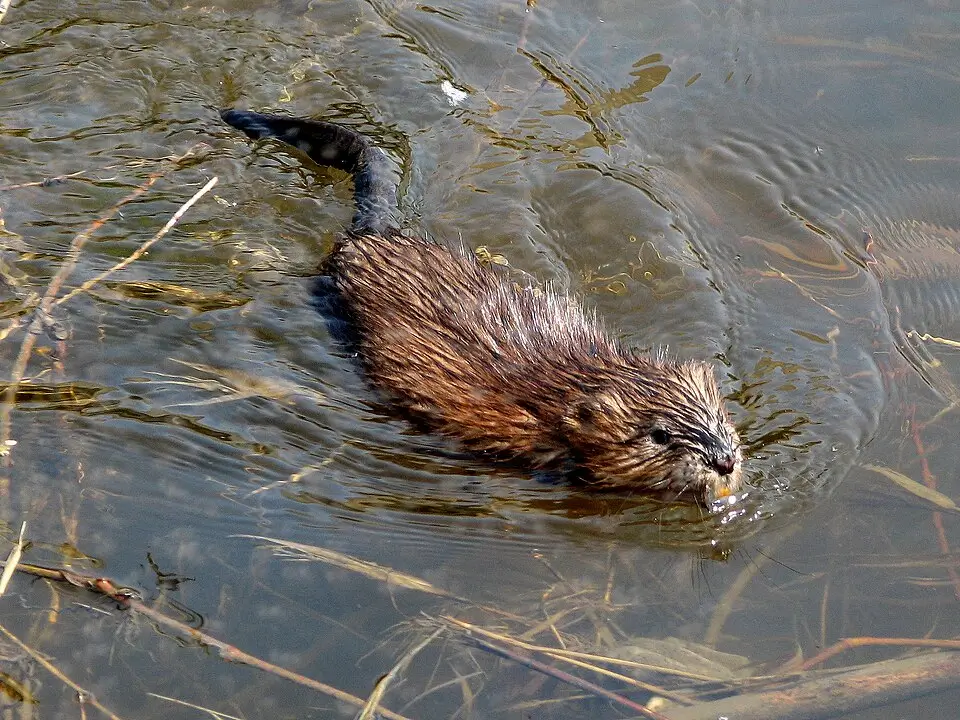
One of the most recognizable features of the muskrat is its body plan, which is superbly adapted for life in and around water. It has a robust, stocky build, covered in two distinct layers of fur: a dense, soft underfur that provides insulation and water resistance, and a layer of longer, coarser guard hairs on top. This dual-layer coat allows the muskrat to remain warm and buoyant even in cold water — an essential trait for an animal that spends a significant portion of its life swimming and diving.
The muskrat's tail is one of its most distinctive physical characteristics. Unlike the round, cylindrical tails of most rodents, the muskrat's tail is laterally flattened — compressed from side to side — and largely hairless. This unique tail functions as a rudder while swimming, helping the animal steer with precision through aquatic environments. Combined with its partially webbed hind feet, the muskrat is a highly capable swimmer that can remain submerged for considerable periods of time.
The species gets the "musk" part of its name from the pair of musk glands located near its tail. These glands produce a potent, musky secretion that the animal uses to mark its territory and communicate with other muskrats during the breeding season. This chemical communication plays an important role in mating and social behavior.
Muskrats are primarily herbivores, feeding on a wide variety of aquatic and semi-aquatic vegetation. Cattails, sedges, rushes, and water lilies are among their preferred food sources, though they will also consume roots, tubers, and rhizomes. During leaner times, particularly in winter, they may supplement their diet with freshwater mussels, frogs, crayfish, and small fish — making them technically omnivorous under certain conditions. Their feeding activity is not merely self-serving; by cropping aquatic vegetation, muskrats play an active role in shaping wetland plant communities, creating open water channels that benefit other wildlife species including waterfowl.
One of the most impressive behaviors of the muskrat is its construction ability. Muskrats are prolific builders, creating two primary types of structures: lodges and bank burrows. Lodges are dome-shaped mounds constructed from piled aquatic vegetation, mud, and debris, often rising several feet above the water's surface. These structures, reminiscent in concept of beaver lodges though smaller in scale, contain interior chambers above the waterline where muskrats rest, feed, and raise their young. The entrances are typically located below the water's surface, providing excellent protection from predators. In areas with steep banks, muskrats may instead excavate complex burrow systems, with tunnels extending well into the bank above the waterline.
Muskrats are prolific breeders. Females are capable of producing multiple litters per year, with litter sizes typically ranging from several to as many as a dozen young, depending on environmental conditions. Young muskrats develop quickly and are capable of swimming at a young age. This high reproductive rate contributes to the species' resilience and its ability to maintain healthy populations across a wide range.
Habitat & Range
The muskrat is one of the most widely distributed mammals in North America. Its range spans from northern Canada and Alaska south through most of the contiguous United States and into northern Mexico. The species has also been widely introduced beyond its native range — including parts of Europe, Asia, and South America — where it has sometimes established invasive populations.
Within this vast range, the muskrat is fundamentally tied to wetland environments. It thrives in freshwater marshes, tidal marshes, river edges, lake margins, ponds, swamps, and drainage ditches — virtually any body of water with sufficient vegetation and stable water levels. The animal is remarkably adaptable and can persist in both pristine wilderness wetlands and human-modified landscapes alike.
Delaware is an ideal state for muskrat habitat. Located in the Mid-Atlantic and South Atlantic regions of the United States, Delaware features an exceptional diversity of wetland types. The state is bordered to the east by the Atlantic Ocean and Delaware Bay — a major estuary that supports vast expanses of tidal marsh. The Delaware coastline and its inland waterways, including the Chesapeake and Delaware Canal corridor and numerous smaller streams, creeks, and drainage systems, provide muskrats with abundant food, cover, and suitable building sites.
The tidal salt marshes and brackish marshes along Delaware Bay are particularly productive muskrat habitat. Muskrats in tidal marshes face different challenges than their freshwater counterparts — they must contend with fluctuating water levels driven by tidal cycles — but they have proven well-adapted to these conditions. The dense stands of saltmarsh cordgrass and other tidal marsh plants provide both food and building material for lodge construction.
Inland, Delaware's freshwater ponds, marshes, farm impoundments, and wetland restoration areas also support healthy muskrat populations. The state's relatively flat topography and its network of agricultural drainage ditches create a surprisingly extensive wetland mosaic that benefits this species throughout the year.
Hunting and Trapping Information
The muskrat has a long and storied history as a furbearer in North America. For centuries, indigenous peoples utilized muskrat fur and meat, and the species became one of the most commercially important furbearers during the North American fur trade era. That tradition continues today, with muskrat trapping remaining a meaningful activity for outdoor enthusiasts, subsistence practitioners, and professional trappers across much of its range.
In Delaware, the Division of Fish and Wildlife — operating under the Delaware Department of Natural Resources and Environmental Control (DNREC) — oversees hunting, trapping, and fishing regulations. The DNREC's Division of Fish and Wildlife is the authoritative agency for all season dates, licensing requirements, bag limits, and legal methods for taking muskrat in the state. Prospective hunters and trappers are strongly encouraged to consult the official DNREC website and current Delaware hunting and trapping regulations guide for the most up-to-date and accurate information before pursuing muskrat in the state. Regulations can change from season to season, and compliance with current licensing and season requirements is both a legal obligation and a cornerstone of responsible wildlife stewardship.
Muskrat trapping in Delaware and across the Mid-Atlantic region traditionally peaks during the colder months of fall and winter, when the animals' fur is at its prime thickness and quality. Common legal methods for taking muskrat include various trap types appropriate to wetland settings, though hunters and trappers should always verify which methods are currently permitted under Delaware law.
In some communities, particularly in the Chesapeake Bay and Delaware Bay regions, muskrat meat has a long culinary tradition. Often described as having a rich, dark flavor, muskrat meat has been enjoyed in regional dishes for generations and remains part of the local foodways in parts of Delaware and neighboring Maryland.
Conservation
The muskrat is currently classified by the International Union for Conservation of Nature (IUCN) as a species of Least Concern, reflecting its wide distribution, adaptability, and generally stable populations across most of its native range. In Delaware and across the broader Mid-Atlantic region, muskrat populations are considered healthy and are sustained by the state's extensive wetland habitats.
That said, the long-term health of muskrat populations is closely tied to the health of wetland ecosystems. Wetland loss and degradation — driven by factors such as coastal development, drainage for agriculture, and the impacts of changing environmental conditions — represent ongoing challenges for all wetland-dependent wildlife, including the muskrat. In Delaware, significant conservation efforts are underway through DNREC and various partner organizations to protect, restore, and enhance wetland habitats throughout the state, which benefits muskrats alongside countless other species of birds, fish, reptiles, and mammals.
Responsible hunting and trapping also play a role in muskrat conservation. When practiced under well-designed regulatory frameworks, regulated take helps ensure that muskrat populations remain in balance with their habitat and that wetland ecosystems continue to function effectively. Hunters and trappers who participate in regulated seasons contribute directly to wildlife management through license fees and excise taxes, which fund habitat conservation and research programs.
The muskrat stands as a testament to the resilience and adaptability of North American wildlife. In Delaware's rich mosaic of coastal marshes, tidal wetlands, and freshwater habitats, this industrious little mammal continues to thrive — a reminder of the extraordinary biodiversity that can be found in even the smallest and most densely populated of American states.