Mule Deer: An Icon of the American West
A Comprehensive Guide to Odocoileus hemionus
Few animals capture the spirit of the American West quite like the mule deer. With its oversized, mule-like ears, distinctive bounding gait, and commanding presence across rugged mountain terrain and open desert landscapes, the mule deer (Odocoileus hemionus) stands as one of North America's most recognized and celebrated wildlife species. Whether encountered on a crisp autumn morning along a ridgeline trail or glimpsed through a spotting scope at first light in a sagebrush valley, the mule deer commands respect and admiration from wildlife enthusiasts, photographers, and hunters alike.
The mule deer is more than just a symbol of the western wilderness. It is a keystone species in many ecosystems, a crucial food source for apex predators, and a prized game animal that has fueled conservation funding and outdoor traditions for generations. Understanding this animal — its biology, its habits, its habitat needs, and its place within the broader landscape of North American wildlife management — is essential for anyone who spends time in the outdoors.
This article takes a deep dive into the world of the mule deer, exploring what makes this species biologically unique, where it thrives, and how hunters, conservationists, and wildlife managers work together to ensure its continued presence across the landscape.
Biological Traits
The mule deer (Odocoileus hemionus) belongs to the family Cervidae, the deer family, which also includes elk, moose, caribou, and the closely related white-tailed deer (Odocoileus virginianus). The species name hemionus is derived from Greek, meaning "half mule" or "mule," a direct reference to the animal's most immediately recognizable feature: its large, prominent ears that closely resemble those of a mule.
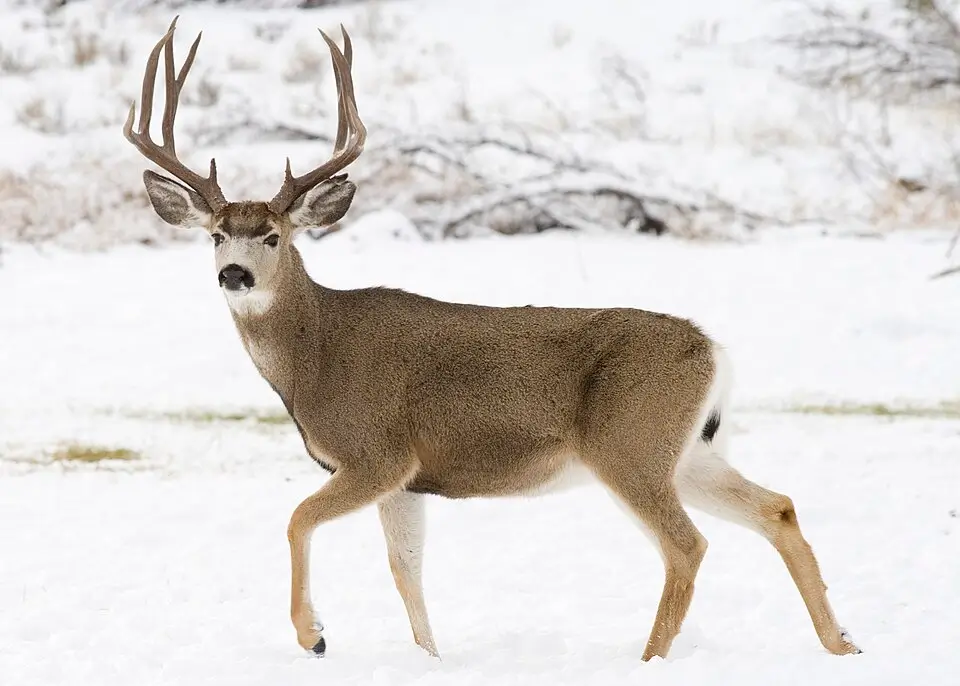
One of the most distinctive physical characteristics of the mule deer, beyond its ears, is its tail. Unlike the white-tailed deer, which raises its broad, white-fringed tail like a flag when alarmed, the mule deer has a narrow, rope-like tail that is white with a black tip. This difference in tail morphology is one of the easiest ways to distinguish the two species in the field, particularly in areas where their ranges overlap.
Mule deer are also well known for their unique locomotion style known as "stotting" or "pronking." When alarmed or navigating rough terrain, mule deer often move in a distinctive bouncing, all-four-feet-off-the-ground leap that allows them to rapidly change direction and traverse steep, rocky slopes with remarkable agility. This gait is believed to be an adaptation to the uneven, technical terrain of their native habitats and may also serve as a signal to predators that the deer is healthy and not worth pursuing.
Antler development in male mule deer, known as bucks, is another fascinating biological trait. Mule deer bucks grow antlers that typically bifurcate — that is, they fork into two equal branches — rather than growing off a single main beam as seen in white-tailed deer. This dichotomous branching pattern is a hallmark of the species and helps hunters and wildlife biologists age and assess the quality of individual animals. Antlers are shed annually, typically in late winter or early spring, and regrowth begins almost immediately, fueled by the rich blood supply within the velvet that covers developing antler tissue.
Mule deer are herbivores, feeding on a wide variety of plant material depending on season and region. Their diet commonly includes grasses, forbs, shrubs, and browse material such as sagebrush, bitterbrush, and various woody shrubs. Their digestive system, like that of all deer, is adapted for a ruminant lifestyle, meaning they have a four-chambered stomach that allows them to efficiently break down tough plant cellulose through a process of fermentation and re-chewing, commonly known as "chewing the cud."
Both sexes of mule deer undergo a seasonal change in coat color. Their summer coat is typically a reddish-tan or tawny color, which transitions to a thicker, grayer coat in winter — an adaptation that provides both insulation against cold temperatures and some degree of camouflage in winter landscapes. Does (female mule deer) typically give birth to one or two fawns in late spring or early summer. Fawns are born with a spotted coat that provides camouflage against dappled forest floors and grassy meadows, and they are capable of standing and moving within hours of birth.
Habitat & Range
The mule deer is fundamentally a western North American species. Its range extends across much of the western United States, western Canada, and portions of northern Mexico. From the coastal mountains of the Pacific Northwest to the high deserts of the Great Basin, from the Rocky Mountain foothills to the brushy draws of the Texas Panhandle, mule deer have demonstrated a remarkable ability to thrive in a diverse array of ecosystems.
Mule deer are particularly associated with open and semi-open habitats — places where they can use their extraordinary eyesight and large ears to detect predators from a distance. Sagebrush steppe, chaparral, pinyon-juniper woodlands, mountain shrublands, and high-elevation coniferous forests all serve as important mule deer habitat depending on the season. Many mule deer populations are migratory, moving between higher-elevation summer ranges and lower-elevation winter ranges as snowpack and food availability dictate. These migrations can cover tens of miles and represent one of nature's most remarkable annual wildlife spectacles.
The presence of water, adequate forage, and suitable escape cover are the primary factors that determine mule deer distribution at any given time of year. Riparian areas — the vegetated corridors along streams and rivers — are particularly important during dry summer months and serve as critical travel corridors throughout the year.
It is important to note for readers in Delaware and the broader Mid-Atlantic region that mule deer are not native to the eastern United States. Delaware's native deer species is the white-tailed deer (Odocoileus virginianus), which is found in abundance throughout the state's forests, farmlands, and wetland edges. The mule deer's range does not extend into Delaware or neighboring Mid-Atlantic states under natural conditions. For those interested in mule deer hunting, travel to western states is generally required, as these animals are intimately tied to the landscapes, elevations, and ecosystems of the American West.
Hunting Information
Mule deer hunting is a deeply rooted tradition across the western United States and Canada. The pursuit of a mature mule deer buck — often through spot-and-stalk hunting in open country or archery hunting in thick riparian draws — is considered by many hunters to be one of the most challenging and rewarding experiences North American hunting has to offer. The wide-open terrain that mule deer inhabit demands physical fitness, patience, quality optics, and a deep understanding of the animal's behavior and movement patterns.
Hunting regulations for mule deer vary significantly by state and province, and specific seasons, license requirements, and tag quotas are managed by individual state wildlife agencies. Regulations are updated regularly based on population surveys, habitat assessments, and broader wildlife management objectives. Hunters interested in pursuing mule deer are strongly encouraged to consult the official wildlife management agency of the state in which they plan to hunt well in advance of the season to obtain current, accurate information regarding licensing, season dates, legal equipment, and any applicable drawing requirements.
For hunters based in Delaware, the Delaware Department of Natural Resources and Environmental Control (DNREC) Division of Fish and Wildlife is the state's primary authority for hunting regulations. While Delaware does not have a native mule deer population or a resident mule deer season, the DNREC's Division of Fish and Wildlife provides comprehensive information for Delaware residents regarding out-of-state hunting opportunities and general licensing guidance. Hunters should consult the DNREC and the relevant western state agencies directly for the most current regulations.
Ethical hunting practices, including fair chase principles, proper shot placement, and responsible use of harvested animals, are foundational values within the mule deer hunting community. Organizations dedicated to mule deer conservation, such as the Mule Deer Foundation, actively promote these values and channel hunting-related funding directly into habitat conservation and population management efforts.
Conservation
The conservation of mule deer is a topic of significant importance to wildlife managers, hunters, and conservationists throughout western North America. Mule deer populations are subject to a variety of pressures, including habitat fragmentation caused by roads, fences, and development; competition with livestock for forage; predation; disease; and the effects of drought and changing vegetation patterns associated with long-term climate variability.
Wildlife migration corridors are a particular area of conservation focus. As mule deer populations depend on seasonal migrations to access high-quality forage and survive harsh winters, anything that interrupts or blocks these corridors can have significant consequences for local and regional populations. Collaborative efforts between state and federal agencies, private landowners, and conservation organizations have produced important successes in identifying, protecting, and restoring migration corridors across the West.
Hunters play a direct and meaningful role in mule deer conservation. License fees, tag revenue, and excise taxes collected under the Federal Aid in Wildlife Restoration Act — commonly known as the Pittman-Robertson Act — generate hundreds of millions of dollars annually for state wildlife agencies to fund habitat management, population monitoring, research, and public access programs. This user-pay conservation model has been foundational to the recovery and long-term management of mule deer and countless other North American wildlife species.
Mule deer also benefit from broader landscape conservation initiatives that protect sagebrush habitat, restore native vegetation after wildfire, and manage water resources in arid environments. The species' health serves as a valuable indicator of overall ecosystem condition across the western landscape.
Conclusion
The mule deer is one of North America's most iconic wildlife species — a creature perfectly adapted to the rugged, open landscapes of the American West. From its bifurcated antlers and bounding stot to its seasonal migrations across vast mountain ranges, the mule deer embodies the wildness and vitality of western ecosystems. For hunters, wildlife watchers, and conservationists alike, this remarkable animal represents a living connection to the land and a powerful reminder of the importance of thoughtful, science-based wildlife stewardship.
Whether you are a Delaware hunter dreaming of a western mule deer adventure or simply a lover of North American wildlife, the mule deer offers a lifetime of fascination and inspiration.