The Gray Fox: North America's Versatile and Fascinating Canid
Among the many remarkable wildlife species that call North America home, the gray fox (Urocyon cinereoargenteus) stands out as one of the most distinctive and intriguing members of the canid family. Known for its striking silver-tipped coat, adaptable nature, and a suite of unique physical abilities that set it apart from nearly every other member of the dog family, the gray fox has earned a well-deserved reputation as one of the continent's most resourceful wild animals.
In Delaware and across the broader Mid-Atlantic region, the gray fox is a recognized and valued part of the natural landscape. From the forested uplands of Pennsylvania's border country to the tidal marshes and woodlands near the Atlantic coast, this resilient animal navigates a wide variety of environments with remarkable ease. Whether observed padding silently through a woodland at dusk or perched improbably in the branches of a tree, the gray fox never fails to capture the imagination of wildlife enthusiasts, hunters, and naturalists alike.
This article explores what makes the gray fox such a compelling subject — from its biology and behavioral traits to its place in the ecosystems of Delaware and the broader eastern United States.
Biological Traits
The gray fox belongs to the genus Urocyon, which is considered one of the most ancient lineages within the family Canidae. Unlike the red fox (Vulpes vulpes), which belongs to a different genus entirely, the gray fox represents a primitive branch of the canid family tree that diverged millions of years ago. This ancient lineage helps explain one of the gray fox's most celebrated and unusual abilities: it is one of only two members of the dog family capable of climbing trees. The other is the raccoon dog of East Asia, but within North America, the gray fox stands alone in this remarkable skill.
The gray fox's climbing ability is made possible by its strong, hooked claws and rotating wrists — physical adaptations that give it a grip more reminiscent of a cat than a dog. These animals can scale trees to escape predators, access food sources such as fruit and bird eggs, or simply find a safe and elevated resting spot. This tree-climbing behavior is not occasional or accidental; it is a well-documented and regularly employed survival strategy.
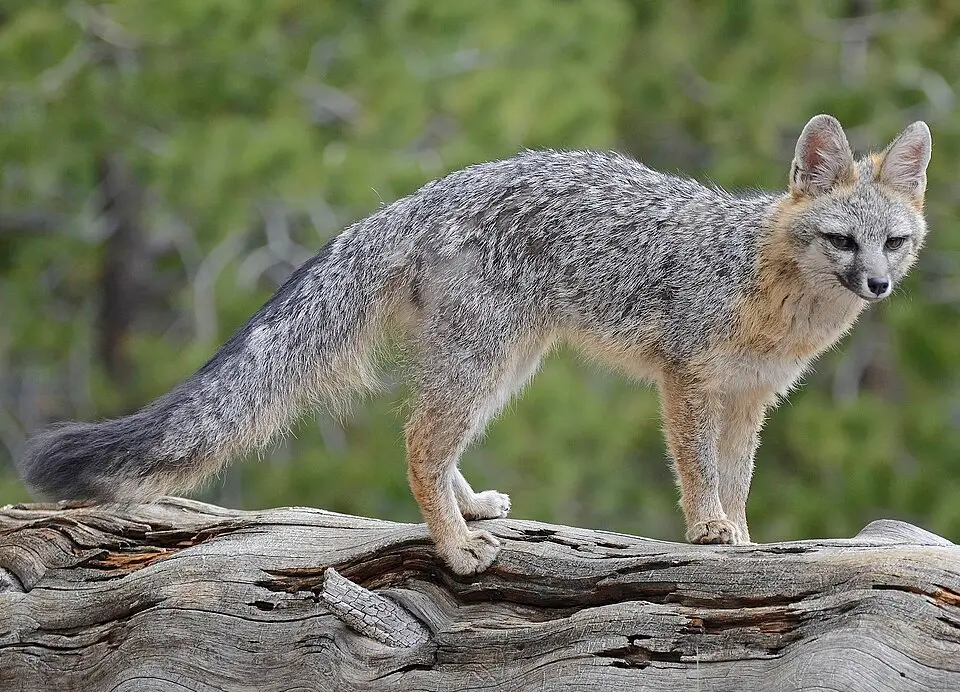
In terms of physical appearance, the gray fox is a medium-sized canid. Its coat is a salt-and-pepper mixture of gray guard hairs over a lighter underfur, giving the animal its characteristic silvery appearance. The sides of the neck, the chest, and the legs are tinged with rusty or reddish-brown coloration, while the belly is typically pale or white. A distinct black stripe runs along the top of the tail from base to tip, ending in a black tip — a useful field mark that distinguishes gray foxes from red foxes, which have a white-tipped tail. The face is also distinctive, often showing a reddish or tawny color along the cheeks and behind the ears, bordered by a darker facial mask.
Gray foxes are generally nocturnal and crepuscular, meaning they are most active during the low-light hours of dawn and dusk and throughout the night. During the day, they typically rest in dens located in hollow logs, rocky outcroppings, dense brush, or even elevated tree cavities. They are relatively solitary animals outside of the breeding season, though mated pairs may maintain overlapping home ranges.
The diet of the gray fox is impressively varied. As opportunistic omnivores, these animals consume a wide range of foods depending on seasonal availability. Small mammals such as rabbits, mice, and voles form a significant part of the diet, supplemented by birds, insects, and carrion. Fruits, berries, acorns, and other plant material are also consumed regularly, particularly during late summer and fall when such resources are abundant. This dietary flexibility is one of the key reasons for the species' widespread success across diverse habitats.
Breeding season for gray foxes typically occurs in late winter, with a gestation period of roughly 53 days. Litters usually consist of several kits, which are born in a protected den and cared for by both parents. Young foxes grow quickly and are typically capable of fending for themselves by late summer or early fall of their first year.
Habitat & Range
The gray fox has one of the broadest distributions of any North American canid. Its range extends from southern Canada through the contiguous United States, into Mexico, and as far south as parts of Central and South America. This makes Urocyon cinereoargenteus one of the few North American mammals whose range extends into South America, reflecting the species' ancient origins and remarkable adaptability.
Within the United States, the gray fox is found across much of the eastern half of the country, throughout the Great Plains, across the Southwest, and along the Pacific Coast. Unlike the red fox, which has historically been more associated with open agricultural landscapes and edge habitats, the gray fox shows a stronger preference for dense wooded cover. It favors mixed hardwood forests, brushy woodlands, and areas where thick undergrowth provides adequate cover for denning and hunting.
In Delaware, a state characterized by a diverse mix of upland forests, agricultural lands, wetlands, and coastal habitats, the gray fox finds suitable territory throughout much of the state. Delaware's position in the Mid-Atlantic region places it within the heart of the gray fox's eastern range. The state's forested corridors, stream bottomlands, and transitional woodland-edge habitats provide the cover and food resources that gray foxes depend upon. The state borders Maryland to the south and west, Pennsylvania to the north, and New Jersey to the northeast — all of which also host healthy gray fox populations, contributing to a connected regional population.
The gray fox's preference for wooded terrain means it often thrives in areas where human development has not completely removed forest cover, and it can coexist alongside a variety of other wildlife species including white-tailed deer, wild turkey, and numerous small mammals that form part of its prey base.
Hunting Information
The gray fox has a long tradition as a game and furbearer species across much of its range, and hunting and trapping of gray foxes occurs in many states where the species is present in healthy numbers.
In Delaware, hunting and wildlife management activities fall under the jurisdiction of the Delaware Department of Natural Resources and Environmental Control (DNREC), specifically through its Division of Fish and Wildlife. DNREC's Division of Fish and Wildlife is responsible for setting and enforcing hunting seasons, licensing requirements, and regulations for all furbearer and game species in the state, including the gray fox.
Hunters and trappers interested in pursuing gray fox in Delaware are encouraged to consult directly with DNREC's Division of Fish and Wildlife for the most current, accurate, and up-to-date season dates, license requirements, and any applicable regulations. Regulations can change from year to year based on population assessments and wildlife management objectives, so referencing the official DNREC resources is always the best practice before heading afield.
Traditionally, gray foxes are pursued through a combination of methods across the United States. Fox hunting with hounds has deep cultural roots in the Mid-Atlantic region, and the gray fox — with its tendency to use dense cover, double back on its trail, and take to the trees — provides a challenging and engaging quarry. Trapping is also practiced in many areas, with gray fox pelts historically valued in the fur trade. Their fur, though not as commercially prominent as it was in past decades, still holds value and represents a traditional harvest activity in rural communities.
Because gray foxes are most active at night and in low-light conditions, hunters who pursue them often use predator calling techniques, employing sounds that mimic distressed prey animals to bring foxes within range. Calling at dusk and dawn, when gray foxes are naturally most active, tends to be most productive.
Conservation
From a conservation standpoint, the gray fox is currently considered a species of least concern across its broad range. Its adaptability, wide distribution, and omnivorous diet have helped it maintain stable populations even as land use patterns have shifted over the decades.
That said, like all wildlife, gray foxes face a range of ongoing pressures. Habitat fragmentation from suburban and urban development can reduce the availability of the dense woodland cover the species depends upon. Road mortality is a notable concern in populated areas, where foxes may frequently cross highways and roads during their nightly foraging movements. Disease, including rabies and canine distemper, can affect local populations periodically.
In Delaware and across the Mid-Atlantic, responsible wildlife management plays an important role in ensuring that gray fox populations remain healthy and sustainable. The DNREC Division of Fish and Wildlife monitors furbearer populations and uses that data to inform management decisions, including the setting of appropriate hunting and trapping seasons.
Landowners can support gray fox populations by maintaining wooded areas, brushy corridors, and natural habitats on their properties. These habitat features benefit not only gray foxes but the broader community of wildlife species that share their ecosystem. Awareness and appreciation of the gray fox's ecological role — as a predator of small mammals and an important part of the food web — contributes to the broader conservation ethic that sustains wildlife populations for future generations.
Conclusion
The gray fox is a truly exceptional animal — ancient in lineage, versatile in behavior, and well-adapted to the varied landscapes of North America. In Delaware and the surrounding Mid-Atlantic region, it represents a valued component of the natural world, appreciated by hunters, trappers, wildlife watchers, and conservationists alike. Its ability to climb trees, its striking appearance, and its adaptable habits make it one of the more fascinating species a naturalist or outdoor enthusiast might encounter in the eastern woodlands. With continued responsible management and habitat stewardship, the gray fox will remain a thriving and visible part of Delaware's wildlife heritage for generations to come.