Eastern Gray Squirrel: A Complete Guide for Wildlife Enthusiasts and Hunters in Delaware
Few creatures are as instantly recognizable across the American landscape as the Eastern gray squirrel (Sciurus carolinensis). Whether darting across a backyard fence, leaping between the canopy branches of a hardwood forest, or industriously burying acorns in preparation for winter, this nimble and resourceful rodent has earned a permanent place in the cultural and ecological fabric of the eastern United States. For wildlife enthusiasts, naturalists, and hunters alike, the Eastern gray squirrel represents one of North America's most engaging and accessible wild animals.
In Delaware — a compact but ecologically diverse Mid-Atlantic state — the Eastern gray squirrel thrives in woodlands, suburban greenbelts, and forested corridors from the rolling piedmont terrain of the north to the coastal plain landscapes of the south. The state's unique geographic position, bordered by Maryland, Pennsylvania, New Jersey, and the Atlantic Ocean, creates a variety of habitats well-suited to supporting healthy squirrel populations year-round.
This article takes a comprehensive look at the Eastern gray squirrel: its biology, behavior, natural habitat, its role in Delaware's hunting traditions, and the conservation principles that help ensure this species continues to flourish for future generations.
Biological Traits
The Eastern gray squirrel (Sciurus carolinensis) belongs to the family Sciuridae, which encompasses squirrels, chipmunks, marmots, and prairie dogs. The genus name Sciurus is derived from the Greek words skia (shadow) and oura (tail), a fitting tribute to the animal's magnificent, bushy tail, which it uses for balance, communication, and thermoregulation. The species epithet carolinensis references the Carolinas, where early naturalists first formally documented the species.
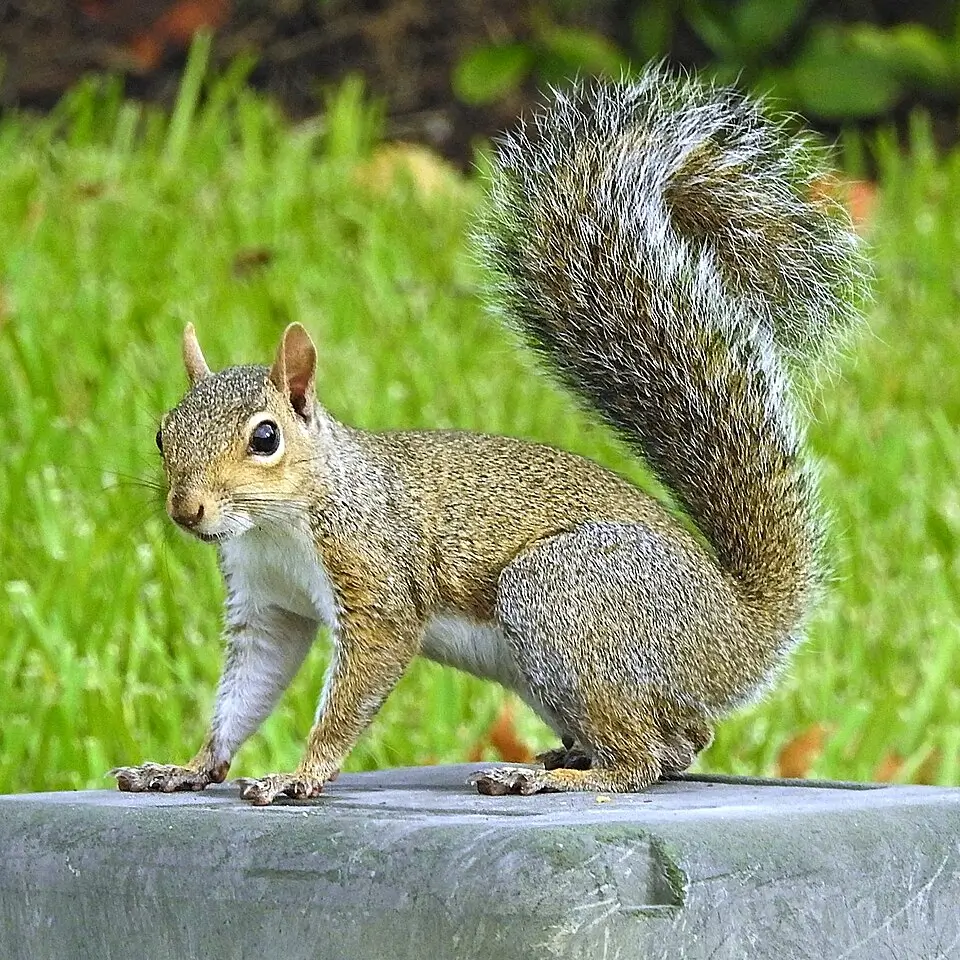
Physically, the Eastern gray squirrel is a medium-sized tree squirrel. Its coat is predominantly gray along the back and sides, with a lighter, often whitish or cream-colored underside. The tail is long, full, and fringed with silver-tipped hairs that give it a distinctive halo-like appearance. During winter months, the coat tends to be thicker and more richly colored, providing essential insulation. A melanistic (black) color variation is not uncommon in certain populations, particularly in some urban and suburban areas, though the gray form remains the most prevalent.
The Eastern gray squirrel is equipped with strong, curved claws that allow it to grip tree bark with remarkable precision, enabling it to descend trees headfirst — a behavior made possible by the unique ability to rotate its hind feet nearly 180 degrees. Its eyes are positioned on the sides of its head, providing a wide field of vision essential for detecting predators such as hawks, owls, foxes, and domestic cats.
One of the most celebrated aspects of Eastern gray squirrel behavior is its masting strategy — the practice of collecting and caching (burying) seeds, nuts, and acorns during times of abundance to retrieve them during leaner winter months. Remarkably, squirrels use spatial memory to relocate a significant portion of their buried caches, though many forgotten stores go on to germinate, making the squirrel an inadvertent but highly effective agent of forest regeneration. Indeed, the Eastern gray squirrel plays a pivotal ecological role in seed dispersal, particularly for oak, hickory, beech, and walnut trees.
Eastern gray squirrels are diurnal animals, meaning they are most active during daylight hours, particularly in the early morning and late afternoon. They construct leafy nests called dreys high in the forks of tree branches, as well as den cavities within hollow trees, which provide more insulated shelter during cold winters. A single squirrel may maintain multiple nests within its home range.
Breeding in Eastern gray squirrels typically occurs twice a year — once in late winter and again in midsummer — although specific timing can vary with geography and climate. Litters generally consist of two to four young, born hairless and helpless, and cared for exclusively by the mother. Young squirrels develop quickly and are typically weaned within a few months, eventually dispersing to establish their own territories.
Their vocalizations are surprisingly varied and expressive, including sharp barks, chattering, and tail-flagging signals used to warn of predators or defend food resources. Experienced hunters and wildlife watchers learn to read these signals as valuable indicators of squirrel activity in a given area.
Habitat & Range
The Eastern gray squirrel is native to eastern North America, with a natural range extending from the eastern seaboard westward through the Great Plains and from southern Canada down into the Gulf Coast states. It is most strongly associated with mature deciduous and mixed hardwood forests, where the mast production of oaks, hickories, and beeches provides the rich food base the species depends upon.
In Delaware, the squirrel's adaptability allows it to inhabit a wide spectrum of environments. The northern part of the state, which shares characteristics with the Appalachian Piedmont region, contains more forested upland areas with mature hardwood stands — ideal squirrel habitat. Moving southward across the Chesapeake and Delaware Canal and into the coastal plain, the landscape transitions to a mix of agricultural land, pine woodlands, tidal marshes, and riparian corridors, all of which the Eastern gray squirrel navigates with ease.
Beyond purely wild settings, the Eastern gray squirrel is one of the most successful urban and suburban wildlife species in North America. Delaware's communities, from Wilmington in the north to communities along the Sussex County coast, support thriving populations of squirrels that have adapted to life among humans, feeding on garden plantings, bird feeders, and ornamental trees alongside their more natural food sources.
The species has also been introduced outside its native range, with established populations now present in parts of western North America, Europe, South Africa, and Australia — testament to the Eastern gray squirrel's extraordinary adaptability.
Hunting Information
Squirrel hunting holds a long and storied place in American hunting tradition. Often considered the ideal quarry for beginning hunters, the Eastern gray squirrel demands patience, woodsmanship, and keen observation, yet is accessible and rewarding in a way that few other game animals can match. For many hunters, pursuing gray squirrels in the early fall hardwood forests marks the very beginning of their hunting journey — and for lifelong hunters, it remains a cherished annual ritual.
In Delaware, hunting activities for species including the Eastern gray squirrel fall under the jurisdiction of the Delaware Department of Natural Resources and Environmental Control (DNREC), specifically the Division of Fish and Wildlife. DNREC is responsible for setting season dates, bag limits, and licensing requirements that govern hunting throughout the First State.
Hunters planning to pursue squirrels in Delaware are encouraged to consult the official DNREC Division of Fish and Wildlife resources directly for the most current and accurate season dates, licensing requirements, and any applicable regulations. Regulations can be updated from season to season, and staying informed through official channels ensures a legal and responsible hunting experience.
From a practical standpoint, squirrel hunting in Delaware is ideally pursued in mature hardwood forests where oaks and hickories are present, as these trees produce the mast crops that concentrate squirrel activity in the fall. Early morning hunts, when squirrels are most active foraging, tend to be the most productive. Still-hunting — moving slowly and quietly through the woods — and stand hunting near den trees or productive mast trees are both effective methods. A small-caliber rifle, such as a .22 LR, or a small-gauge shotgun loaded with appropriate shot, are the traditional tools of the trade.
Squirrel hunting in Delaware also offers the added benefit of preparing hunters for the deer season that follows, as time spent in the woods sharpens observation skills, builds familiarity with terrain, and reinforces patience and stillness — qualities that translate directly to larger game hunting.
Conservation
The Eastern gray squirrel is currently classified as a species of Least Concern by the International Union for Conservation of Nature (IUCN), reflecting healthy and widespread populations across its native range. While habitat loss and fragmentation remain general concerns for wildlife across North America, the Eastern gray squirrel's adaptability to human-altered landscapes has allowed it to maintain robust numbers in most areas.
Conservation of the Eastern gray squirrel is, in many respects, inseparable from broader forest conservation efforts. Protecting and restoring mature hardwood forests — with their diversity of tree species, structural complexity, and mast-producing capacity — benefits not only squirrels but the full community of wildlife that depends on these ecosystems, from white-tailed deer and wild turkey to neotropical migratory songbirds.
In Delaware, the DNREC Division of Fish and Wildlife works to monitor wildlife populations, manage public lands, and regulate hunting seasons in ways that maintain healthy, sustainable squirrel populations. Responsible hunting, guided by science-based management, is itself a conservation tool — generating license revenue that funds wildlife research and habitat programs while keeping populations in balance with available habitat.
Individual hunters and wildlife enthusiasts can contribute to conservation by supporting land protection initiatives, participating in citizen science wildlife surveys, and practicing ethical hunting and outdoor recreation.
Conclusion
The Eastern gray squirrel is far more than a familiar backyard visitor. It is a keystone species in eastern hardwood forests, a beloved game animal with deep roots in American hunting culture, and a remarkable example of wildlife adaptability. In Delaware, this charismatic squirrel finds a welcoming home across the state's varied landscapes, from piedmont woodlands to coastal plain forests and suburban greenbelts.
Whether you encounter the Eastern gray squirrel on a quiet morning walk through a Delaware state forest, through the scope of a .22 rifle during the fall season, or simply in the trees outside your window, this species offers an enduring reminder of the richness and accessibility of North America's wildlife heritage.