The Coyote (Canis latrans): A Comprehensive Guide for Wildlife Enthusiasts and Hunters in Delaware
Few animals embody the spirit of adaptability quite like the coyote (Canis latrans). Once largely confined to the open prairies and deserts of western North America, this resourceful and intelligent canid has expanded its range dramatically over the past century, establishing thriving populations across nearly every corner of the continent — including the Mid-Atlantic states like Delaware. Whether you encounter one trotting across a frost-covered field at dawn or hear its haunting, high-pitched howl echoing through a stand of pines at dusk, the coyote never fails to leave an impression.
Known by many names — brush wolf, prairie wolf, and the American jackal, among others — the coyote has earned a reputation as one of the most resilient and versatile wild animals in North America. It has successfully colonized suburban neighborhoods, agricultural landscapes, dense forests, and coastal marshes alike. Its ability to thrive in close proximity to human development is a testament to its remarkable intelligence and behavioral flexibility.
In Delaware, the coyote is a relatively recent addition to the wildlife community, having expanded eastward over the course of several decades. Today, coyotes are found throughout the First State, from its rolling farmlands to its coastal marshes along Delaware Bay. For wildlife watchers, outdoor enthusiasts, and hunters, understanding the biology, habits, and management of this fascinating animal is both rewarding and practically valuable.
Biological Traits
The coyote (Canis latrans) belongs to the family Canidae, making it a close relative of wolves, domestic dogs, and foxes. Its scientific name, Canis latrans, translates from Latin as "barking dog" — a fitting description for an animal renowned for its wide and expressive vocal repertoire.
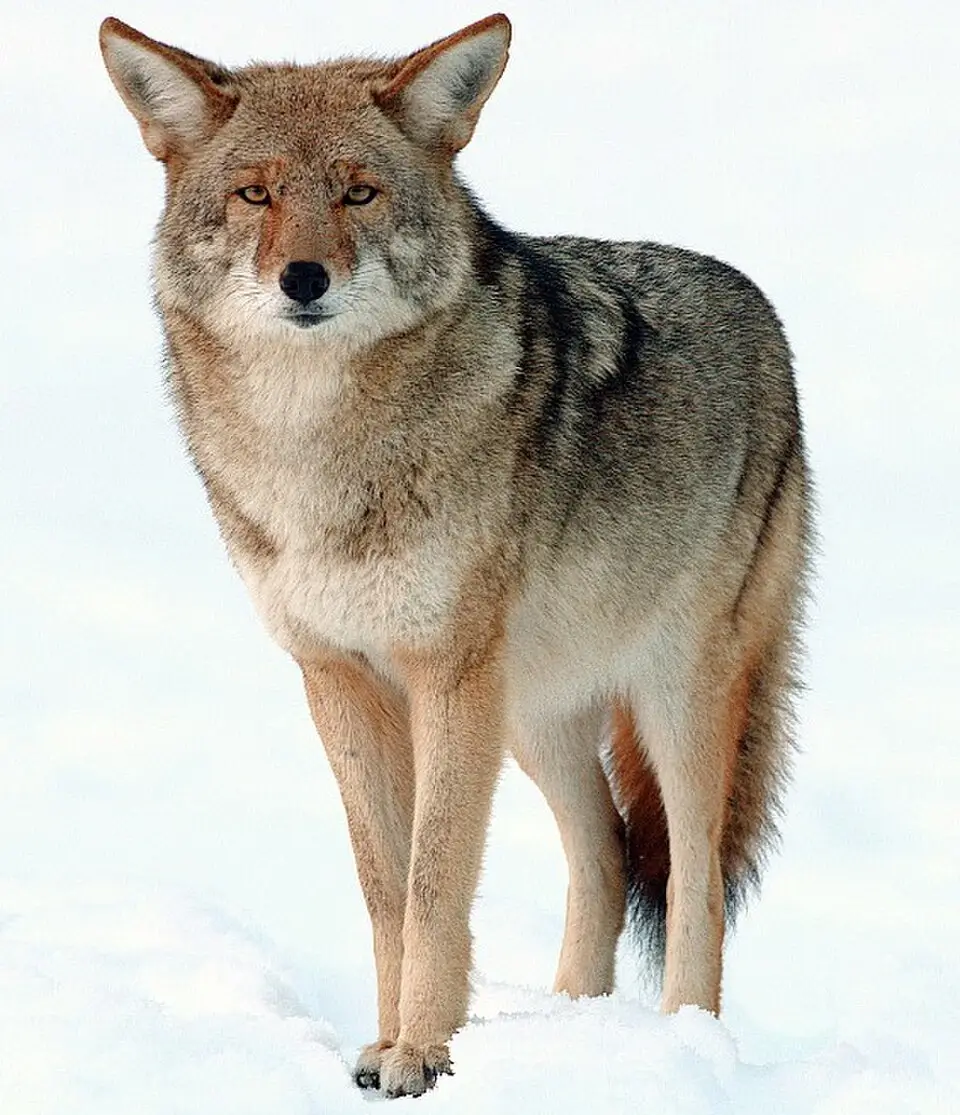
In terms of physical appearance, coyotes are medium-sized canids, typically leaner and more lightly built than wolves but larger and longer-legged than most foxes. Their coat is generally a mix of gray, brown, and tan, often with rusty or reddish tones along the legs, face, and ears. The underside is typically paler, and the tail — which is bushy and black-tipped — is usually carried low when running, a key distinguishing feature from wolves and domestic dogs that often hold their tails higher.
Coyotes are highly vocal animals. Their communication repertoire includes howls, yips, barks, and whines, which they use for everything from claiming territory to coordinating with pack members and signaling their location to mates. The chorus of a coyote family group at night is one of the most distinctive and evocative sounds of the North American wilderness.
As omnivores, coyotes have an impressively broad diet. They are opportunistic feeders, consuming small to medium-sized mammals such as rabbits, squirrels, and mice, as well as birds, reptiles, insects, fruits, berries, and carrion. In suburban and agricultural areas, they may also take advantage of human-related food sources. This dietary flexibility is one of the primary reasons coyotes have been so successful in colonizing diverse environments.
Coyotes are primarily crepuscular and nocturnal, meaning they are most active around dawn and dusk and through the night. However, in areas with less human disturbance, they can frequently be observed during daylight hours as well.
Socially, coyotes are flexible. They can live as solitary individuals, as mated pairs, or in small family groups. Mated pairs typically form strong bonds and may remain together for multiple years. Breeding generally occurs in late winter, and after a gestation period of approximately 60 to 63 days, females give birth to litters typically ranging from four to seven pups, though litter sizes can vary. Pups are born in dens — which may be dug by the parents or appropriated from other animals — and are cared for by both parents.
One of the coyote's most fascinating biological traits is its ability to increase its reproductive rate in response to population pressure. When coyote populations are reduced, females tend to produce larger litters and more juveniles survive to adulthood, a compensatory mechanism that makes population control through hunting alone a complex challenge.
Habitat & Range
The coyote's original range was primarily the grasslands, shrublands, and deserts of central and western North America. However, following the widespread removal of wolves and other large predators — combined with landscape changes brought about by European settlement — coyotes began expanding eastward dramatically throughout the 20th century.
Today, Canis latrans can be found across virtually all of North America, from Alaska and Canada in the north to Panama in the south, and from the Pacific coast to the Atlantic seaboard. Coyotes have proven themselves capable of inhabiting an extraordinary range of habitat types: open prairies, dense deciduous forests, boreal forests, subtropical swamps, agricultural fields, suburban neighborhoods, and coastal marshes.
In Delaware, coyotes have established themselves as a permanent part of the wildlife community. Delaware is a geographically compact state situated in the Mid-Atlantic and South Atlantic regions of the United States, bordered by Maryland to the south and west, Pennsylvania to the north, New Jersey to the northeast, and the Atlantic Ocean to the east. Despite its small size, Delaware offers a diverse mix of habitats that suit coyotes well, including agricultural fields, woodlots, freshwater wetlands, and tidal marshes along Delaware Bay.
Coyotes in the eastern United States, including Delaware, tend to be somewhat larger than their western counterparts. This is largely due to historical interbreeding with wolves and domestic dogs as coyotes expanded their range eastward — a phenomenon that has led some researchers to informally refer to eastern coyotes as "coywolves," though they remain classified as Canis latrans.
In suburban and semi-rural Delaware, coyotes have adapted readily to living alongside humans, often going undetected despite residing close to populated areas. They make use of greenways, stream corridors, farm fields, and forest edges to move through the landscape.
Hunting Information
Coyote hunting is practiced across much of North America, both as a wildlife management tool and as a challenging pursuit in its own right. Hunters and outdoor enthusiasts in Delaware who are interested in pursuing coyotes should consult the Delaware Department of Natural Resources and Environmental Control (DNREC), specifically its Division of Fish and Wildlife, for the most current and accurate regulations, licensing requirements, and season information.
The DNREC's Division of Fish and Wildlife serves as the primary regulatory body for hunting in Delaware, overseeing the management of the state's wildlife resources. Delaware's hunting program falls under the broader administrative umbrella of the DNREC, which includes numerous divisions covering air quality, water, coastal resources, parks and recreation, and more.
Because hunting regulations — including season dates, legal methods, and licensing requirements — are subject to change from year to year, hunters are strongly encouraged to visit the official DNREC website or contact the Division of Fish and Wildlife directly to obtain the most up-to-date information before pursuing coyotes in the First State.
Coyote hunting typically employs a variety of methods. Calling — using electronic or mouth-blown calls that mimic distressed prey animals or coyote vocalizations — is among the most popular and exciting techniques. Hunters position themselves in areas with known coyote activity and use calls to attract animals within range. This form of hunting requires patience, concealment, and a solid understanding of coyote behavior.
Hunting coyotes during the winter months is often considered optimal in many parts of the country, as foliage is minimal, making animals more visible, and coyotes may be more actively searching for mates during the late winter breeding season. However, specific seasons and legal methods in Delaware should always be confirmed through official state resources.
Conservation
The coyote occupies a complex and important role in North American ecosystems. As a mid-level predator, it helps regulate populations of small and medium-sized prey species such as rabbits, rodents, and deer fawns. In ecosystems where larger apex predators have been reduced or eliminated, coyotes often step into a more significant ecological role, contributing to balance within food webs.
The species is currently classified as a species of Least Concern by the International Union for Conservation of Nature (IUCN), reflecting its wide distribution, large population, and demonstrated ability to persist and expand even in the face of significant human pressure. In many respects, the coyote is one of conservation's more encouraging success stories — a species that has not only survived dramatic landscape-scale changes but has actively thrived in the modern world.
Wildlife managers, researchers, and agencies like Delaware's DNREC Division of Fish and Wildlife continue to monitor coyote populations and study their interactions with native species and agricultural interests. Responsible management and accurate population monitoring are key tools in ensuring that coyotes remain a healthy and ecologically functional part of Delaware's wildlife community for generations to come.
Whether viewed as a subject of scientific fascination, a target for skilled hunters, or simply a remarkable example of nature's resilience, the coyote (Canis latrans) deserves recognition as one of North America's most extraordinary wild animals.