The Cougar: North America's Enigmatic Apex Predator
A Comprehensive Guide to Puma concolor
Few animals capture the imagination of wildlife enthusiasts, hunters, and naturalists quite like the cougar. Known by more common names than perhaps any other mammal in the Western Hemisphere — mountain lion, puma, panther, catamount, and painter, among dozens of others — the cougar (Puma concolor) stands as one of North America's most fascinating and adaptable large predators. Powerful, elusive, and extraordinarily wide-ranging, this magnificent feline has carved out a remarkable place in the ecosystems it inhabits, as well as in the cultural and historical fabric of the Americas.
The cougar's story is one of resilience and adaptability. At a time when many large predators face mounting pressures from habitat loss and human encroachment, the cougar continues to thrive across vast stretches of the Western Hemisphere, from the cold, snow-covered forests of Canada to the humid tropical rainforests of South America. Understanding this animal — its biology, behavior, habitat needs, and conservation status — is essential for anyone who spends time in the outdoors, whether as a hunter, hiker, wildlife photographer, or simply a curious nature lover.
This article explores the cougar in depth, examining what makes it such a uniquely successful predator, where it lives, its relationship with hunting culture and wildlife management, and why its conservation matters deeply to the health of wild ecosystems across the Americas.
Biological Traits
The cougar, classified scientifically as Puma concolor, belongs to the family Felidae and is the sole member of the genus Puma. Despite its impressive size, the cougar is more closely related to smaller cats than to the so-called "big cats" like lions and tigers. Unlike lions, tigers, leopards, and jaguars — which belong to the genus Panthera and are capable of roaring — the cougar communicates through a range of vocalizations that include whistles, chirps, growls, hisses, and a distinctive high-pitched scream that has startled many a night hiker in cougar country.
One of the cougar's most striking biological features is its sheer physical presence. Adult males are significantly larger than females, a trait known as sexual dimorphism that is common among large felids. Adult males can reach impressive lengths and weights, making them the largest wild cat in North America north of the jaguar's range. Their muscular, lithe bodies are built for explosive bursts of speed and power — perfectly suited to the ambush hunting style that defines their predatory behavior.
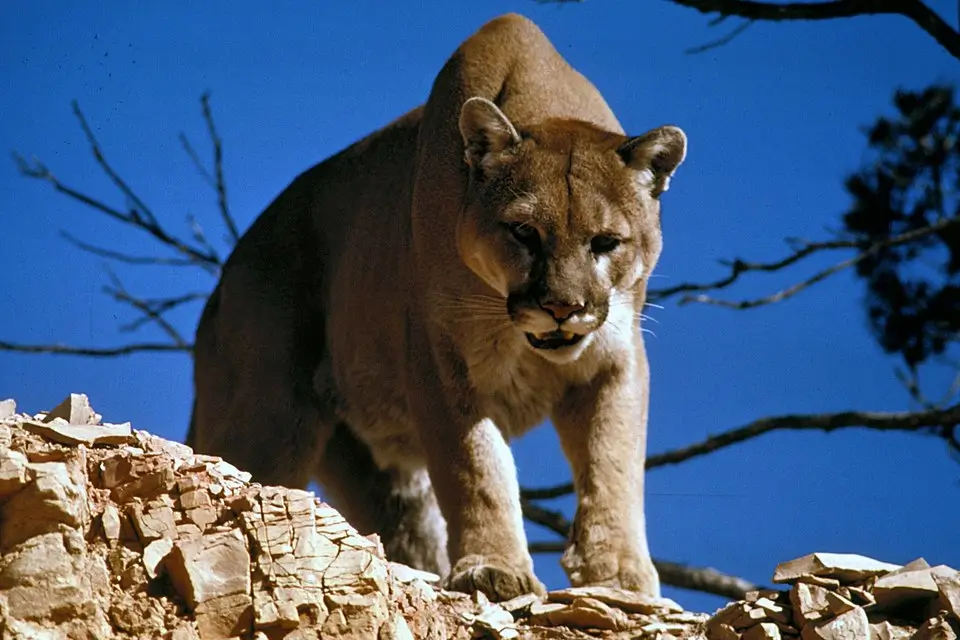
The cougar's coat is typically a uniform tawny or tan color, which gives the species its Latin name concolor, meaning "of uniform color." This relatively plain coat, devoid of spots or stripes in adults, provides excellent camouflage across a wide range of environments, from rocky desert terrain to dense forest undergrowth. Kittens, interestingly, are born with spotted coats and blue eyes — features that gradually fade as they mature into adulthood.
As a solitary and largely nocturnal animal, the cougar is a creature of stealth. It is a classic ambush predator, relying on patience, concealment, and an explosive final rush to bring down prey. Deer constitute the primary prey item across much of the cougar's North American range, though it is a highly opportunistic hunter capable of taking a wide variety of prey, from small mammals and birds to elk and even moose in areas where those species overlap. The cougar's powerful jaws and forelimbs allow it to deliver a swift killing bite, typically to the base of the skull or the throat of its prey.
Cougars are also notable for their impressive territorial instincts. Individual animals, particularly adult males, maintain large home ranges that they mark and defend against rival males. Females tend to occupy smaller territories, often overlapping with the range of a dominant male. This spatial organization helps regulate cougar populations naturally and reduces direct competition for resources within a given landscape.
Reproduction in cougars follows no fixed seasonal breeding cycle; females can come into estrus at any time of year, though births tend to peak in certain seasons depending on geographic location. Litters typically consist of two to four kittens, which remain dependent on their mother for an extended period — often up to two years — during which they learn the complex skills of hunting and survival. This lengthy period of maternal investment underscores the cougar's status as a highly intelligent and behaviorally sophisticated predator.
The lifespan of a wild cougar is typically estimated at around eight to thirteen years, though individuals in captivity have been known to live considerably longer. Mortality in the wild comes from a variety of sources, including territorial disputes with other cougars, encounters with other large predators such as wolves and bears, and human-related causes.
Habitat & Range
Perhaps no other characteristic of the cougar is more remarkable than its extraordinary geographic range and habitat flexibility. Puma concolor holds the distinction of having the largest range of any wild terrestrial mammal in the Western Hemisphere. Its distribution spans from the Yukon territory in northwestern Canada all the way to the southern tip of South America in Patagonia — a latitudinal range that is virtually unmatched among land-dwelling mammals.
Within this vast range, the cougar demonstrates a remarkable ability to thrive in an astonishing diversity of habitats. It inhabits dense coniferous forests in the Pacific Northwest, arid desert scrublands in the American Southwest, tropical and subtropical forests in Central and South America, open grasslands, swampy lowlands, and rugged mountain terrain at elevations reaching well above ten thousand feet. This habitat generalism is a key factor in the cougar's success as a species and explains why it has managed to persist even as human development has dramatically altered landscapes across the Americas.
In the eastern United States, however, the story is more complicated. Cougars were once widespread across the entire continent, but centuries of hunting pressure, habitat loss, and prey depletion led to the virtual elimination of the species from most of the East. Today, established wild cougar populations in North America are primarily found in the western United States, western Canada, and Florida, where the critically endangered Florida panther (Puma concolor couguar) represents a distinct and carefully managed subspecies.
For states like Delaware, located in the Mid-Atlantic region, free-ranging wild cougars are not a feature of the modern landscape. Delaware's relatively small land area, high human population density, and heavily fragmented natural habitats do not support cougar populations. Occasional reports of cougar sightings in eastern states do occur from time to time, and wildlife biologists take such reports seriously, investigating them carefully. These sightings may represent dispersing individuals — typically young males traveling extraordinary distances in search of new territories — a behavior that has been well documented in recent decades as western cougar populations have grown and expanded.
Hunting Information
The cougar occupies a complex and deeply interesting place in North American hunting culture. In states and provinces where cougar populations are established and healthy, regulated hunting has long been recognized as a legitimate and important wildlife management tool. Hunting helps manage cougar populations, reduces human-wildlife conflicts, and generates funding through license and tag sales that supports broader wildlife conservation efforts.
However, it is important to note that for the state of Delaware, there is no established wild cougar population and therefore no cougar hunting season or associated licensing framework. Delaware's wildlife management, overseen by the Delaware Department of Natural Resources and Environmental Control (DNREC) Division of Fish and Wildlife, focuses on the species that actually inhabit the state's diverse mix of coastal, wetland, and upland habitats. Hunters in Delaware are encouraged to consult the DNREC Division of Fish and Wildlife for current, accurate information on all hunting seasons, regulations, and licensing requirements applicable to the state.
For hunters in western states where cougar populations are present and hunting seasons are established, pursuing a cougar is widely considered one of the most challenging and rewarding hunting experiences available in North America. Cougar hunts are typically conducted with the assistance of trained hounds, which track and tree the cat, allowing the hunter to approach on foot. This style of hunting demands exceptional physical fitness, skilled dogs, and a deep knowledge of the terrain. The relatively low success rates associated with cougar hunting speak to the animal's natural elusiveness and cunning.
Conservation
The conservation status of the cougar is a nuanced and regionally variable picture. As a whole species, Puma concolor is classified as of Least Concern on the International Union for Conservation of Nature (IUCN) Red List, reflecting its broad range and relatively stable populations across much of the Americas. This is genuinely encouraging news for a large predator in the modern era.
That said, certain populations and subspecies face significant challenges. The Florida panther is one of the most endangered mammals in North America, with recovery efforts representing one of the landmark wildlife conservation stories of recent decades. Habitat connectivity — the ability of animals to move between protected areas through wildlife corridors — is recognized as critically important for the long-term viability of cougar populations across fragmented landscapes.
Cougars play an irreplaceable ecological role as apex predators. By regulating prey populations, particularly deer and elk, they influence vegetation structure, watershed health, and the broader biodiversity of the ecosystems they inhabit. The presence of cougars in a landscape is widely regarded by ecologists as a sign of ecological health and integrity.
Conservation organizations, wildlife agencies, hunters, and landowners all have important roles to play in ensuring that cougars continue to thrive across their range. Through responsible hunting regulations, habitat protection, wildlife corridor preservation, and ongoing scientific research, there is every reason for optimism about the future of this extraordinary animal.