Common Snipe (Gallinago gallinago): A Complete Guide for Wildlife Enthusiasts and Hunters in Delaware
Few birds in the natural world inspire as much curiosity, admiration, and sporting tradition as the Common snipe (Gallinago gallinago). This elusive, cryptically patterned shorebird has captured the imagination of naturalists, birdwatchers, and hunters for centuries — and for good reason. With its dramatic aerial displays, remarkable camouflage, and lightning-fast flight, the Common snipe is a species that rewards patient observation and skilled fieldwork alike.
In the Mid-Atlantic region, including the state of Delaware, the Common snipe occupies an important ecological niche as both a migratory visitor and a symbol of wetland health. Delaware's unique geography — nestled between the Delaware Bay to the east, the Atlantic coastline, and the rich marshlands of the Mid-Atlantic region — makes it an ideal stopover and wintering location for this remarkable bird. Whether you are a wildlife enthusiast hoping to catch a glimpse of this masterful flyer or a hunter looking to understand the quarry better, this guide offers a comprehensive look at one of nature's most fascinating shorebirds.
Biological Traits
The Common snipe (Gallinago gallinago) belongs to the family Scolopacidae, the large and diverse family of sandpipers and their relatives. It is a medium-sized wading bird with a suite of physical and behavioral adaptations that make it perfectly suited to life in wet, vegetated environments.
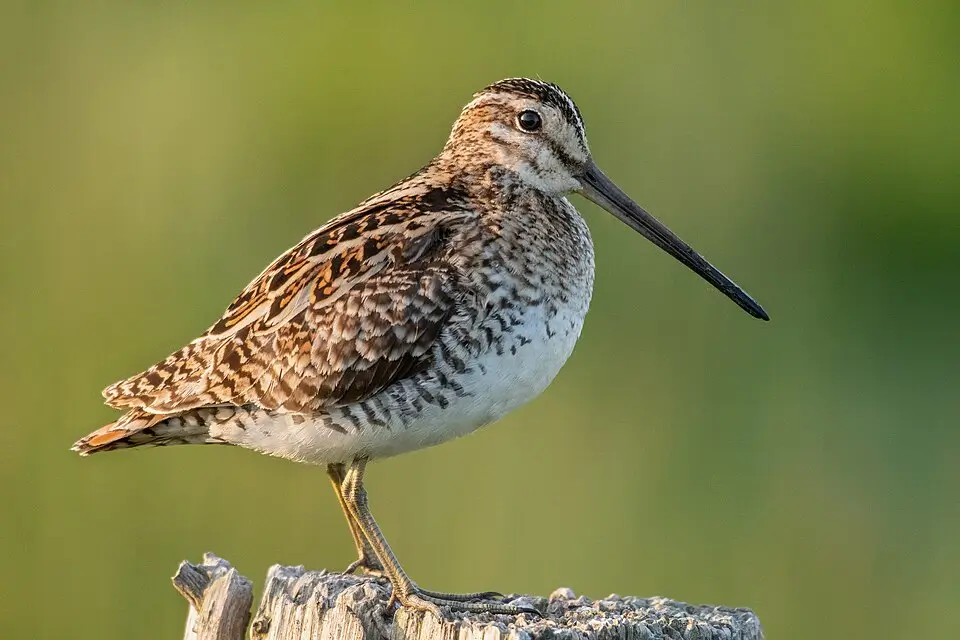
One of the most immediately recognizable features of the Common snipe is its extraordinarily long bill, which can account for a significant portion of the bird's total body length. This bill is not merely a visual curiosity — it is a precision instrument. The tip of the bill is highly sensitive and flexible, allowing the snipe to detect and capture invertebrates, worms, insect larvae, and other small organisms hidden deep in soft mud and waterlogged soil. The bird can open just the tip of its bill while it remains inserted in the ground, a remarkable feeding adaptation known as "rhynchokinesis."
The plumage of the Common snipe is a masterclass in natural camouflage. The bird's upperparts are a complex mixture of brown, buff, black, and white streaks and bars that mimic the dappled light and shadow patterns of reed beds, sedge meadows, and marshy grasslands. This cryptic coloration makes the snipe extraordinarily difficult to spot when it is crouching motionless among vegetation. Broad pale stripes run along the crown and back, further breaking up the bird's outline against a background of dried grasses and rushes.
The Common snipe's eyes are positioned high and to the sides of its head, providing a wide field of vision that allows the bird to detect approaching predators without moving. This panoramic vision is a critical survival adaptation for an animal that relies heavily on remaining undetected.
When flushed from cover, the Common snipe reveals another of its most celebrated traits: its flight. Upon being startled, a snipe erupts from the ground in an explosive burst and immediately launches into a rapid, twisting, zigzagging flight pattern that makes it one of the most challenging birds in the world to follow with the eye — or a gun. This erratic escape flight, often accompanied by a sharp, raspy call, has given rise to the English word "sniper," originally used to describe a marksman skilled enough to shoot such a difficult target.
During the breeding season, male Common snipe perform a spectacular aerial courtship display known as "drumming" or "winnowing." The bird climbs high into the sky and then dives at steep angles, spreading its outer tail feathers so that the rush of air through them produces a distinctive trembling, humming sound that carries far across open marshes. This sound is one of the evocative soundscapes of wetland spring and early summer in much of the Northern Hemisphere.
Common snipe typically nest on the ground in dense vegetation, constructing a simple cup of grasses and plant material. The female lays a clutch of eggs, and both parents participate in the care of the young. The chicks are precocial, meaning they are relatively mobile and independent shortly after hatching, covered in downy camouflage plumage that mimics their surroundings from the very beginning of their lives.
Habitat & Range
The Common snipe enjoys one of the widest distributions of any shorebird in the world. It breeds across a vast swath of the Northern Hemisphere, from Iceland, the British Isles, and Scandinavia eastward across Russia, Siberia, and into parts of Asia. In North America, the Common snipe — sometimes referred to alongside its close relative, Wilson's snipe (Gallinago delicata), which was formerly considered the same species — breeds across Canada and parts of the northern United States.
During migration and winter, Common snipe spread southward, occupying a broad range of wetland habitats across Europe, Africa, Asia, and the Americas. In the eastern United States, including Delaware, snipe are encountered primarily as migrants and winter residents, passing through or lingering in suitable wetland habitats during the cooler months.
The species shows a strong preference for wet, open environments. Ideal snipe habitat includes freshwater and brackish marshes, wet meadows, flooded agricultural fields, bogs, fens, sedge-dominated wetlands, river margins, and the muddy edges of ponds and lakes. The common thread connecting all of these habitats is the presence of soft, moist soil that the bird can probe with its sensitive bill, combined with enough dense low vegetation to provide cover and concealment.
Delaware's geographic position along the Atlantic Flyway — one of North America's great migratory corridors — makes it an important staging and wintering area for Common snipe. The state's extensive tidal marshes, freshwater wetlands, agricultural lowlands, and coastal impoundments provide a mosaic of habitat types that snipe find attractive. The Delaware Bay shoreline and the wetland complexes of the state's inland areas are particularly valuable, offering the combination of soft substrate, invertebrate food resources, and vegetative cover that the species requires.
Birdwatchers in Delaware seeking Common snipe are advised to focus on wet, grassy fields, flooded meadows, and the margins of marshes, particularly during the early morning and evening hours when snipe tend to be more active. The birds' cryptic coloration means they are often overlooked until they flush suddenly at close range.
Hunting Information
The Common snipe has a long and storied history as a game bird. In Europe and North America alike, snipe hunting was once considered one of the most demanding tests of a hunter's skill, and as noted earlier, the term "sniper" in the military context traces its linguistic roots directly to the difficulty of shooting this fast, unpredictable bird on the wing.
In the United States, snipe hunting is regulated at both the federal and state levels, as Common snipe (and Wilson's snipe) are migratory birds protected under the Migratory Bird Treaty Act. This means that hunters must comply with federal frameworks, including the possession of a valid federal migratory bird hunting stamp (commonly known as the "Duck Stamp"), in addition to meeting all applicable state licensing and regulatory requirements.
In Delaware, hunting activities are overseen by the Delaware Department of Natural Resources and Environmental Control (DNREC), specifically through its Division of Fish and Wildlife. Hunters interested in pursuing Common snipe in Delaware should consult the DNREC Division of Fish and Wildlife directly for current season dates, bag limits, licensing requirements, and any specific regulations that may apply. Regulations can change from year to year, and it is always the responsibility of the individual hunter to verify current rules before heading into the field.
Snipe hunting is typically a walk-up affair, conducted in the kinds of wet, open habitats described above. Hunters work through marshes, wet fields, and flooded meadows, flushing birds as they go. Because of the snipe's explosive flush and unpredictable flight, it demands quick reflexes and practiced shooting skills. Many experienced wing shooters regard a limit of snipe as one of the most challenging and rewarding accomplishments in upland and marsh hunting.
Dogs can be useful for snipe hunting, particularly flushing breeds and retrievers that are comfortable working in wet conditions, though the snipe's tendency to crouch and hold tight means that hunters can sometimes approach quite close before a bird flushes.
Conservation
The Common snipe, taken as a whole across its global range, is currently assessed as a species of Least Concern by major conservation organizations, reflecting the fact that its population remains large and widespread. However, like virtually all wetland-dependent species, Common snipe are sensitive to the loss and degradation of their preferred habitats.
Wetland drainage for agriculture, urban development, and infrastructure has reduced the availability of suitable snipe habitat in many parts of the world over the past century. Efforts to conserve, restore, and manage freshwater and brackish wetlands benefit not only Common snipe but an entire community of wetland-dependent birds, mammals, fish, amphibians, and invertebrates.
In Delaware and across the Mid-Atlantic region, wetland conservation efforts by state agencies including DNREC, federal programs, and non-profit conservation organizations play a vital role in maintaining the habitat networks that migratory birds like the Common snipe depend upon during their annual journeys. The health of Delaware's wetlands is directly connected to the vitality of migratory bird populations along the entire Atlantic Flyway.
Hunters, birdwatchers, and conservationists all share a common interest in ensuring that wetland habitats remain intact and productive. Participation in conservation programs, support for wetland restoration initiatives, and responsible stewardship of natural areas all contribute to a positive future for the Common snipe and the many other species that share its world.