Bufflehead (Bucephala albeola): A Complete Guide to North America's Smallest Diving Duck
Few sights on a cold winter morning along a coastal estuary or freshwater pond are quite as captivating as a small, boldly patterned duck diving and darting across the water's surface with remarkable agility. That duck is almost certainly the Bufflehead — a compact, energetic, and visually striking species that has earned a devoted following among birdwatchers, naturalists, and waterfowl hunters alike. Known scientifically as Bucephala albeola, the Bufflehead holds the distinction of being the smallest diving duck in North America, a fact that only seems to amplify its outsized personality and charm.
The Bufflehead is a true North American native, spending its breeding seasons across the boreal forests of Canada and Alaska before dispersing southward to coastal bays, rivers, reservoirs, and tidal marshes during the winter months. For hunters, birdwatchers, and outdoor enthusiasts across the eastern United States — including residents of Delaware and the broader Mid-Atlantic region — the arrival of Buffleheads each autumn signals the heart of waterfowl season and the extraordinary seasonal rhythms of nature. Understanding this remarkable bird — its biology, its behaviors, its habitats, and its place in conservation — enriches any outdoor experience, whether you're carrying a shotgun or a pair of binoculars.
Biological Traits
The Bufflehead (Bucephala albeola) belongs to the family Anatidae, the large and diverse family that includes all ducks, geese, and swans. Within this family, the Bufflehead is placed in the genus Bucephala, which it shares with the Common Goldeneye (Bucephala clangula) and Barrow's Goldeneye (Bucephala islandica). The genus name Bucephala derives from the Greek word for "large-headed" or "buffalo-headed," a reference to the noticeably rounded, puffy head that characterizes all three species. The species name albeola comes from the Latin word for "white," referencing the striking white plumage found on the male.
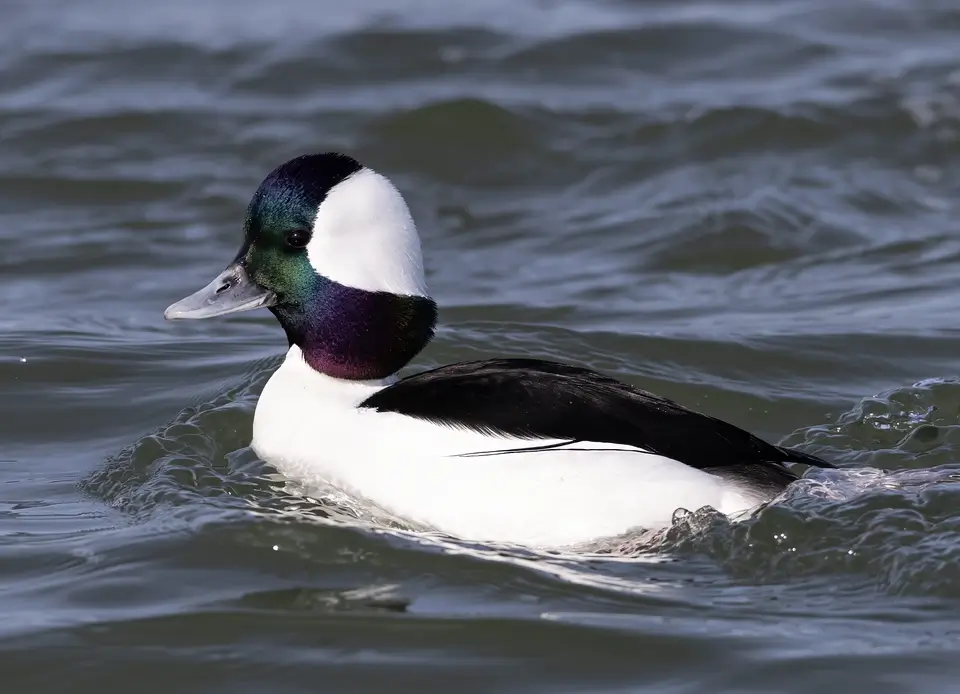
As North America's smallest diving duck, the Bufflehead is a bird that punches well above its weight in terms of visual impact. Adult males are among the most strikingly plumaged of all North American waterfowl. They display a largely white body contrasted sharply by a dark, iridescent back and head. The head itself is particularly distinctive: when viewed in good light, the dark feathering shimmers with green, purple, and violet iridescence, and a large, bold white patch sweeps across the back of the head from eye to eye, creating an unmistakable "bonnet" effect that makes the male immediately identifiable even at a considerable distance.
Female Buffleheads are far more modestly dressed, as is common among ducks. Their plumage is primarily gray-brown overall, providing effective camouflage during the nesting season. Females do display a small but distinctive white cheek patch, which helps birders distinguish them from other small diving ducks in the field. Both sexes have the characteristic large, rounded head relative to body size — the feature that inspired the bird's common name, "Bufflehead," which is itself a colloquial shortening of "buffalo-headed."
In terms of size, Buffleheads are noticeably smaller than most other diving ducks. They are compact and well-proportioned birds built for an aquatic lifestyle. Their legs are set far back on the body, an adaptation common to diving ducks that makes them excellent swimmers and divers but somewhat awkward on land. When diving, Buffleheads can descend to significant depths to pursue prey, using their feet to propel themselves underwater in pursuit of aquatic invertebrates, crustaceans, mollusks, and small fish. Their diet is largely animal-based during winter, though they may also consume some plant material depending on habitat and season.
One of the most fascinating aspects of Bufflehead biology is their use of tree cavities for nesting — a behavior that sets them apart from many diving ducks. Buffleheads are almost entirely dependent on old woodpecker holes, particularly those excavated by the Northern Flicker (Colaptes auratus), for their nesting sites. This relationship makes the Bufflehead uniquely tied to the availability of mature forest with standing dead trees, known as snags, in proximity to water. Females demonstrate strong nest site fidelity, returning to the same cavity year after year when the site remains available.
Buffleheads are also notably monogamous within a breeding season, and pairs typically reunite in subsequent years, which is relatively uncommon behavior among dabbling and diving ducks. Clutch sizes are generally modest, and the female assumes all incubation and brooding duties without assistance from the male. Ducklings are precocial — born covered in down and capable of leaving the nest and feeding themselves within a day of hatching — though they remain under the watchful care of the mother for several weeks.
Habitat & Range
The Bufflehead is a bird of two very different worlds, divided between its breeding grounds in the northern boreal forests and its wintering grounds across much of the continental United States and coastal North America.
During the breeding season, Buffleheads occupy freshwater lakes, ponds, and rivers embedded within the vast boreal and aspen parkland forests of Canada and Alaska. This northern breeding range stretches from Alaska east across much of Canada, with the highest densities occurring in the interior of British Columbia, Alberta, and the Northwest Territories. The critical requirement in all of these habitats is the presence of both open water and mature forest with sufficient woodpecker cavities for nesting.
As autumn approaches and temperatures drop, Buffleheads begin their southward migration. Their wintering range is remarkably broad, extending across both the Pacific and Atlantic coasts, the Gulf Coast, and many interior waterways. On the East Coast, Buffleheads are common winter visitors along the entire Atlantic Seaboard, making them a familiar sight throughout the Mid-Atlantic states — including Delaware.
Delaware, situated at the heart of the Mid-Atlantic region, offers exceptional wintering habitat for Buffleheads. The state's tidal marshes, coastal bays, estuaries, and freshwater ponds provide ideal foraging and roosting conditions. Delaware Bay itself — one of the largest and most ecologically significant estuaries on the Atlantic Coast — serves as an important corridor and wintering area for numerous waterfowl species, including the Bufflehead. The state's position along the Atlantic Flyway, one of North America's principal migratory routes for birds, ensures that Delaware receives reliable visits from Buffleheads each winter season.
In their wintering habitats, Buffleheads favor protected coastal waters, shallow bays, tidal creeks, and freshwater impoundments. They are generally found in flocks, sometimes mixed with other diving ducks such as Goldeneyes, Scaup, and Ring-necked Ducks. Buffleheads are notably alert and quick to take flight, a behavioral trait that waterfowl hunters are well acquainted with.
Hunting Information
The Bufflehead is a legal game species in the United States and is managed under the framework of the Migratory Bird Treaty Act, with seasons and bag limits set cooperatively by the U.S. Fish and Wildlife Service and individual state wildlife agencies. In Delaware, waterfowl hunting regulations are administered by the Delaware Department of Natural Resources and Environmental Control (DNREC), specifically through its Division of Fish and Wildlife.
Hunters pursuing Buffleheads along Delaware's coastal marshes, bay waters, and freshwater wetlands can anticipate exciting and challenging shooting. The Bufflehead's small size, rapid flight, and wary nature make it a sporting quarry. Because they often arrive in mixed-species flocks and feed actively in open water, hunters typically pursue them using layout boats, shore blinds, or floating blinds positioned near productive feeding areas.
Decoy spreads for Buffleheads do not need to be elaborate. Small blocks or even standard diving duck decoys can attract these birds effectively. Their natural curiosity and tendency to congregate in flocks mean that a well-positioned spread can draw birds within range consistently throughout the season.
For anyone planning to hunt waterfowl in Delaware, it is strongly recommended to consult directly with the DNREC Division of Fish and Wildlife for the most current and accurate season dates, bag limits, licensing requirements, and any special regulations that may apply to specific zones or water bodies. Regulations change from year to year and can vary by location, so verifying the latest information through official DNREC channels before heading afield is essential practice for any responsible hunter.
Conservation
The Bufflehead is currently considered a species of low conservation concern across its range. Its populations have remained relatively stable over recent decades, and it does not face the acute pressures that have driven some other North American waterfowl to threatened status. The species is closely monitored through long-term waterfowl surveys conducted by the U.S. Fish and Wildlife Service, the Canadian Wildlife Service, and various state and provincial wildlife agencies.
However, like all migratory waterfowl, the Bufflehead is not entirely without conservation considerations. The species' reliance on Northern Flicker nest cavities for breeding creates a degree of vulnerability to habitat change in the boreal forest. Forest management practices that reduce the availability of standing dead timber can limit nesting opportunities. Climate change also poses potential long-term challenges to boreal wetland habitats, which serve as the engine of Bufflehead productivity.
On their wintering grounds, including the coastal and estuarine waters of Delaware and the broader Mid-Atlantic region, Buffleheads benefit from ongoing wetland conservation and restoration efforts. Organizations such as Ducks Unlimited, state wildlife agencies, and land trusts have worked for decades to protect and enhance waterfowl habitat along the Atlantic Flyway, work that directly benefits Buffleheads and dozens of other migratory species.
Hunters also play an important role in Bufflehead conservation through the purchase of Federal Duck Stamps, which fund the acquisition and protection of critical wetland habitats across the country. This direct connection between hunting participation and habitat conservation represents one of the most successful models of wildlife funding in American history, and Bufflehead hunters are active contributors to that legacy.
For residents and visitors to Delaware, the Bufflehead represents a wonderful symbol of the wild, living landscape that makes the Mid-Atlantic coast so extraordinary each winter — a small but brilliant duck that travels thousands of miles to grace the state's waters every season.