The American Woodcock: A Fascinating Upland Bird of the Eastern Woods
Few birds in North America capture the imagination of wildlife enthusiasts and upland hunters quite like the American woodcock (Scolopax minor). Known by a colorful collection of nicknames — including "timberdoodle," "bogsucker," "mudsnipe," and "Labrador twister" — this stocky, secretive shorebird has carved out a unique niche in the forests and thickets of the eastern United States and Canada. Despite technically belonging to the shorebird family, the American woodcock has largely abandoned the open coastlines and mudflats favored by its relatives, instead making its home in the moist, dense woodlands and alder thickets of the interior landscape.
For hunters, the American woodcock represents one of the most challenging and rewarding upland game birds on the continent. Its explosive flush from dense cover, its erratic twisting flight through the timber, and the sheer difficulty of locating it in its preferred haunts all combine to make woodcock hunting a pursuit that demands skilled dogs, patient fieldwork, and considerable shooting ability. For wildlife watchers and naturalists, the bird's extraordinary anatomy, its spectacular spring courtship flights, and its remarkable migratory behavior make it one of the most fascinating creatures in the eastern woodlands.
In Delaware and throughout the Mid-Atlantic region, the American woodcock passes through as a migratory species, offering both hunters and wildlife observers seasonal opportunities to encounter this truly unique bird. Understanding the biology, behavior, habitat preferences, and conservation needs of the American woodcock is essential for anyone who values this remarkable species.
Biological Traits
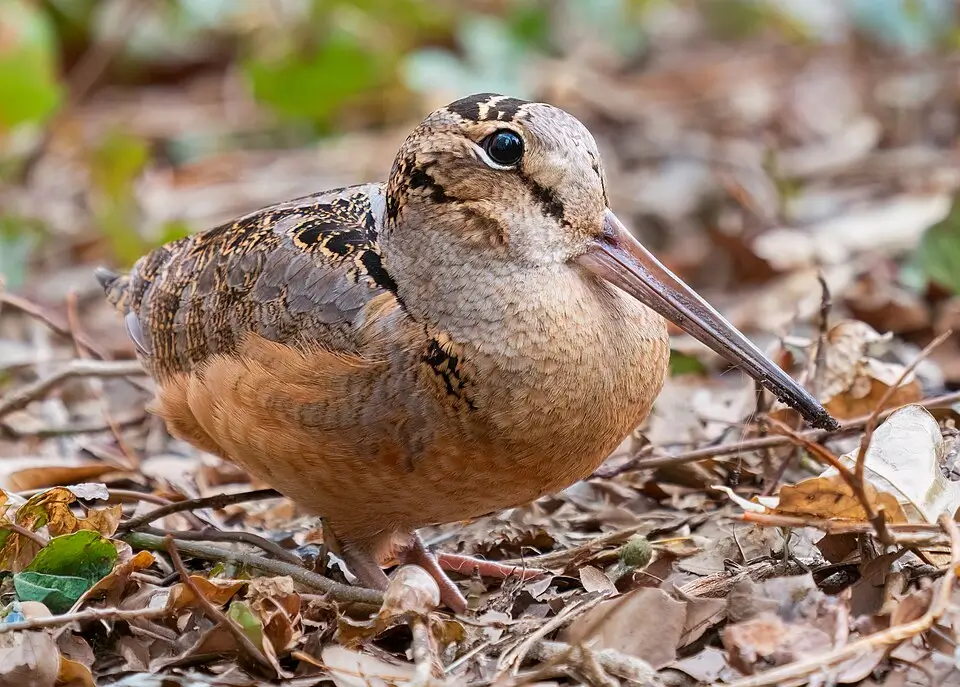
The American woodcock is a bird of striking physical contrasts. At first glance, it seems almost improbable — a compact, rotund body carried on short legs, topped by a large, rounded head featuring the most distinctive bill in the bird world: a long, flexible, prehensile bill that can measure nearly three inches in length. This remarkable bill is the woodcock's primary feeding tool, designed specifically for probing deep into soft, moist soil in search of earthworms, which make up the bulk of its diet. The tip of the upper mandible is flexible and packed with sensitive nerve endings, allowing the bird to detect and grasp earthworms underground without needing to see them.
The woodcock's eyes are positioned high and far back on the skull, giving it a nearly 360-degree field of vision — an extraordinary adaptation that allows the bird to watch for predators even while its bill is buried in the ground. This placement also means the woodcock has binocular vision both in front of and behind its head, a trait found in very few birds.
Perhaps the most remarkable anatomical feature of the American woodcock, beyond its bill and eyes, is the arrangement of its brain. The woodcock's brain is literally rotated within its skull, with the cerebellum positioned at the bottom rather than the back — a direct consequence of the evolutionary pressure that pushed the eyes so far up and back on the head.
The bird's plumage is a masterpiece of cryptic camouflage. Browns, rusts, blacks, and tans combine in an intricate pattern of streaks and bars that renders the woodcock nearly invisible against the forest floor litter of dead leaves and twigs. A sitting woodcock is exceptionally difficult to spot, even at close range, and the bird relies on this camouflage as its primary defense, often sitting motionless until nearly stepped upon before flushing.
One of the most celebrated aspects of American woodcock biology is the male's spectacular spring courtship display, known as the "sky dance." At dusk and dawn during the breeding season, male woodcock perform an elaborate aerial display from open clearings or forest edges. The performance begins with a series of nasal "peent" calls delivered from the ground, followed by a spiraling, whistling flight high into the night sky, and concluding with a tumbling, chirping descent back to the display ground. This nightly ritual is one of the great wildlife spectacles of the eastern spring, drawing naturalists and bird enthusiasts to meadow edges and forest clearings across the bird's breeding range.
Female woodcock are notably larger than males — one of the few North American bird species in which females are significantly bigger than their mates. Both sexes are solitary outside of the breeding season, and females alone are responsible for incubating the eggs and raising the young.
Habitat & Range
The American woodcock is found exclusively in eastern North America, making it one of the continent's most geographically specific game birds. Its breeding range extends from the Canadian Maritime provinces and southern Quebec westward through the Great Lakes region and south through the Appalachians. Wintering birds concentrate in the southeastern United States, particularly in states along the Gulf Coast.
The species favors a very specific combination of habitat features. Young, moist forests — particularly those dominated by alder, aspen, birch, and similar early-successional tree species — provide the dense overhead cover the woodcock prefers for roosting and nesting. These areas must be underlain by soft, moist, earthworm-rich soils that the bird can probe effectively for food. Open fields, forest clearings, and shrubby edges adjacent to moist woodlands serve as singing grounds for displaying males and as feeding areas during evening hours.
The woodcock's dependence on young forest habitat is a key factor in its population dynamics. As forests mature and the dense, brushy early-successional stages give way to closed-canopy woodland, woodcock habitat quality declines. The species thrives in landscapes where natural disturbance, beaver activity, timber harvesting, or active land management keeps portions of the forest in young, open, shrubby condition.
In Delaware and the broader Mid-Atlantic region, the American woodcock appears primarily as a migratory species during spring and fall passage, though some birds do breed in suitable habitat within the state. Delaware's position along the Atlantic Flyway makes it an important corridor for migrating woodcock moving between their northern breeding grounds and southern wintering areas. The moist woodlands, river bottoms, and alder thickets of Delaware's interior provide valuable stopover habitat for migrating birds.
Hunting Information
The American woodcock holds a special place in American hunting tradition. Hunting the timberdoodle — as it is affectionately known — is a pursuit deeply embedded in the culture of the eastern United States, with roots stretching back to the colonial era. The combination of challenging cover, unpredictable flushes, and the acrobatic flight of a flushed woodcock makes it one of the most demanding tests of wing-shooting skill available to the American hunter.
Woodcock hunting is typically conducted with pointing or flushing dogs, as locating birds in their preferred dense cover is extremely difficult without a dog's nose. A well-trained bird dog can detect the strong, distinctive scent of a sitting woodcock and either point or flush the bird for the waiting hunter. The close-cover nature of woodcock hunting means that shots are typically taken at short range through heavy brush, demanding quick reflexes and an open-choked shotgun.
In Delaware, woodcock hunting falls under the regulatory jurisdiction of the Delaware Department of Natural Resources and Environmental Control (DNREC) Division of Fish and Wildlife. As a migratory bird, the American woodcock is managed cooperatively between individual states and the U.S. Fish and Wildlife Service under the framework of the Migratory Bird Treaty Act. Hunters pursuing woodcock in Delaware are required to comply with both state and federal regulations. Prospective hunters are strongly encouraged to consult the official DNREC website and current federal migratory bird hunting regulations for the most up-to-date information on season dates, bag limits, licensing requirements, and any applicable regulations, as these details are subject to change from year to year.
Woodcock hunting in Delaware and the Mid-Atlantic is closely tied to fall migration. As cold fronts push birds southward from their northern breeding grounds in October and November, Delaware's moist woodlands can experience significant influxes of migrating woodcock, creating exciting hunting opportunities for those prepared to work the right cover at the right time.
Conservation
Conservation of the American woodcock is a subject of active attention among wildlife managers, conservation organizations, and hunters across the eastern United States. Like many species dependent on young forest habitat, woodcock populations have experienced long-term pressures associated with landscape change, including forest maturation, suburban development, and the reduction of actively managed early-successional habitats.
The American Woodcock Society, state wildlife agencies, and federal programs have all invested significant effort in promoting habitat management practices that benefit woodcock and the broader suite of wildlife species that depend on young forest. Timber harvesting conducted with wildlife habitat in mind, prescribed burning, and the maintenance of forest openings all contribute to the mosaic of young and mature forest that woodcock and many other species require.
Because the woodcock is a migratory species, its conservation requires coordinated management across its entire flyway — from the boreal forests of Canada through the mid-Atlantic states like Delaware and down to the wintering grounds of the Gulf Coast states. The U.S. Fish and Wildlife Service's American Woodcock Conservation Plan provides a scientific framework for guiding these efforts at a continental scale.
Delaware, positioned at a critical juncture along the Atlantic Flyway, plays an important role in the broader conservation picture. The preservation and enhancement of moist woodland habitats within the state contributes meaningfully to the welfare of migrating birds and supports the long-term health of the species across its range. Wildlife managers at DNREC's Division of Fish and Wildlife work alongside federal partners and private landowners to maintain and improve habitats that benefit not only woodcock but the full diversity of Delaware's wildlife heritage.
Hunters, in particular, have long been among the most committed advocates for woodcock conservation. Through federal excise taxes on firearms and ammunition collected under the Pittman-Robertson Act, as well as through the direct involvement of hunting organizations in habitat work, the hunting community contributes substantially to the resources available for woodcock management and research.
The American woodcock, with its extraordinary anatomy, its enchanting sky dance, and its challenging hunting qualities, is a species well worth celebrating and protecting. Whether encountered on a misty autumn morning behind a quivering bird dog, or watched from the edge of a meadow as it spirals into the spring twilight, the timberdoodle remains one of the most captivating characters in the rich cast of eastern North American wildlife.