The Wood Duck (Aix sponsa): America's Most Colorful Waterfowl
Few birds in North America capture the imagination quite like the Wood duck (Aix sponsa). Often described as one of the most strikingly beautiful waterfowl on the continent — and arguably in the entire world — the Wood duck is a true testament to the artistry of nature. With its iridescent plumage, distinctive crested head, and affinity for forested wetlands, this species has earned a devoted following among birdwatchers, wildlife enthusiasts, and waterfowl hunters alike.
The Wood duck holds a special place in American conservation history as well. Once pushed to the brink of local extinction due to overhunting and habitat loss in the late 19th and early 20th centuries, the species made a remarkable comeback through dedicated conservation efforts, legal protections, and innovative wildlife management programs. Today, the Wood duck stands as one of the most celebrated success stories in North American wildlife management — a living symbol of what thoughtful stewardship and scientific conservation can achieve.
Whether you encounter one gliding silently across a glassy woodland pond, perched regally in a tree cavity, or lifting off the water with its distinctive call, a Wood duck sighting is always a memorable experience. This article explores the biology, habitat, hunting tradition, and conservation legacy of this extraordinary bird.
Biological Traits
The Wood duck (Aix sponsa) belongs to the family Anatidae — the large and diverse family that encompasses all ducks, geese, and swans. The species name sponsa is Latin for "betrothed" or "bride," a reference to the bird's ornate, almost ceremonial appearance. The genus Aix is shared with only one other species worldwide: the Mandarin duck (Aix galericulata) of East Asia, a close relative that shares similarly spectacular plumage.
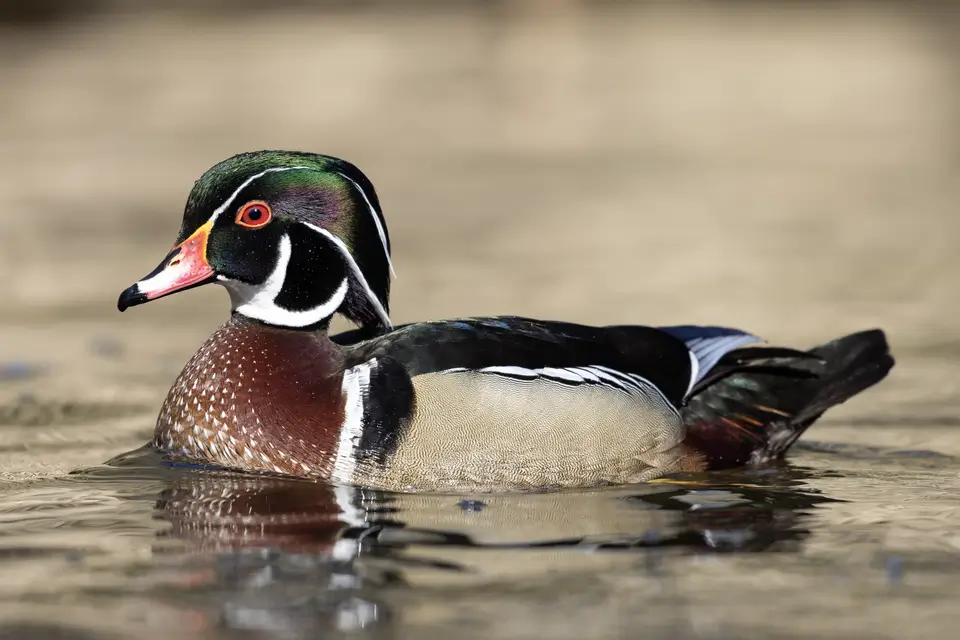
The male Wood duck, or drake, is among the most visually complex birds in North America. His head features an elaborate iridescent green and purple crest, accented with bold white stripes that trace striking patterns along the face and throat. A vivid red eye and red-based bill add further color to the face, while the chest is a rich chestnut-brown adorned with white spots. The flanks transition to golden-buff tones with fine black-and-white barring, and the back shimmers with iridescent greens, blues, and purples. It is a bird that seems almost too ornate to be real.
The female, or hen, is considerably more subdued in coloration — as is common among dabbling and perching ducks — but she is by no means plain. She features a grayish-brown body, a distinctive white teardrop-shaped eye ring, and a subtly iridescent blue-purple speculum on the wing. Her understated elegance is perfectly suited to her role as a nesting bird that must remain inconspicuous.
One of the most biologically remarkable features of the Wood duck is its adaptation for nesting in tree cavities. Unlike the vast majority of ducks, which nest on the ground, Wood ducks are cavity nesters. They seek out natural hollows in mature trees — often quite high above the ground or water — as nesting sites. Their feet are equipped with sharp claws that allow them to perch and cling to bark and branches, a highly unusual adaptation among waterfowl.
Shortly after hatching, Wood duck ducklings perform one of nature's most astonishing feats. Within 24 hours of emerging from the egg, the tiny, downy chicks must leap from the nest cavity — sometimes from heights of 50 feet or more — in response to their mother's calls from below. The lightweight ducklings are resilient enough to survive the fall and quickly follow their mother to water. This behavior is one of the most dramatic early-life experiences of any North American bird.
Wood ducks are also known to exhibit a behavior called "egg dumping" or brood parasitism, where females will sometimes lay eggs in the nests of other Wood ducks. Nests can occasionally contain very large clutches as a result. A typical clutch, however, ranges from roughly 7 to 15 eggs, and the incubation period lasts approximately 28 to 37 days, with the hen incubating alone.
Wood ducks are dabbling and perching ducks, and their diet is highly varied. They consume a wide range of plant materials — including seeds, acorns, berries, and aquatic vegetation — as well as invertebrates such as insects, beetles, and small crustaceans. Acorns are a particularly important food source in autumn, and Wood ducks are often found foraging in flooded bottomland hardwood forests where acorn production is high.
The Wood duck's call is also quite distinctive. The female produces a loud, rising oo-eek, oo-eek alarm call that carries well through forested wetlands. Drakes vocalize with softer, more whistle-like notes. These calls help hunters and wildlife observers locate birds in dense, wooded habitats.
Habitat & Range
The Wood duck is primarily a bird of the eastern United States, though a significant population also inhabits the Pacific Coast region, from British Columbia southward through California. In between, populations exist across portions of the interior West wherever suitable habitat is found. The species is largely absent from the arid Great Plains and the Rocky Mountain interior.
As their name suggests, Wood ducks have a deep association with wooded, water-rich environments. They favor forested swamps, wooded river bottoms, beaver ponds, freshwater marshes edged by trees, and lakes or ponds bordered by mature forest. The presence of large, mature trees with natural cavities — or man-made nest boxes — is essential for successful breeding.
Wood ducks are migratory, generally moving southward in autumn to wintering grounds in the southeastern United States, Mexico, and parts of Central America. Spring migration brings them back north to breeding grounds across much of the eastern half of the continent and the Pacific Coast. In warmer portions of their range, some populations may be year-round residents.
The species' dependence on forested wetlands means that its distribution closely tracks the health of riparian and bottomland hardwood ecosystems. Where these habitats are protected and well-managed, Wood ducks thrive.
Hunting Information
The Wood duck is one of the most sought-after species in North American waterfowl hunting. Its combination of challenging habitat, swift flight, and spectacular beauty makes it a prized bird for duck hunters across much of the continent.
Wood duck hunting often takes place in intimate, wooded settings — flooded timber, swamp edges, beaver flowages, and stream corridors — that are quite different from the open marsh or field hunting associated with many other duck species. This intimate, forested style of hunting has a distinctive character and tradition all its own.
Early-season Wood duck hunting, which often takes place before migrant ducks arrive from the north, can be excellent in many parts of their range. Wood ducks tend to be most active at dawn and dusk, and hunters who position themselves along flight corridors near roost ponds or feeding areas can experience fast action.
Because hunting regulations for Wood ducks — including season dates, bag limits, and licensing requirements — vary significantly by state, province, and management zone, hunters are always encouraged to consult the current regulations published by their state or provincial wildlife agency before heading afield. Regulations change from year to year and are carefully managed to ensure sustainable harvest levels consistent with population monitoring data.
In Alaska, where Wood ducks are not a prominent species, hunters interested in waterfowl should consult Alaska Department of Fish and Game resources for current regulations and species-specific guidance relevant to the waterfowl available in that state.
Conservation
The Wood duck's conservation story is one of the most inspiring in American wildlife history. By the late 1800s, a combination of market hunting, habitat destruction, and the millinery trade — which used Wood duck feathers for hat decoration — had reduced populations to dangerously low levels across much of the continent.
The Migratory Bird Treaty Act of 1918 provided critical federal protection that halted the commercial and unregulated hunting of Wood ducks and many other migratory birds. This legislation is widely credited as one of the most important conservation laws in American history.
Complementing legal protections, the widespread deployment of artificial nest boxes has played an enormous role in the Wood duck's recovery. Because the species readily accepts man-made nest structures, conservation organizations, wildlife agencies, and private landowners have placed hundreds of thousands of nest boxes across the landscape — effectively supplementing the loss of natural tree cavities that resulted from the clearing of mature forests. This nest box program represents one of the most successful and cost-effective wildlife management tools ever developed for a waterfowl species.
Wetland conservation efforts — including the protection and restoration of bottomland hardwood forests, forested swamps, and riparian corridors — have also contributed significantly to the species' continued health. Organizations such as Ducks Unlimited, the U.S. Fish and Wildlife Service, and countless state wildlife agencies have worked tirelessly to preserve and restore the forested wetland habitats that Wood ducks depend upon.
Today, the Wood duck is considered a species of Least Concern by the International Union for Conservation of Nature (IUCN), and it is one of the most abundant duck species in eastern North America. Its recovery from the brink of collapse stands as powerful proof that science-based wildlife management, habitat conservation, and responsible hunting regulation can work together to preserve wild species for future generations.
The Wood duck remains an enduring symbol of resilience, natural beauty, and the enduring promise of American conservation.