The American Woodcock: A Fascinating Upland Game Bird
Few birds in North America capture the imagination of wildlife enthusiasts and upland hunters quite like the American woodcock (Scolopax minor). Often called by a colorful collection of nicknames — timberdoodle, bog sucker, mud snipe, and Labrador twister among them — this remarkable shorebird-turned-forest-dweller occupies a singular niche in both the ecological and sporting worlds. Compact, cryptically patterned, and possessed of one of the most extraordinary courtship displays in the avian kingdom, the American woodcock is a species that rewards patience, curiosity, and a keen eye for the understory.
Despite belonging to the sandpiper family, the woodcock long ago abandoned the open shorelines favored by its relatives in favor of dense, moist forests, alder thickets, and brushy bottomlands. This evolutionary departure from coastal life has given rise to a suite of physical and behavioral adaptations that continue to fascinate biologists and naturalists alike. For hunters, the woodcock represents one of the classic upland game bird experiences — a fast-flushing, twisting flier that tests even the most experienced wingshooter. For conservationists, its dependence on young forest habitats makes it an important indicator species for the health of early successional landscapes across the eastern half of the continent.
Understanding the American woodcock means appreciating not just one remarkable animal, but an entire ecosystem of alder runs, wet woodlands, and regenerating forest that supports a rich diversity of life.
Biological Traits
The American woodcock is a study in evolutionary specialization. Classified within the family Scolopacidae — the same family that includes sandpipers, snipe, and curlews — Scolopax minor is the only woodcock species native to North America. Its closest relative, the Eurasian woodcock (Scolopax rusticola), is a larger bird found across Europe and Asia, and the two species share many anatomical similarities that reflect their common ancestry and parallel lifestyles.
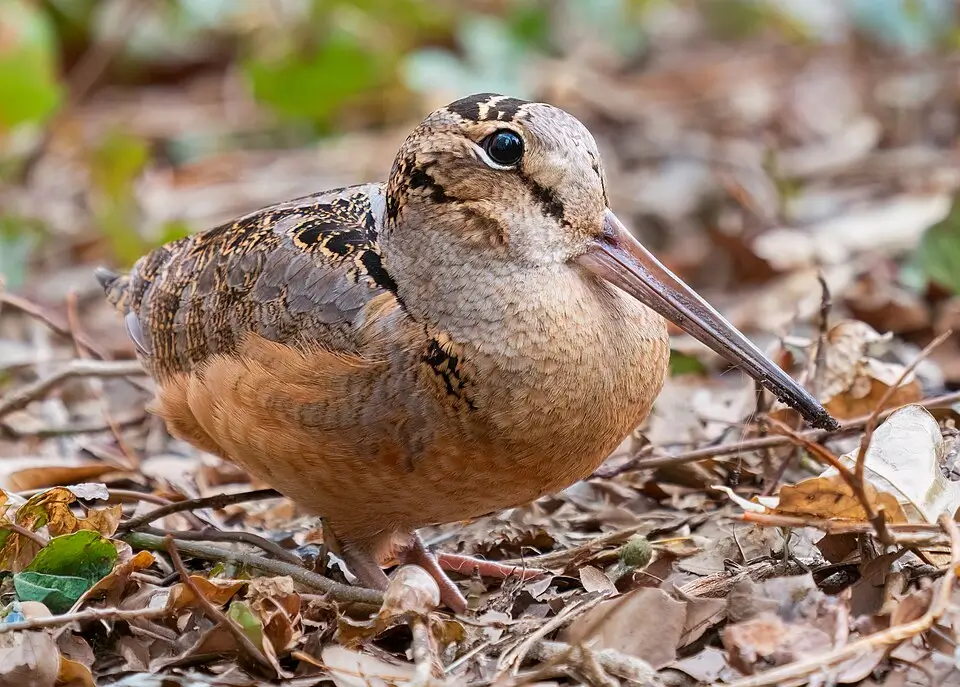
Perhaps the woodcock's most iconic physical feature is its extraordinarily long bill, which can measure roughly 2.5 to 2.8 inches in length. This bill is not merely an elongated probe; it is a sophisticated sensory instrument. The tip of the upper mandible is flexible and packed with sensitive nerve endings called Herbst corpuscles, which allow the bird to detect the movement of earthworms deep in the soil without ever seeing its prey. A woodcock feeding in soft ground rocks its body back and forth in a distinctive bobbing motion, a behavior that is thought to transmit vibrations into the earth and stimulate worm movement, making them easier to locate.
The woodcock's eyes are another remarkable adaptation. Set far back and high on the sides of its large, rounded head, the eyes provide an almost 360-degree field of vision — including a wide arc behind the bird. This near-panoramic vision allows the woodcock to watch for predators even while its bill is buried in the ground, a clear survival advantage for a bird that spends much of its time feeding in dense vegetation.
In terms of size, the American woodcock is a relatively small bird, typically weighing between 5 and 8 ounces, with females generally being larger than males — a phenomenon known as reverse sexual size dimorphism that is common among shorebirds. The plumage is a masterwork of cryptic coloration: a rich blend of chestnut, buff, gray, and black that renders the bird nearly invisible among fallen leaves and forest litter. Transverse black bars across the crown, a pale supercilium, and subtle barring on the breast complete an appearance that is both beautiful and supremely functional.
One of the most celebrated aspects of woodcock biology is the male's spring courtship display, known as "sky dancing." At dawn and dusk during the breeding season, male woodcock take to the air from open forest clearings or fields, spiraling upward in wide circles while producing a series of musical chirping sounds. At the apex of the flight, often hundreds of feet above the ground, the bird produces a liquid, bubbling song before plunging back to earth in a twisting descent. This aerial display is repeated multiple times each evening and serves both to attract females and to defend territory. Witnessing a woodcock sky dance is widely considered one of the great seasonal wildlife spectacles of the eastern woodlands.
Habitat & Range
The American woodcock is primarily a bird of the eastern half of North America, with its breeding range extending from the Gulf Coast states northward through New England and the Upper Midwest into the southern regions of Canada, including southern Manitoba, Ontario, Quebec, and the Maritime Provinces. The species winters primarily across the southeastern United States, from the Carolinas west through the Gulf Coast states and into parts of eastern Texas.
As a migratory species, the woodcock undertakes seasonal movements between its northern breeding grounds and southern wintering areas. Migration is largely nocturnal, and woodcock tend to move in loose, scattered fashion rather than in large, concentrated flocks. The timing of migration is closely tied to weather patterns and soil conditions — woodcock require soft, frost-free ground to probe for earthworms, so they move southward ahead of hard freezes and return north in early spring as the soil thaws.
The habitat preferences of the American woodcock are specific and well-documented. During the breeding season, woodcock favor a mosaic of young, dense forest — particularly stands of alder, aspen, and birch — interspersed with nearby openings such as old fields, forest clearings, and shrubby wetland edges. These early successional habitats provide the dense overhead cover that woodcock need for nesting and daytime resting, while the moist, loamy soils beneath support abundant earthworm populations that form the core of the bird's diet.
Earthworms make up the vast majority of the woodcock's diet, though the birds will also consume insects, insect larvae, millipedes, and various plant material. The species' dependence on earthworms means that soil quality, moisture, and pH are all critical factors in determining woodcock habitat suitability.
Hunting Information
The American woodcock has a long and storied tradition as an upland game bird across the eastern United States and Canada. It is considered one of the classic quarry species for wingshooters who hunt with pointing breeds or flushing spaniels, and the woodcock's tendency to hold tight before flushing in explosive, twisting flight has made it a beloved challenge for hunters of all experience levels.
Woodcock hunting is regulated at the federal level in the United States through the U.S. Fish and Wildlife Service, which sets frameworks for season dates and bag limits that individual states then adopt and refine. Because the woodcock is a migratory bird, it falls under the jurisdiction of the Migratory Bird Treaty Act, and hunters are required to possess a valid federal migratory bird hunting stamp (commonly known as the Duck Stamp) in addition to applicable state licenses and stamps.
Season dates, bag limits, and licensing requirements vary by state and are subject to annual review and adjustment by wildlife management agencies. Hunters interested in pursuing woodcock should always consult the current regulations for their specific state or province before heading afield. For the most accurate and up-to-date information regarding seasons and licensing in any particular state, including Alaska, prospective hunters should contact their state wildlife agency directly or visit the official state hunting regulations portal.
Woodcock are typically hunted over pointing dogs — breeds such as the English setter, Brittany, and German shorthaired pointer are particularly popular — that locate and pin the birds before the hunter approaches to flush them. The woodcock's reliance on dense cover means that hunting can be physically demanding work, with much of the day spent pushing through thick alder runs and brushy bottomlands. Early morning and late afternoon tend to be the most productive hunting times, as these correspond to the periods of most active feeding.
Conservation
The conservation status of the American woodcock is a topic of genuine concern among wildlife biologists and conservation organizations. Long-term population monitoring data, including the U.S. Fish and Wildlife Service's annual Singing Ground Survey, have indicated declining trends in woodcock populations across much of the species' range over recent decades. Biologists believe these declines are linked primarily to habitat loss — specifically, the ongoing maturation and loss of young forest habitats across the northeastern and north-central United States and Canada.
As eastern forests have matured, regrown following widespread agricultural abandonment, and undergone changes in land use, the early successional habitats that woodcock depend on have become increasingly scarce. This has prompted conservation organizations, including the American Woodcock Society and Ruffed Grouse Society, to advocate for and implement active forest management practices — such as timber harvesting, prescribed burning, and mechanical clearing — that create and maintain the young forest conditions that woodcock and many other wildlife species require.
Hunters and conservationists have worked collaboratively on woodcock habitat initiatives for decades, recognizing that the long-term sustainability of woodcock populations depends on proactive landscape-level habitat management. These efforts represent a meaningful example of the broader conservation role that sportsmen and women play in supporting wildlife across North America.
Despite the population challenges it faces, the American woodcock remains a resilient and adaptable species, and thoughtful habitat management efforts continue to provide hope for the long-term future of this remarkable bird.