The Gray Wolf (Canis lupus): A Comprehensive Guide to North America's Apex Predator
Few animals command the imagination quite like the wolf. Revered in indigenous cultures, studied by biologists, and admired by wildlife enthusiasts around the world, the gray wolf (Canis lupus) stands as one of the most iconic and ecologically significant predators on Earth. With its haunting howl echoing across vast wilderness landscapes, the wolf embodies the untamed spirit of wild places — and nowhere is that spirit more alive than in the rugged expanses of Alaska.
The gray wolf is the largest wild member of the family Canidae, a group that also includes domestic dogs, coyotes, foxes, and jackals. As a keystone predator, the wolf plays a foundational role in shaping ecosystems wherever it roams. Its presence — or absence — can ripple through entire food webs, influencing populations of prey animals, vegetation patterns, and even the behavior of rivers and streams. Understanding the wolf means understanding nature's grand design in some of its most breathtaking forms.
Alaska, the largest and northernmost state in the United States, provides some of the most expansive and pristine wolf habitat remaining in North America. Bordering Canada's Yukon territory and British Columbia to the east, and stretching across immense boreal forests, tundra plains, coastal ranges, and river valleys, Alaska represents a stronghold for wolf populations at a time when the species faces mounting pressures across much of its historic range. For hunters, wildlife managers, and conservationists alike, Alaska is a place where the relationship between humans and wolves continues to be written.
Biological Traits
The gray wolf, Canis lupus, is a fascinating animal from a biological standpoint. It belongs to the order Carnivora and the family Canidae, making it a close relative of the domestic dog — so close, in fact, that the two are considered the same species by many taxonomists, with the domestic dog classified as Canis lupus familiaris. This genetic proximity speaks volumes about the long, intertwined history between wolves and humans.
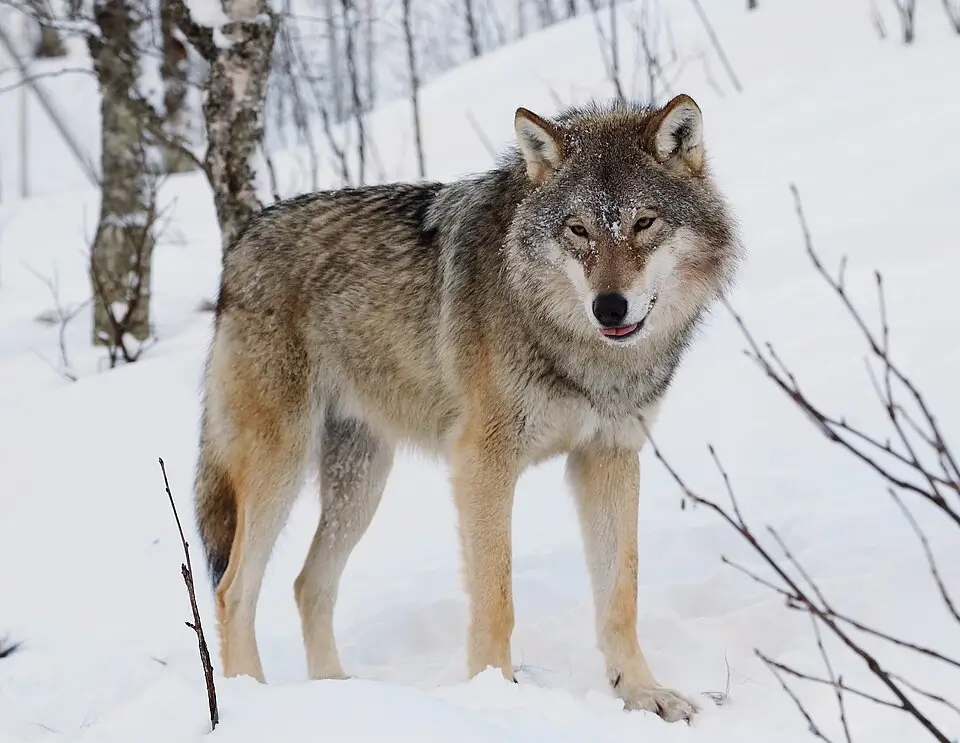
Wolves are powerful, highly social animals built for endurance and efficiency. They possess a deep chest, long legs, and large, padded feet well-suited for traveling across snow, rocky terrain, and open tundra. Their coats are dense double-layered affairs, providing insulation against extreme cold — a critical adaptation in northern climates like Alaska. Coat colors vary widely and can include shades of gray, black, white, brown, and tawny; in Alaska, both gray and black color phases are commonly observed.
As apex predators, wolves are equipped with strong jaws and large teeth designed for capturing and consuming prey. They are pursuit hunters, relying on stamina, teamwork, and intelligence rather than pure speed alone. A wolf pack's coordinated hunting strategy allows the group to take down prey animals far larger than any individual wolf could manage alone, including moose, caribou, elk, and deer. Wolves are also opportunistic feeders and will consume smaller mammals, birds, fish, and carrion when available.
One of the most compelling aspects of wolf biology is their social structure. Wolves are pack animals, typically living in family groups led by a breeding pair — often referred to as the alpha male and alpha female. Pack size can vary considerably depending on habitat, prey availability, and the specific population. Within the pack, wolves maintain complex social hierarchies reinforced through body language, vocalizations, and ritualized behaviors. Communication among wolves is sophisticated, encompassing howling, barking, growling, whimpering, and an intricate system of scent marking.
Wolves are highly territorial. A pack will actively defend its home range against rival packs and intruding individuals. Home ranges can be enormous, especially in Alaska, where prey may be distributed across vast landscapes and seasonal migrations require wolves to cover extensive ground. The howl — arguably the wolf's most recognizable trait — serves multiple communicative functions, including coordinating pack members, advertising territory, and maintaining social bonds.
Reproduction in wolves follows a seasonal pattern. Breeding typically occurs in late winter, with pups born in the spring. A litter generally consists of multiple pups, which are born blind and dependent on the entire pack for care and feeding. The communal raising of pups is one of the most endearing aspects of wolf behavior, with subordinate pack members — sometimes called "helpers" — contributing to pup development and survival. Wolves are long-lived relative to many carnivores, with wild individuals capable of surviving for many years in healthy environments.
Habitat & Range
The gray wolf once ranged across nearly the entire Northern Hemisphere, occupying habitats as diverse as Arctic tundra, temperate forests, grasslands, deserts, and mountain ranges across North America, Europe, Asia, and the Middle East. While its range has been dramatically reduced over centuries due to habitat loss, persecution, and prey depletion, robust populations still exist in key regions — and Alaska remains one of the most important wolf strongholds in the world.
Alaska's sheer geographic diversity makes it ideal wolf territory. From the boreal forests of the Interior to the open tundra of the North Slope, from the coastal rainforests of Southeast Alaska to the sweeping river valleys of the Yukon and Kuskokwim drainages, wolves occupy virtually every corner of the state. The abundance of large ungulate prey — including moose, caribou, Dall sheep, and Sitka black-tailed deer in coastal areas — provides the nutritional foundation that sustains healthy wolf populations across diverse Alaskan ecosystems.
Alaska borders Canada's Yukon Territory and British Columbia to the east, and wolves move freely across this international boundary, underscoring the importance of transboundary wildlife management. The connectivity between Alaskan and Canadian wolf populations contributes to the overall genetic health and resilience of wolf populations across the broader northwestern North American region.
Wolves in Alaska must adapt to some of the most extreme environmental conditions on Earth. Winters can be long, brutally cold, and dark, with deep snowpack that can either impede or, paradoxically, assist wolves in hunting prey. Summers are characterized by extended daylight hours, abundant food resources, and active denning and pup-rearing activity. The seasonal rhythms of Alaska's ecosystems — including the annual migrations of caribou herds — shape wolf movements and social dynamics in profound ways.
Hunting Information
Wolf hunting is a traditional and legal activity in Alaska, reflecting the state's long history of subsistence and sport hunting as integral parts of its cultural and wildlife management heritage. Alaska's approach to wolf management is guided by the Alaska Department of Fish and Game, which uses scientific population data to inform harvest regulations and ensure that wolf populations remain healthy and sustainable.
For those interested in pursuing wolves in Alaska, it is strongly recommended to consult the Alaska Department of Fish and Game directly for the most current and accurate information regarding licenses, permits, seasons, bag limits, and any applicable regulations. Wildlife management regulations can change from season to season based on population assessments and management goals, and hunters are responsible for staying informed about the rules that apply to the specific area and time period in which they intend to hunt.
Wolf hunting in Alaska can be conducted through various methods, including trapping, which has a deep historical and cultural tradition in the state, as well as hunting by foot, snowmobile, and in some areas and circumstances, aircraft-assisted methods as permitted by law. As with all hunting in Alaska, ethical and fair-chase principles are highly valued, and hunters are encouraged to approach wolf hunting with respect for both the animal and the wilderness it inhabits.
Alaska's wolf hunting tradition is not separate from conservation — it is part of it. Regulated harvest contributes to population management, generates funding for wildlife programs through license and tag sales, and maintains the balance between predator and prey species in ways that support healthy, functioning ecosystems.
Conservation
The gray wolf's conservation story is one of the most dramatic in the history of wildlife management in North America. Wolves were extirpated from much of the contiguous United States during the 19th and 20th centuries through a combination of habitat destruction, prey base collapse, and direct persecution. Their recovery — through natural recolonization and deliberate reintroduction programs — has been celebrated as one of conservation's great success stories, though the process has not been without controversy.
In Alaska, wolves were never fully eliminated, and the state has maintained continuous wild wolf populations throughout the modern era. This continuity makes Alaska uniquely valuable from a conservation perspective, as it represents one of the few places in the world where large, connected, and ecologically functional wolf populations have persisted within a largely intact predator-prey system.
The wolf's role as a keystone species makes its conservation significant far beyond wolf populations alone. Research conducted in ecosystems where wolves have been reintroduced — most famously in Yellowstone National Park — has demonstrated the cascading ecological effects of wolf presence. By regulating prey populations and influencing the behavior of herbivores, wolves can help restore vegetation, reduce stream erosion, support songbird diversity, and create conditions that benefit dozens of other species. These "trophic cascades" highlight why wolf conservation is inseparable from broader ecosystem health.
Alaska's wolf populations are managed under a framework that seeks to balance ecological sustainability with the interests of hunters, subsistence users, rural communities, and wildlife observers. This management philosophy recognizes that wolves are both a valued wildlife resource and an essential ecological force, and that their long-term conservation depends on maintaining landscapes large enough, wild enough, and prey-rich enough to support them for generations to come.
The gray wolf endures as a symbol of wilderness — powerful, intelligent, and deeply connected to the landscapes it shapes. In Alaska, where wild places still stretch to the horizon in every direction, the wolf continues to howl.