The Wild Turkey (Meleagris gallopavo): America's Most Iconic Game Bird
Few animals capture the spirit of American wildlife quite like the wild turkey. Bold, intelligent, and surprisingly elusive, Meleagris gallopavo is a bird that has fascinated naturalists, hunters, and casual observers alike for centuries. Long before the turkey became a symbol of Thanksgiving tradition, it was a cornerstone of the natural landscape across North America — a bird so impressive that Benjamin Franklin famously suggested it might make a worthy national symbol. Whether you encounter one strutting through an open meadow at dawn or hear the echoing gobble roll across a quiet woodland, the wild turkey commands attention in a way that few other animals can match.
Once pushed to the brink of disappearance through unregulated hunting and widespread habitat loss in the early twentieth century, the wild turkey has staged one of the most celebrated wildlife comeback stories in conservation history. Today, it thrives across a vast range of the North American continent, providing millions of hunters and wildlife enthusiasts with incredible outdoor experiences each and every year. Understanding this remarkable bird — its biology, its behavior, its habitat requirements, and its place in the hunting tradition — deepens the appreciation that so many people already feel for it.
This article takes a comprehensive look at the wild turkey, drawing on established biological knowledge and celebrating the enduring importance of this magnificent species in the American outdoors.
Biological Traits
The wild turkey, Meleagris gallopavo, belongs to the family Phasianidae and is one of only two species of turkey in the world, the other being the ocellated turkey (Meleagris ocellata) of the Yucatán Peninsula. As the heaviest member of the order Galliformes native to North America, the wild turkey is a bird of impressive physical presence.
Adult male wild turkeys, known as toms or gobblers, are large, powerfully built birds with iridescent plumage that shimmers with bronze, green, copper, and red tones in the right light. One of the most distinctive features of the tom is its beard — a cluster of modified, hair-like feathers that protrudes from the center of the breast. Beards can grow quite long over the course of a bird's life and are a prized measurement for hunters. Toms also sport sharp, curved spurs on the backs of their legs, which they use in combat with rival males during the breeding season.
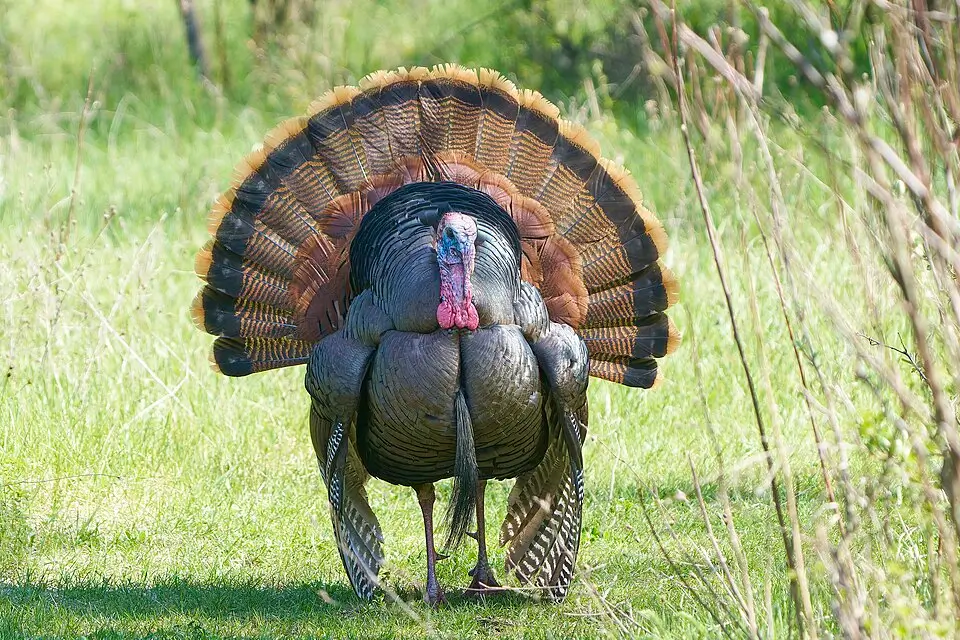
Perhaps no feature of the male turkey is more recognizable than its extraordinary fan display. During courtship, a tom will puff up its body feathers, fan its tail into a wide, dramatic arc, drag its wing tips along the ground, and produce a deep, resonant gobble that can carry over a mile in the right conditions. This gobbling behavior is not only a means of attracting hens but also a declaration to rival males. The tom's head and neck are bare of feathers and can flush with vivid colors — red, white, and blue — depending on its mood and level of excitement, a feature that makes it one of the most visually expressive birds in North America.
Female wild turkeys, called hens, are considerably smaller and more modestly colored, wearing earthy browns and buffs that provide excellent camouflage while nesting. Hens are attentive mothers, typically laying a clutch of around 10 to 14 eggs in a shallow ground nest concealed beneath brush or fallen logs. The incubation period lasts approximately 28 days, after which the poults — young turkeys — hatch and are almost immediately mobile, following their mother through the forest within hours of hatching.
Wild turkeys are omnivores with a remarkably varied diet. They forage on the ground for acorns, seeds, berries, insects, small reptiles, and even amphibians. Their sharp eyesight is widely regarded as one of the best among any game bird — turkeys can detect movement at great distances and have a wide field of vision that makes them highly alert to potential threats. Their hearing is equally acute. These sensory capabilities, combined with an innate wariness developed through millennia of surviving predators, make wild turkeys a genuinely challenging quarry for hunters.
Wild turkeys are also strong and agile despite their size. They are capable of short bursts of flight reaching speeds of up to 55 miles per hour, and they are surprisingly fleet on foot, capable of running at speeds exceeding 20 miles per hour. Roosting in trees at night keeps them safe from many ground-based predators, and the sight of large turkeys sailing gracefully into the high branches of a mature oak at dusk is one of the more surprising spectacles in American wildlife.
There are six recognized subspecies of wild turkey in North America, each adapted to a distinct region. These include the Eastern (M. g. silvestris), Osceola or Florida (M. g. osceola), Rio Grande (M. g. intermedia), Merriam's (M. g. merriami), Gould's (M. g. mexicana), and South Mexican (M. g. gallopavo) subspecies. Each subspecies varies subtly in coloration, size, and behavior, and many hunters pursue the achievement of harvesting all five huntable subspecies in what is known as a Royal Slam or World Slam.
Habitat & Range
The wild turkey is a highly adaptable species that occupies a wide variety of habitats across North America. Historically, its range extended across much of the eastern United States and into parts of the Southwest and Mexico. After significant population declines in the nineteenth and early twentieth centuries, successful reintroduction programs have expanded the turkey's range to include all of the contiguous 48 states, as well as parts of Canada and Hawaii.
Wild turkeys thrive in mixed forests interspersed with open areas — a mosaic of habitat types that provides both the food resources and cover they need to survive. Mature hardwood forests rich in mast-producing trees such as oaks, beeches, and hickories are particularly important, as acorns and other hard mast form a critical component of the turkey's autumn and winter diet. Agricultural landscapes also provide valuable foraging opportunities, and turkeys are often found working the edges of crop fields, especially during morning and evening hours.
Water sources, open grasslands, forest edges, and brushy clearings all contribute to quality turkey habitat. During the spring breeding season, toms seek out open areas — old fields, forest openings, logging roads, and pastures — where they can display to hens with maximum visibility. Nesting habitat typically consists of areas with dense ground cover that provides concealment for the incubating hen.
While the wild turkey is not currently found as a native, established wild population in Alaska — a state with a climate and ecosystem quite different from the bird's typical range — the species' broader story of range expansion across North America is a testament to its adaptability and the effectiveness of wildlife management programs throughout the continent.
Hunting Information
The wild turkey holds a cherished place in the American hunting tradition. Spring turkey season, timed to coincide with the breeding season when gobblers are actively seeking hens, is widely considered one of the most exciting and demanding hunting experiences available to North American sportsmen and women. The act of calling in a gobbler — mimicking the sounds of a hen to draw a tom within range — requires patience, skill, and an intimate understanding of turkey behavior that can take a lifetime to fully develop.
Turkey hunters typically use a range of calls including box calls, slate or pot calls, diaphragm mouth calls, and locator calls to locate and engage birds. Shotguns loaded with turkey-specific loads are the most common firearm choice, though archery equipment and muzzleloaders are increasingly popular among hunters seeking an additional challenge. Successful turkey hunting demands full camouflage concealment, near-total stillness, and the ability to read and respond to a bird's behavior in real time.
Fall turkey seasons are also offered in many states, providing a different style of hunting that often involves locating and scattering flocks before calling them back together — a technique that capitalizes on turkeys' strong flocking instincts.
Hunters interested in pursuing wild turkeys should always consult their state's official wildlife agency for current season dates, licensing requirements, bag limits, and legal methods of take, as regulations vary significantly by state and subspecies. In Alaska specifically, prospective hunters are encouraged to reach out directly to the Alaska Department of Fish and Game for the most accurate and up-to-date information regarding any applicable regulations.
Conservation
The wild turkey's conservation story is one of the greatest triumphs in North American wildlife management. By the early 1900s, unregulated hunting and extensive deforestation had reduced wild turkey populations to dangerously low levels, with the species eliminated from much of its historical range. Estimates suggest that populations may have fallen to fewer than 30,000 birds continent-wide at their lowest point.
The recovery of the wild turkey is the result of concerted efforts by state and federal wildlife agencies, combined with the passionate advocacy and financial support of hunters and organizations such as the National Wild Turkey Federation (NWTF). Through trap-and-transfer programs that relocated wild-caught birds to suitable unoccupied habitats, and through habitat restoration initiatives and regulated hunting seasons, wild turkey populations rebounded dramatically throughout the twentieth century. Today, estimates place the North American wild turkey population at approximately 6 to 7 million birds — a staggering recovery by any measure.
This success story underscores the vital role that regulated hunting plays in wildlife conservation. License fees, excise taxes on hunting equipment through the Federal Aid in Wildlife Restoration Act (Pittman-Robertson Act), and the voluntary contributions of hunter-conservationists have funded the research and management programs that made the turkey's recovery possible. The wild turkey stands as living proof that science-based wildlife management, combined with the conservation ethic of America's hunting community, can achieve extraordinary outcomes for native wildlife.