Striped Skunk (Mephitis mephitis): A Complete Wildlife Guide
Few animals in North America are as instantly recognizable — or as universally respected — as the striped skunk. With its bold black-and-white coloration and legendary chemical defense, Mephitis mephitis has earned a unique place in the continent's wildlife tapestry. Far from being merely a punchline in popular culture, the striped skunk is a fascinating, ecologically important mammal that plays a meaningful role in the ecosystems it inhabits. Whether you are a wildlife enthusiast, a hunter, a trapper, or simply a curious naturalist, the striped skunk rewards a closer look.
Known across rural communities, suburban neighborhoods, and wild landscapes alike, the striped skunk is one of the most widely distributed mammals in North America. Its adaptability, resourcefulness, and unique survival strategies make it a compelling subject for anyone interested in North American wildlife. This guide explores the biology, habitat, behavior, and broader significance of this remarkable animal.
Biological Traits
The striped skunk, Mephitis mephitis, belongs to the family Mephitidae — a group of mammals commonly known as skunks. The genus name Mephitis is derived from Latin, meaning "noxious exhalation" or "bad odor," a fitting reference to the animal's most famous characteristic. The species name mephitis repeats this descriptor, essentially doubling down on what makes this animal so distinctive.
The striped skunk is a medium-sized mammal, generally comparable in size to a domestic cat. Adults typically weigh between 2.5 and 15 pounds, with males tending to be noticeably larger than females. The body is compact and sturdy, supported by short, muscular legs equipped with strong, curved claws well-suited for digging.
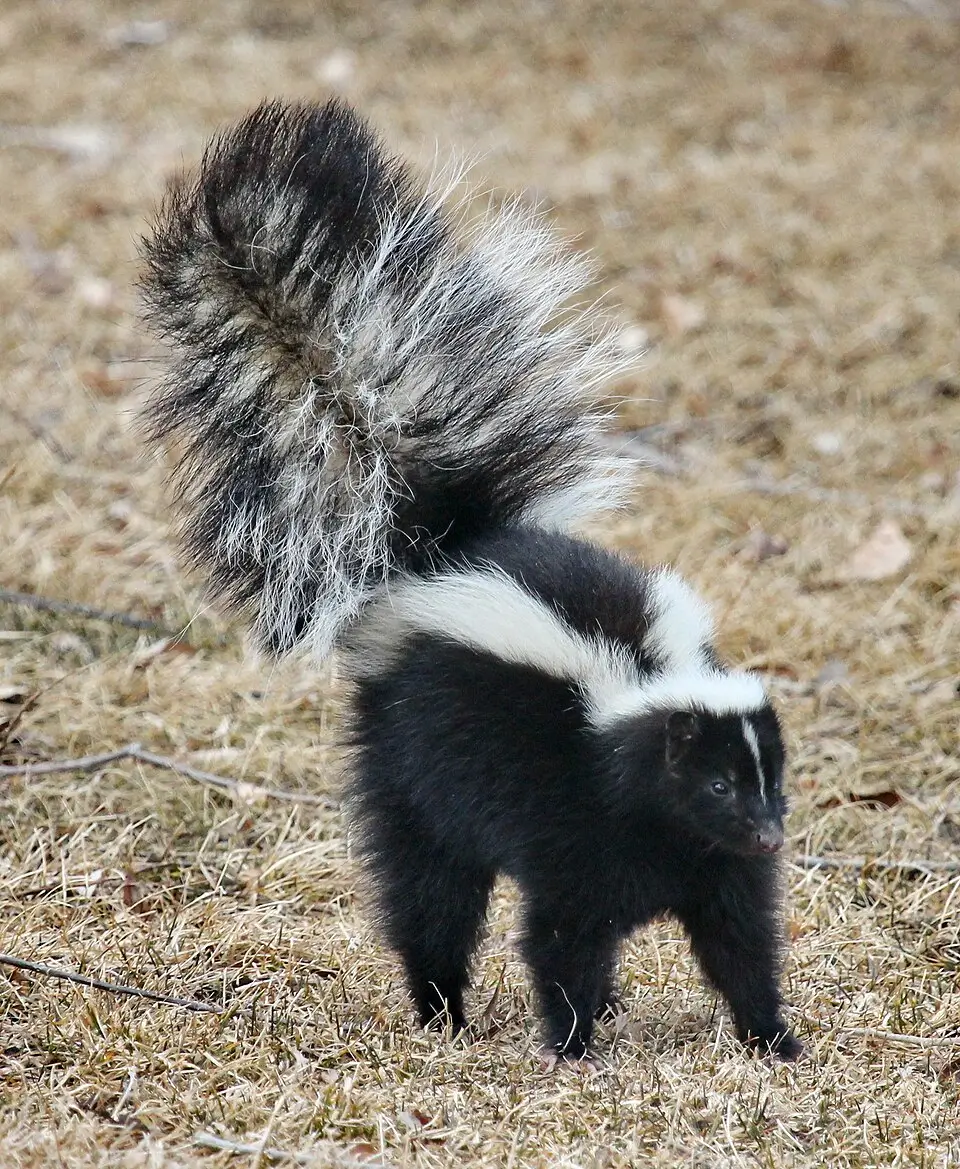
The coat of the striped skunk is predominantly glossy black, accented by a prominent white stripe that begins at the top of the head, splits at the shoulders, and runs down both sides of the back toward the tail. This striking pattern serves a vital biological purpose: it is a form of aposematism, or warning coloration, signaling to potential predators that the animal is capable of a powerful chemical defense. The bushy tail itself is often a mix of black and white fur and is frequently held erect as a warning signal.
The striped skunk's most famous feature is, of course, its musk glands — two highly specialized scent glands located on either side of the anus. These glands produce a sulfur-containing chemical compound, primarily composed of thiols (formerly called mercaptans), that can be accurately sprayed at targets up to ten feet away. The odor is potent, penetrating, and notoriously difficult to neutralize. Before spraying, skunks typically provide ample warning: stamping their front feet, raising the tail, and even performing a handstand in some species of skunk. The striped skunk generally turns its body into a U-shape so that both its head and hindquarters face the threat before releasing its spray.
Striped skunks are omnivores with a highly varied diet that shifts with the seasons. In warmer months, insects — particularly beetles, grasshoppers, and larvae — make up a significant portion of their diet. They also consume small mammals, bird eggs, frogs, earthworms, berries, fruits, nuts, and plant matter. This dietary flexibility is one of the key reasons the striped skunk thrives in such a wide variety of environments. In agricultural areas, skunks are well-known for foraging in gardens and around livestock facilities, often in search of grubs and insects.
Skunks are not true hibernators, but they do enter periods of torpor during cold winter months, relying on stored body fat to survive. In regions with mild winters, they may remain active year-round. During winter denning periods, multiple females sometimes share a den, while males tend to den alone or with several females.
Reproduction in striped skunks typically occurs in late winter or early spring. After a gestation period of approximately 59 to 77 days, females give birth to litters that commonly range from four to seven kits, though litters as large as ten have been recorded. The young are born blind and helpless but develop rapidly. Their eyes open within three weeks, and they begin accompanying the mother on foraging trips within two months. By autumn, the young skunks are largely independent.
Striped skunks have a relatively short lifespan in the wild, typically living two to four years, though individuals in captivity have lived considerably longer. Key natural predators include the great horned owl — one of the few predators with a limited sense of smell — as well as coyotes, foxes, bobcats, and large raptors. Disease, particularly rabies, is also a significant factor in striped skunk population dynamics, as skunks are one of the primary wildlife reservoirs for the rabies virus in North America.
Habitat & Range
The striped skunk is one of the most broadly distributed mammals on the continent. Its range extends across most of North America, from southern Canada through the contiguous United States and into northern Mexico. It is absent from desert regions of the extreme Southwest, the highest elevations of the Rocky Mountains, and notably from Alaska and most of Canada's far north.
The striped skunk is a habitat generalist, meaning it is not restricted to any single ecosystem type. It thrives in mixed woodlands, grasslands, open prairies, farmlands, forest edges, and increasingly in suburban and even urban environments. The key requirements for skunk habitat are relatively simple: access to adequate food sources, suitable denning sites, and proximity to water. Dens are typically located underground, either in burrows the skunk has dug itself or in dens appropriated from other animals such as groundhogs. They also den under buildings, wood piles, rock piles, and in dense brush.
The striped skunk's success in human-modified landscapes is a testament to its adaptability. Suburban areas, with their combination of green lawns (rich in grubs and earthworms), ornamental plants, bird feeders, and accessible garbage, often support dense skunk populations. This proximity to human development makes the striped skunk one of the most commonly encountered wild mammals in many parts of North America.
Hunting and Trapping Information
The striped skunk has a long history as a furbearer in North America. Historically, skunk fur was commercially valuable, and trapping played a significant role in the broader North American fur trade. While the commercial fur market for skunk pelts has diminished considerably compared to its historical peak, skunks remain a legal and traditional target species for trappers across much of their range.
Trapping is the most common method of harvest for striped skunks, as it minimizes the risk of triggering a spray response that would be inevitable in many hunting scenarios. Cage traps and foothold traps are commonly used. Experienced trappers learn to approach live-caught skunks with great care and patience, keeping calm and moving slowly to avoid provoking a defensive response.
In terms of hunting regulations, requirements vary significantly by state and locality. Striped skunks are managed as furbearers or non-game animals in most jurisdictions. Hunters and trappers are strongly encouraged to consult the wildlife management agency in their specific state or province for current, accurate season dates, bag limits, licensing requirements, and any specific rules regarding methods of take. Regulations change periodically, and local guidance is always the authoritative source.
In the state of Alaska, it is worth noting that the striped skunk does not naturally occur in the wild — its range does not extend into Alaska's climate and geography. As a result, there is no established hunting or trapping season for striped skunks in that state.
Conservation
The striped skunk is currently classified as a species of Least Concern on the IUCN Red List of Threatened Species, reflecting its wide distribution, adaptability, and generally stable population levels across most of its range. The species is not considered at risk of significant population decline at a continental scale.
That said, skunks face a range of localized pressures. Vehicle collisions are among the leading causes of skunk mortality in many areas, given the animal's tendency to forage along roadsides and its relatively slow movement. Habitat loss associated with large-scale land conversion can reduce available denning and foraging sites, though the skunk's generalist nature provides considerable resilience.
Disease is an important conservation and public health consideration. Striped skunks are a primary wildlife reservoir for rabies in many parts of North America, and monitoring skunk population health is a component of broader wildlife disease surveillance programs. Canine distemper is another disease that can significantly impact local skunk populations.
From an ecological standpoint, striped skunks provide genuine benefits to the ecosystems they inhabit. Their insectivorous habits help regulate populations of grubs, beetles, and other invertebrates, including many agricultural pest species. By consuming rodents and insects, skunks contribute to natural pest control in both wild and agricultural settings. They also serve as prey for several important predator species, linking them into broader food web dynamics.
Appreciating the striped skunk for what it truly is — a resilient, ecologically valuable, and biologically fascinating native mammal — offers a richer and more complete understanding of North American wildlife. Whether encountered on a night hike, spotted crossing a country road, or researched as a potential trapping quarry, the striped skunk deserves the respect and curiosity its remarkable nature warrants.