Sandhill Crane: A Living Fossil of the American Skies
Few birds capture the imagination quite like the Sandhill Crane (Grus canadensis). Standing tall against an open sky, bugling its resonant, rattling call across marshes and grasslands, this magnificent bird represents one of nature's most enduring success stories. With a fossil record stretching back approximately 2.5 million years, the Sandhill Crane is widely regarded as one of the oldest living bird species on Earth — a true living fossil that has witnessed the rise and fall of entire ecosystems while continuing to thrive in its own ancient way.
For hunters, wildlife enthusiasts, and naturalists alike, the Sandhill Crane offers a compelling subject of study and admiration. Its dramatic migratory spectacles, its complex social behaviors, and its growing presence across much of North America make it a species worth understanding deeply. Whether you encounter them in their wintering grounds, along their migratory flyways, or in their northern breeding territories — including the vast wilderness of Alaska — Sandhill Cranes command attention and respect.
This article takes a comprehensive look at one of North America's most iconic birds: its biology, its habitat, its role in hunting culture, and its conservation standing.
Biological Traits
The Sandhill Crane is a large, long-legged, long-necked bird belonging to the family Gruidae — the true cranes. Its scientific name, Grus canadensis, reflects its strong association with Canada and the broader North American continent, though its range extends far beyond Canadian borders.
Physical Appearance
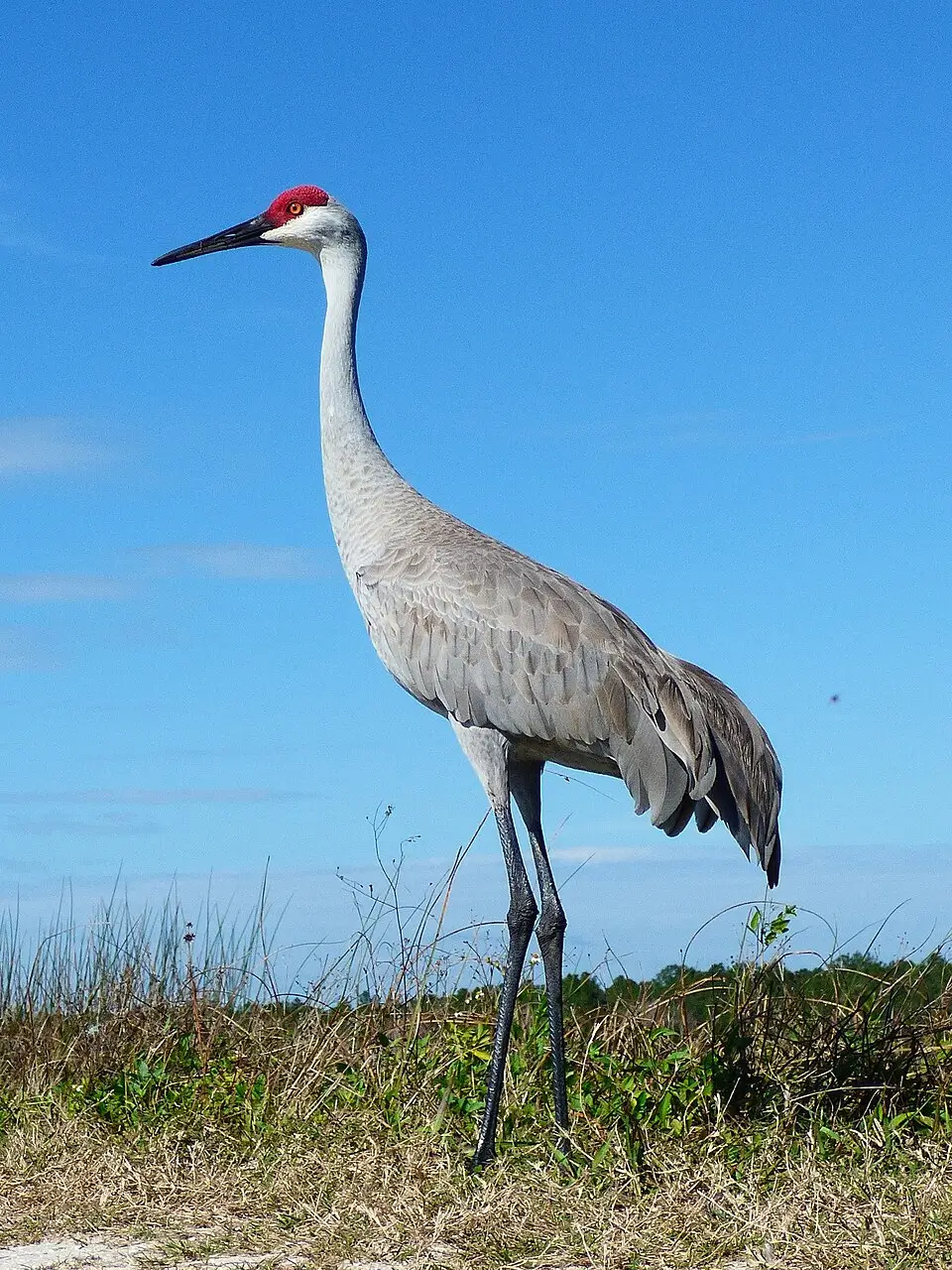
Sandhill Cranes are immediately recognizable by their slate-gray plumage, which often takes on a rusty or brownish hue due to the birds' habit of preening with iron-rich mud during the breeding season. This self-applied "staining" gives many individuals a distinctive reddish-brown coloration, particularly during spring and summer months. Perhaps the most striking feature of the adult Sandhill Crane is the bare red patch of skin on the crown of the head — a characteristic that sets it apart from many other large wading birds.
Adults have long, dark legs, a straight pointed bill, and a bushy, drooping set of tertial feathers over the tail that can give the rear end a somewhat fluffy appearance. In flight, Sandhill Cranes extend their necks fully — a key field identifier that distinguishes them from herons, which fly with their necks tucked back in an S-curve.
Size and Subspecies
Sandhill Cranes vary considerably in size depending on subspecies. Six subspecies are generally recognized, ranging from the relatively smaller Florida Sandhill Crane (Grus canadensis pratensis) to the larger migratory subspecies such as the Greater Sandhill Crane (Grus canadensis tabida) and the Lesser Sandhill Crane (Grus canadensis canadensis). The latter is particularly abundant across Alaska and Arctic Canada.
Adult birds typically stand between 3 and 4 feet tall, with a wingspan that can reach 6 to 7 feet — making them among the largest birds in North America by wingspan. Despite their impressive size, these birds are capable of sustained long-distance flight, utilizing thermal updrafts to soar efficiently during migration.
Vocalizations
The Sandhill Crane's call is one of the most evocative sounds in the natural world. Their bugling, rolling, trumpet-like calls can carry for miles across open terrain. This distinctive vocalization is produced in part by the unusually long, coiled trachea found within the bird's sternum — a structural adaptation that amplifies sound in remarkable ways. Cranes use an array of calls to communicate with mates, warn of predators, maintain flock cohesion during migration, and coordinate behavior during courtship.
Courtship and Breeding
One of the most celebrated behaviors of the Sandhill Crane is its elaborate courtship dance. Pairs — and sometimes entire flocks — engage in leaping, wing-spreading, head-bobbing, and bowing displays that are as graceful as they are energetic. These dances strengthen pair bonds, which in Sandhill Cranes can last for many years.
Sandhill Cranes are monogamous and typically raise one to two chicks per breeding season. Both parents share incubation duties and are highly protective of their nests and young. Chicks — known as "colts" — are precocial, meaning they can walk and follow their parents shortly after hatching. Juvenile cranes travel with their parents through their first migration, learning routes and staging areas through direct experience.
Longevity
Sandhill Cranes are notably long-lived birds. In the wild, individuals commonly reach 20 years of age, and captive birds have been recorded living even longer. This longevity, combined with a relatively low annual reproductive rate, means that population dynamics for this species are closely tied to adult survival.
Habitat & Range
The Sandhill Crane occupies an impressively broad range across North America. Breeding populations can be found from the Arctic tundra of Alaska and Siberia to the wetlands of the Gulf Coast states. Wintering grounds are concentrated primarily in the southwestern United States and northern Mexico, with key areas including the Platte River valley in Nebraska — one of the world's most remarkable wildlife spectacles, where hundreds of thousands of cranes stage each spring.
Alaska and the Arctic
Alaska holds special significance for Sandhill Cranes. The state's vast, largely undisturbed landscapes — encompassing tundra, boreal forest wetlands, river deltas, and coastal marshes — provide ideal breeding habitat for the Lesser Sandhill Crane. Alaska's Yukon-Kuskokwim Delta and other major river systems are important nesting areas, and the state plays a critical role in supporting some of the continent's largest crane populations.
During the breeding season, Sandhill Cranes in Alaska favor wetland areas near lakes, ponds, bogs, and river systems, where they nest in shallow water or on raised hummocks among dense marsh vegetation. The surrounding uplands and meadows provide vital foraging habitat, where cranes feed on a wide variety of food items.
Diet
Sandhill Cranes are omnivores with a highly varied diet. They consume plant matter including seeds, berries, grains, and agricultural crops, as well as animal protein in the form of insects, worms, small rodents, frogs, snakes, and other invertebrates. Their diet shifts seasonally, with migratory birds taking advantage of waste grain in agricultural fields during fall and spring movements — a behavior that has made them a familiar sight in farming communities throughout the Great Plains.
Hunting Information
The Sandhill Crane holds a respected place in North American hunting tradition. In many western and central states, as well as in parts of Canada, regulated hunting seasons for Sandhill Cranes have been established, making the crane one of the few migratory birds in this category available to hunters.
Hunters who pursue Sandhill Cranes often describe the experience in reverential terms. The birds are large, wary, and capable of covering enormous distances — qualities that make them a challenging and rewarding quarry. Their meat, often described as tender and rich in flavor, has earned cranes the informal nickname "the ribeye of the sky" among hunting communities, further enhancing their appeal.
Crane hunting typically involves decoys, calls, and careful field setups in open agricultural areas or near roosting wetlands. Hunters must possess a strong understanding of crane behavior and migration patterns to be consistently successful.
Important Note for Alaska Hunters: Specific season dates, bag limits, license requirements, and regulatory information for Sandhill Crane hunting in Alaska were not available in the source data consulted for this article. Hunters interested in pursuing Sandhill Cranes in Alaska are strongly encouraged to consult directly with the Alaska Department of Fish and Game and the U.S. Fish and Wildlife Service for current, accurate, and up-to-date regulations before planning a hunt. Migratory bird regulations are subject to change annually, and compliance with all applicable state and federal rules is essential.
Conservation
The conservation story of the Sandhill Crane is largely one of recovery and resilience. Several subspecies experienced significant population declines during the 19th and early 20th centuries, largely due to habitat loss and unregulated hunting. The enactment of the Migratory Bird Treaty Act of 1918 provided federal protection that proved critical to population recovery.
Today, the migratory populations of Sandhill Crane — particularly the Mid-Continent Population, which is the largest — are considered healthy and abundant. Conservation efforts focused on wetland preservation, responsible agricultural practices, and scientifically managed hunting seasons have contributed to this positive trajectory.
However, non-migratory subspecies such as the Mississippi Sandhill Crane (Grus canadensis pulla) remain endangered and are the subject of active recovery programs. The broader success of crane conservation serves as a powerful example of what coordinated wildlife management can achieve when science, policy, and public engagement work together.
The ongoing protection of critical migratory stopover habitats — particularly the Platte River in Nebraska and key wintering sites — remains a conservation priority. Organizations including the International Crane Foundation continue to play a vital role in research, habitat protection, and public education related to all crane species worldwide.
Conclusion
The Sandhill Crane is far more than a bird — it is a symbol of wildness, endurance, and the remarkable capacity of nature to persist across vast stretches of time. From its ancient lineage to its spectacular migrations, from its joyful courtship dances to its resonant calls echoing across open skies, this species enriches every landscape it inhabits. For hunters, conservationists, and wildlife watchers alike, the Sandhill Crane represents one of North America's great natural treasures — worthy of admiration, respect, and careful stewardship for generations to come.