The Muskox: An Ancient Arctic Giant of the Far North
Few animals embody the raw, unrelenting spirit of the Arctic quite like the muskox (Ovibos moschatus). Standing as a living relic of the Pleistocene epoch, this remarkable creature has survived ice ages, shifting climates, and millennia of harsh polar conditions to remain one of the most iconic large mammals of the far north. With its massive, shaggy silhouette set against sweeping tundra landscapes, the muskox is a symbol of endurance, adaptability, and wild beauty. Whether encountered on a remote Alaskan hillside or across the vast Arctic plains of northern Canada, coming face to face with a herd of muskoxen is an experience that few wildlife enthusiasts or hunters will ever forget.
The muskox occupies a unique place in the natural world. It is neither a true ox nor simply a relative of domestic cattle, but rather a member of the subfamily Caprinae — making it more closely related to sheep and goats than to cattle, despite its bovine appearance. This fascinating blend of characteristics has intrigued naturalists and biologists for centuries, and today the muskox remains one of the most studied and celebrated animals of Arctic ecosystems.
Biological Traits
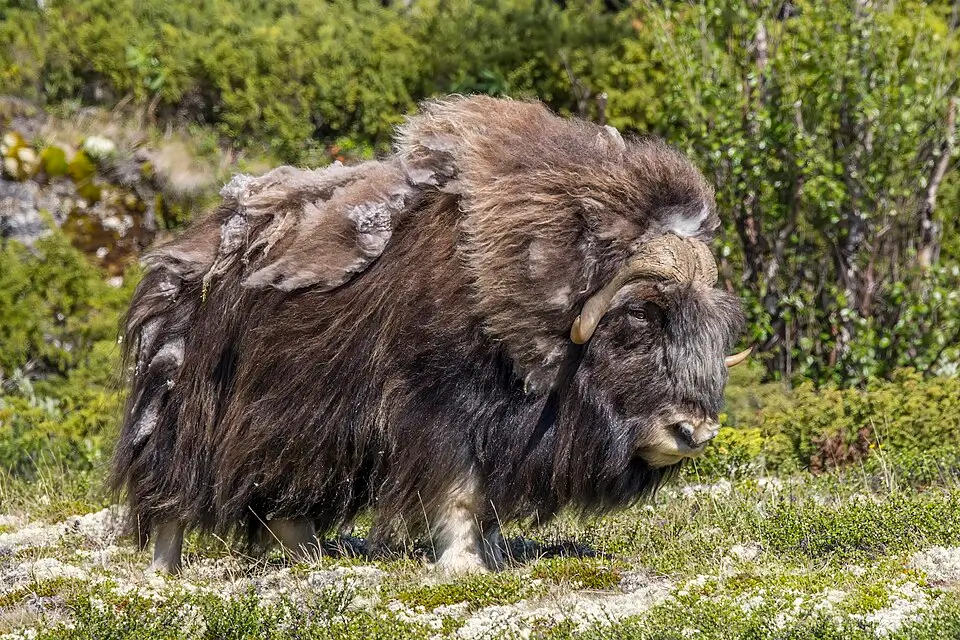
The muskox is an impressive animal in both appearance and physiology. Adults are large, stocky mammals covered in one of the most remarkable coats in the animal kingdom. Their outer coat consists of long, coarse guard hairs that can hang nearly to the ground, providing a dramatic and imposing visual presence. Beneath this outer layer lies a dense, soft undercoat known as qiviut — an insulating fiber so fine and warm that it has been prized by indigenous peoples and textile artisans alike. Qiviut is widely regarded as one of the warmest natural fibers in the world, making the muskox extraordinarily well-equipped for life in temperatures that can plunge far below freezing.
Both male and female muskoxen possess horns, a trait that distinguishes them from many other large ungulates. The horns of adult males, called bulls, are particularly dramatic — they form a broad, heavy boss across the forehead before curving downward and then sweeping upward at the tips. These formidable weapons are used during the breeding season, known as the rut, when bulls compete aggressively for dominance and mating rights. Clashes between rival bulls can be spectacular and intense, with the animals charging one another at considerable speed and colliding with tremendous force.
The scientific name Ovibos moschatus offers additional insight into the animal's nature. Ovibos translates roughly to "sheep-ox," reflecting the animal's taxonomic position bridging those two groups, while moschatus refers to the musky odor produced by bulls during the rut — an olfactory signal that gives the muskox its common name. This scent, produced by glands located near the eyes, plays an important role in communication and mate attraction during the breeding season.
Muskoxen are highly social animals, typically living in herds that provide both warmth and protection. One of their most well-known defensive behaviors is the formation of a tight defensive circle or line when threatened by predators such as wolves or bears. In this formation, adults face outward with their horns presented to the threat while calves are protected in the center. This instinctive and coordinated response has proven highly effective against natural predators over thousands of years, though it unfortunately also made early muskox populations vulnerable to human hunters armed with firearms, who could simply wait out the defensive formation.
Calves are typically born in spring, and like many Arctic ungulates, they must be able to stand and move within hours of birth to survive in the challenging polar environment. Muskox cows are attentive mothers, and the social structure of the herd provides additional protection for young animals during their most vulnerable early weeks of life.
Habitat & Range
The muskox is a true creature of the Arctic, inhabiting some of the most remote and inhospitable terrain on Earth. Their range spans the Arctic tundra regions of northern North America, Greenland, and parts of northern Europe and Russia where they have been reintroduced. In North America, muskoxen are found across the Canadian Arctic Archipelago, the mainland territories, and importantly for American hunters and wildlife enthusiasts, in Alaska.
In Alaska, the muskox has an interesting conservation story. The species was hunted to local extinction in Alaska by the late 19th and early 20th centuries. However, thanks to dedicated reintroduction efforts beginning in the 1930s, muskoxen were successfully re-established in the state. Animals were brought from Greenland and introduced to Nunivak Island, and subsequent transplanting efforts have since established populations in several other areas of Alaska, including the Seward Peninsula, the Arctic Slope, and other suitable habitats across the state's vast northern and western regions.
The tundra habitat preferred by muskoxen is characterized by open, treeless landscapes underlain by permafrost. These landscapes support a variety of grasses, sedges, willows, and other low-growing vegetation that muskoxen rely upon for sustenance. During winter, muskoxen use their large, broad hooves to sweep away snow and expose the frozen vegetation beneath — a feeding behavior known as cratering. Their ability to survive on the sparse, low-quality forage available during Arctic winters is a testament to their remarkable physiological adaptations and efficient digestive systems.
River valleys, slopes with wind-blown snow exposures, and coastal plains are among the favored microhabitats of muskoxen, as these areas tend to offer the most accessible winter forage. In summer, muskoxen take advantage of the relative abundance of Arctic vegetation, consuming a wide variety of plant species to build up the fat reserves they will draw upon during the long, dark winter months.
Hunting Information
Hunting muskox is considered one of the most unique and challenging big game experiences available in North America. Alaska is among the select few places in the United States where muskox hunting opportunities exist, making the state a destination of significant interest for serious big game hunters. Because muskox populations in Alaska are carefully managed as a recovered and reintroduced species, hunting opportunities are limited and tightly regulated to ensure the long-term sustainability of herds.
Hunters interested in pursuing muskox in Alaska should consult directly and thoroughly with the Alaska Department of Fish and Game (ADF&G) for the most current and accurate licensing, permit, and season information. Regulations governing muskox hunting in Alaska can vary by area and are subject to change, and because specific season dates and licensing requirements were not available in the source data at the time of this writing, prospective hunters are strongly encouraged to visit the official ADF&G website or contact their offices directly to obtain up-to-date guidance.
What is well established is that muskox hunting in Alaska typically involves navigating some of the state's most remote and demanding terrain. Hunters often access muskox country via small aircraft, and expeditions may require significant logistical planning, cold-weather gear, and a readiness to endure the unpredictable conditions of the Arctic environment. Guided hunts are a popular option for those unfamiliar with the terrain, and numerous licensed Alaskan guides specialize in muskox hunts, offering expertise in locating herds and navigating the wilderness safely.
A muskox taken on a fair-chase hunt in the Alaskan Arctic represents a significant and meaningful trophy — not just for the impressive horns and distinctive hide, but for the extraordinary wild experience that the hunt entails. For many hunters, the journey through remote Arctic landscapes is every bit as rewarding as the harvest itself.
Conservation
The conservation story of the muskox is ultimately one of resilience and successful stewardship. Having survived the last Ice Age alongside woolly mammoths and other Pleistocene megafauna — many of which did not survive — the muskox proved its hardiness. Yet the species was severely reduced across much of its range by unregulated hunting in the 19th and early 20th centuries, leading to local extinctions in Alaska and other areas.
The successful reintroduction of muskoxen to Alaska stands as a landmark achievement in North American wildlife conservation, reflecting decades of careful management, scientific study, and cooperation between government agencies, indigenous communities, and conservation organizations. Today, muskox populations in Alaska are actively monitored and managed, with hunting regulated as a tool to maintain healthy herd sizes in balance with their habitat.
Indigenous communities in Arctic Alaska have maintained deep cultural and subsistence connections to the muskox, and their knowledge and values have played an important role in shaping management approaches. The qiviut produced by muskoxen has also supported cooperative economic initiatives in Alaska Native communities, blending conservation with cultural and economic sustainability.
Globally, the muskox is currently listed as a species of Least Concern by the International Union for Conservation of Nature (IUCN), reflecting stable populations across much of its range. However, ongoing attention to habitat protection, climate change impacts on Arctic ecosystems, and sustainable harvest management remains essential to ensuring that this ancient Arctic giant continues to thrive for generations to come.
The muskox is more than an animal — it is a living bridge to the Pleistocene, a symbol of Arctic wilderness, and a testament to what dedicated conservation work can achieve. Whether observed from a distance across a windswept tundra plain or pursued as a once-in-a-lifetime hunting trophy in the remote reaches of Alaska, the muskox commands respect, admiration, and wonder.