Mourning Dove (Zenaida macroura): A Complete Guide to North America's Most Beloved Game Bird
Few birds capture the spirit of the American landscape quite like the Mourning Dove. Its soft, mournful cooing drifts through backyards, open fields, and woodland edges from coast to coast, making it one of the most recognized birds across North America. Whether you know it as a gentle visitor to your backyard bird feeder or as a swift, challenging target in the autumn sky, the Mourning Dove holds a special place in the hearts of birdwatchers, naturalists, and hunters alike.
Scientifically classified as Zenaida macroura, the Mourning Dove belongs to the family Columbidae — the same family that includes pigeons and doves worldwide. The species name macroura is derived from Greek, meaning "long-tailed," a fitting reference to one of this bird's most distinctive physical features. With an estimated population of hundreds of millions of individuals, the Mourning Dove is widely considered one of the most abundant native bird species on the continent.
More dove hunting trips take place in the United States each year than any other migratory bird hunting activity, and the Mourning Dove sits at the center of that tradition. Its combination of speed, aerial agility, and delicious table fare has made it a cornerstone of upland and migratory bird hunting culture across the country. Yet beyond its sporting appeal, the Mourning Dove is a fascinating creature worth understanding in full — its biology, behavior, habitat preferences, and role in the broader ecosystem all tell the story of a remarkably adaptable and successful species.
Biological Traits
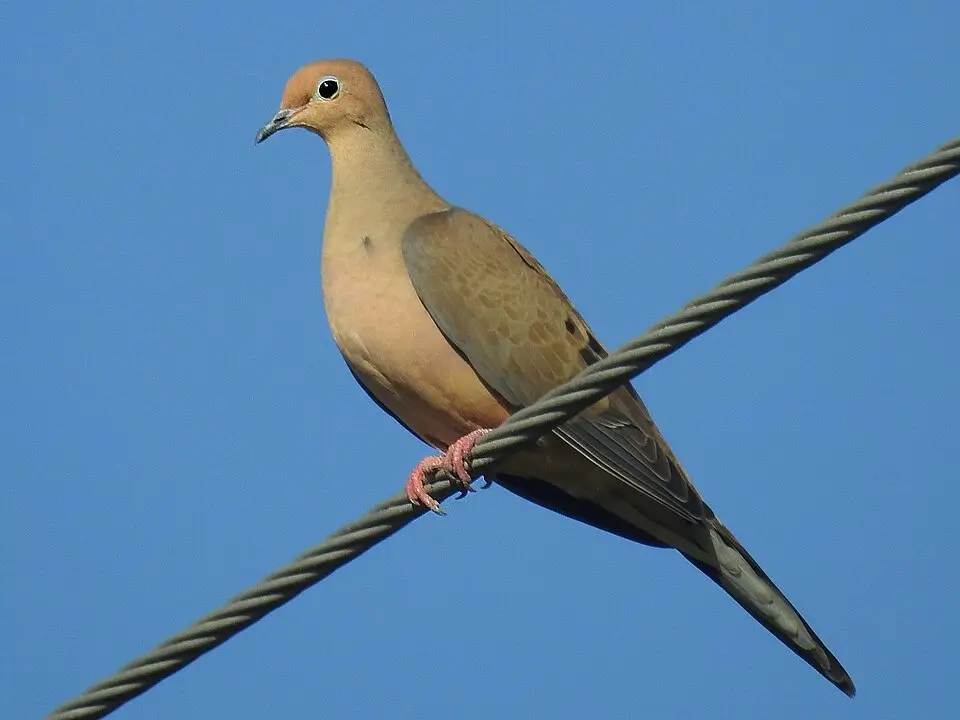
The Mourning Dove is a slender, graceful bird with a small rounded head and a long, tapered tail that makes it instantly recognizable in flight. Adults are generally a soft grayish-brown or buffy-tan color across the back and wings, with a pale pinkish or peachy wash on the breast and underparts. The wings often display small black spots, and the outer tail feathers are tipped in white, which creates a distinctive flash pattern when the bird takes flight.
One of the most notable features of the Mourning Dove is the iridescent patch of feathers found on the neck of adult birds, which shimmers with shades of pink and green in good light. The eyes are dark and surrounded by a ring of bare, pale blue-gray skin, giving the bird an almost gentle, expressive appearance. Adult males and females look very similar, though males tend to display slightly more vivid iridescence on the neck and a more pronounced pinkish hue on the breast.
In terms of size, the Mourning Dove is a medium-small bird, typically measuring between 9 and 13 inches in length, with a wingspan in the range of 17 to 19 inches. The bird is lightweight, contributing to its remarkable aerial speed and maneuverability. When flushed, Mourning Doves can accelerate rapidly and fly in erratic, twisting patterns that make them one of the more challenging birds to pursue in the field.
Perhaps one of the most endearing aspects of Mourning Dove biology is its voice. The species produces a distinctive, soft "coo-OO-oo-oo-oo" call that has long been associated with peaceful mornings and the quiet of the countryside. This mournful, almost melancholy sound is the origin of the bird's common name and has made it a beloved symbol in folklore and poetry across many cultures.
Mourning Doves are strong, fast fliers. They produce a characteristic whistling sound with their wings upon takeoff — a result of the air rushing through specially shaped primary feathers. This sound serves as an alarm signal, alerting other doves in the area to potential danger.
In terms of diet, Mourning Doves are almost exclusively granivorous, meaning they feed primarily on seeds. They forage on the ground, picking up seeds from a wide variety of grasses, weeds, agricultural crops, and wild plants. Corn, sunflower seeds, millet, wheat, and various weed seeds make up a large portion of their diet depending on the season and region. Unlike many birds, doves swallow seeds whole and store them temporarily in an expandable portion of the esophagus known as the crop before digestion. A single dove can consume a substantial volume of seeds in a single feeding session.
Mourning Doves are also one of the few bird species capable of drinking water by suction, submerging their bill and drawing water up continuously — a behavior more typical of mammals than birds.
Reproduction is another area where Mourning Doves stand out. They are prolific breeders, capable of raising multiple broods throughout a single breeding season, which can stretch from spring well into late summer in many parts of their range. Nests are simple, loosely constructed platforms of twigs, typically placed in the fork of a tree or shrub, though doves will also nest on the ground or on man-made structures. Clutch size is almost always exactly two eggs, which both parents take turns incubating. After hatching, the chicks — called squabs — are fed a protein-rich substance called "crop milk," a nutrient-dense secretion produced in the crops of both parents. This unique adaptation allows doves to rear young even in environments where high-protein insect food is scarce.
Habitat & Range
The Mourning Dove is one of the most widely distributed birds in North America. Its range extends across virtually the entire continental United States, much of Canada during the breeding season, Mexico, Central America, and into parts of the Caribbean. It is a year-round resident throughout most of the lower 48 states, though northern populations do migrate south during colder months.
The species demonstrates remarkable habitat flexibility. Mourning Doves thrive in open and semi-open environments, including agricultural fields, grasslands, open woodlands, roadsides, suburban neighborhoods, and desert scrub. They tend to favor areas with a combination of open ground for foraging, access to water, and nearby trees or shrubs for perching and nesting. This adaptability has allowed the Mourning Dove to flourish in human-altered landscapes, and the species is commonly observed in suburban parks, farms, and even urban edge habitats.
In the western United States, Mourning Doves are found in arid and semi-arid environments, making use of desert washes, irrigated agricultural areas, and riparian corridors. In the east, they are common in farmland mosaics interspersed with woodlot edges. Across the Great Plains, they are abundant wherever grain crops and water sources are available.
Hunting Information
Mourning Dove hunting is a cherished tradition across the United States and is widely recognized as one of the most popular forms of migratory bird hunting in the country. The pursuit of doves combines the social atmosphere of an outdoor gathering with genuine shooting challenge, as these birds' speed and unpredictable flight paths demand sharp reflexes and consistent marksmanship.
Dove hunting typically takes place near food sources such as harvested grain fields, sunflower fields, and areas near water, where doves congregate in numbers during the late summer and early fall. Hunters generally use shotguns and set up along flight paths or near feeding and watering locations, waiting for birds to pass within range.
Because the Mourning Dove is a migratory bird, hunting regulations in the United States are governed at the federal level by the U.S. Fish & Wildlife Service, which establishes frameworks for seasons, bag limits, and legal shooting hours. Individual states then set their specific seasons and limits within those federal frameworks. Regulations vary significantly from state to state, and hunters are always encouraged to consult the most current regulations from their state wildlife agency before taking to the field.
It is important to note that specific season dates, bag limits, and licensing requirements for Alaska were not available in the source data consulted for this article. Hunters planning to pursue Mourning Doves in Alaska or any other state should contact their state fish and wildlife agency directly for current, accurate regulatory information.
Conservation
The Mourning Dove enjoys a stable and healthy population status across most of its range, a testament to both its biological resilience and the careful management of regulated hunting. Conservation efforts for the species fall under the jurisdiction of the U.S. Fish & Wildlife Service's migratory bird programs, which monitor population trends through annual breeding bird surveys and other scientific assessments.
The species has demonstrated a remarkable ability to thrive alongside human land use. Agricultural landscapes in particular have provided abundant food resources that support large dove populations. Habitat conservation efforts that maintain open country, native grasslands, and clean water sources all contribute positively to Mourning Dove populations.
Hunters themselves play a meaningful role in dove conservation. Federal excise taxes collected through the Pittman-Robertson Act, paid on the purchase of firearms and ammunition, generate hundreds of millions of dollars annually for wildlife conservation and habitat restoration programs that benefit doves and countless other species.
The Mourning Dove serves as an important ecological link as well — as a seed disperser, as prey for raptors and other predators, and as an indicator of broader ecosystem health in open landscapes. Its enduring abundance is something worth celebrating and protecting for generations to come.