Mountain Goat (Oreamnos americanus): A Complete Guide for Wildlife Enthusiasts and Hunters
Few animals embody the spirit of wild, untamed wilderness quite like the mountain goat. With its brilliant white coat, sharp black horns, and seemingly effortless ability to navigate near-vertical cliff faces, Oreamnos americanus is one of North America's most iconic and captivating large mammals. Whether you are a wildlife enthusiast scanning alpine ridgelines with binoculars, a photographer chasing the perfect shot, or a hunter preparing for one of the most physically demanding pursuits the continent has to offer, the mountain goat commands respect and admiration in equal measure.
Found across the rugged peaks and rocky escarpments of western North America, the mountain goat is a symbol of resilience and adaptability. Its range extends from the Rocky Mountains northward through British Columbia and into the remote wilderness of Alaska — a state renowned for producing some of the most extraordinary wildlife experiences on Earth. Alaska, the largest and northernmost state in the United States, offers vast stretches of mountain terrain that provide ideal habitat for these remarkable animals. Understanding the biology, behavior, habitat, and conservation status of the mountain goat is essential for anyone who wishes to encounter or pursue this species responsibly and ethically.
Biological Traits
The mountain goat, known scientifically as Oreamnos americanus, is classified within the family Bovidae and the subfamily Caprinae, making it a relative of true goats, sheep, and chamois. Despite its common name, the mountain goat is not a true goat in the strictest taxonomic sense. It is, in fact, more closely related to Old World species such as the chamois and serow. The genus name Oreamnos is derived from Greek, roughly translating to "mountain lamb," while americanus reflects its exclusively North American range — the only place in the world where this species is found in the wild.
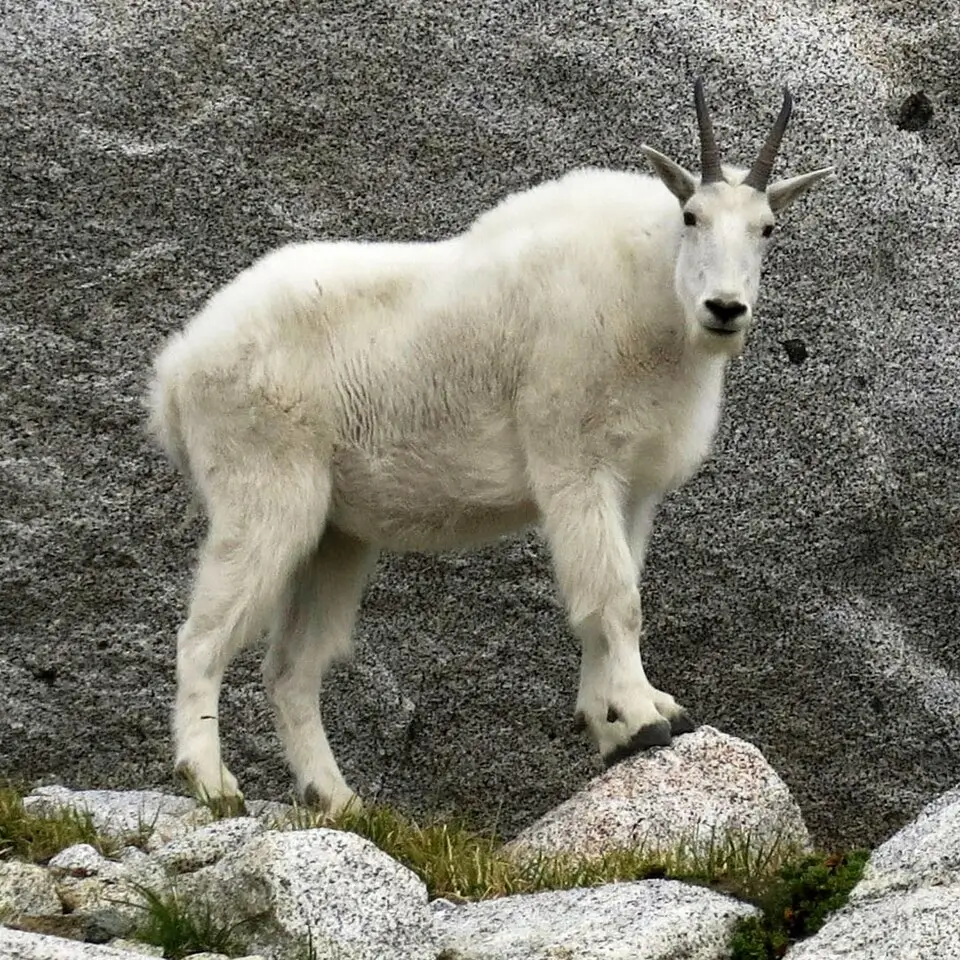
One of the most immediately recognizable features of the mountain goat is its striking white or cream-colored coat. This dense, woolly fur serves a critical thermoregulatory function, insulating the animal against the brutal cold of high-altitude winters. The coat consists of two layers: a fine, soft undercoat and a coarser outer layer of guard hairs that can reach several inches in length, particularly during the winter months. Come spring and summer, mountain goats shed this thick winter coat in dramatic, shaggy patches, giving them a somewhat ragged appearance during the molting season.
Both male and female mountain goats — known respectively as billies and nannies — possess sharp, slightly curved black horns. Unlike the antlers of deer, elk, and moose, these horns are permanent structures that are never shed. They grow throughout the animal's lifetime, and while they are present in both sexes, the horns of billies tend to be slightly longer and more robust. Interestingly, the horns can be used to estimate a mountain goat's age, as they develop annual growth rings, similar to the growth rings of a tree. A set of particularly long, well-developed horns is a prized trophy for hunters who undertake the formidable challenge of pursuing this species.
Mountain goats are well-known for their extraordinary surefootedness on steep, rocky terrain. This ability is no accident of nature — it is the result of several highly specialized anatomical adaptations. Their hooves are uniquely designed, featuring a hard outer edge that grips rock surfaces and a softer, concave inner pad that provides traction much like a natural climbing shoe. Dewclaws positioned higher on the leg also assist with stability on extreme slopes. Additionally, mountain goats have powerful shoulder and leg muscles that allow them to make precise, controlled movements on terrain that would be impassable for virtually any other large mammal.
Adult mountain goats are stocky, heavily built animals. Billies are generally larger than nannies, as is typical of many ungulate species. They possess a characteristic beard, or "goatee," and a pronounced shoulder hump that contributes to their distinctive silhouette. Their overall body structure — low center of gravity, strong forequarters, and short, sturdy legs — is perfectly engineered for life on the vertical world of alpine rock faces and cliff ledges.
Mountain goats are primarily grazers and browsers, consuming a wide variety of plant material including grasses, sedges, lichens, mosses, ferns, and woody browse depending on the season and elevation. In summer, they tend to feed at or above the treeline, taking advantage of the flush of alpine vegetation. In winter, they may descend slightly in elevation to access food beneath the snowpack, though they are remarkably capable of surviving in conditions that would challenge most other large herbivores.
Social structure among mountain goats is relatively loose compared to many other ungulates. Nannies typically live in small groups with their kids and yearlings, while adult billies tend to be more solitary, particularly outside of the November and December breeding season — known as the rut. During the rut, billies compete for access to nannies, though serious fighting is relatively rare due to the potentially lethal nature of their sharp horns. After a gestation period of roughly 150 to 180 days, nannies give birth to typically a single kid, though twins do occur. Kids are precocial — born with open eyes and the ability to stand and move within hours of birth — a critical survival adaptation given the precarious terrain in which they enter the world.
Habitat & Range
The mountain goat is exclusively a North American species, with its native range concentrated along the mountainous western regions of the continent. Its core range spans from the northern Rocky Mountains of the United States — including states such as Montana, Idaho, and Washington — northward through the Canadian Rockies of Alberta and British Columbia, and into the coastal ranges and interior mountain systems of Alaska.
Alaska, with its enormous expanse of wilderness and dramatic topography, represents a major stronghold for mountain goat populations. The state's rugged coastal mountains, including the Chugach Range, the Kenai Mountains, the Wrangell-St. Elias system, and the Boundary Ranges of the Southeast, all provide prime mountain goat habitat. These areas offer the steep, rocky cliffs and talus slopes that mountain goats depend upon not only for foraging but also for escape cover from predators such as wolves, bears, and golden eagles, which occasionally prey upon kids.
Elevation is a defining characteristic of mountain goat habitat. These animals are most commonly associated with alpine and subalpine zones, typically ranging from around 3,500 feet to well above 10,000 feet in elevation depending on the region. The sheer inaccessibility of their preferred terrain is one of the mountain goat's greatest defenses against both predators and human disturbance. It also makes any encounter with these animals — whether for hunting, wildlife viewing, or scientific study — a genuinely memorable and hard-earned experience.
Hunting Information
Hunting the mountain goat is widely considered one of the most demanding physical pursuits available to big game hunters in North America. The remote, high-altitude terrain that defines mountain goat habitat demands exceptional physical fitness, careful planning, and a willingness to endure challenging weather and strenuous hiking conditions. For many hunters, a mountain goat tag represents the culmination of years of preparation and dreaming.
In Alaska, mountain goat hunting is a regulated activity managed by the Alaska Department of Fish and Game. However, specific current season dates, license requirements, and harvest regulations for Alaska were not available in the source data used for this article. Hunters planning to pursue mountain goats in Alaska are strongly encouraged to consult directly with the Alaska Department of Fish and Game for the most current and accurate regulatory information prior to planning any hunt. Regulations can vary significantly by game management unit, and obtaining the correct licenses and permits is an absolute requirement.
What is consistent across virtually all jurisdictions where mountain goat hunting is permitted is the premium placed on fair chase ethics and wildlife conservation. Mountain goat populations, while stable in many areas, are generally not as numerous as other big game species, and hunting pressure is carefully managed to ensure the long-term health of local herds. Tags are often limited in number and may be allocated through draw systems.
The physical demands of a mountain goat hunt cannot be overstated. Hunters typically must be prepared for multi-day backcountry expeditions, often in areas accessible only by floatplane, helicopter, or extended foot travel. Shooting opportunities may present themselves at challenging angles and distances, and the work of packing out an animal from steep, remote terrain requires both physical endurance and sound wilderness skills. For those who are prepared, however, a successful mountain goat hunt in Alaska or any part of the species' range is an achievement of a lifetime.
Conservation
The mountain goat is currently listed as a species of least concern by major wildlife conservation bodies, reflecting the fact that its overall population remains reasonably stable across much of its range. Nevertheless, mountain goat populations are not without their vulnerabilities, and responsible wildlife management remains essential.
Mountain goats are particularly sensitive to habitat disturbance, especially during the critical winter months and during the kidding season in spring. Human encroachment into alpine habitats, whether through recreational activity, resource extraction, or infrastructure development, can stress local populations. Climate change also poses a longer-term concern, as shifting snowpack levels, vegetation changes at high elevations, and increased temperatures may gradually alter the quality and extent of suitable mountain goat habitat.
Wildlife managers in Alaska and across the species' range continue to monitor mountain goat populations carefully, using techniques such as aerial surveys, collaring programs, and harvest data analysis to track population trends and adjust management strategies accordingly. The collaboration between hunters, conservation organizations, wildlife agencies, and the public is vital to ensuring that future generations will continue to enjoy the sight of these remarkable white-coated climbers perched impossibly on a distant cliff face.