Common Snipe (Gallinago gallinago): A Complete Guide to North America's Most Elusive Upland Bird
Few birds in the hunting world carry as much mystique and tradition as the common snipe. For generations, the phrase "snipe hunting" has been used as a playful ruse to send unsuspecting newcomers on a wild goose chase — but make no mistake, the common snipe (Gallinago gallinago) is a very real, very challenging, and deeply rewarding quarry for those dedicated enough to pursue it. This remarkable shorebird has earned its reputation as one of the most difficult birds to hunt and observe in the wild, thanks to its cryptic camouflage, explosive flight, and preference for some of the most demanding terrain on earth.
The common snipe is a bird of paradoxes. It is simultaneously widespread and elusive, common in name but rarely seen by the casual observer. It is a shorebird that hunters classify among upland game. It is a migrant that travels thousands of miles yet returns faithfully to the same wetland meadows year after year. For birders, wildlife enthusiasts, and hunters alike, the common snipe represents one of nature's most intriguing success stories — a species perfectly engineered for survival in a world of mud, marsh, and mist.
This article explores everything worth knowing about the common snipe: its biology, behavior, habitat preferences, hunting traditions, and conservation status. Whether you are a seasoned snipe hunter, a curious birder, or simply someone who wants to understand one of the world's most fascinating wading birds, read on for a comprehensive look at Gallinago gallinago.
Biological Traits
The common snipe belongs to the family Scolopacidae, the large and diverse group of wading birds known as sandpipers. Within this family, snipe occupy the genus Gallinago, a group characterized by long bills, cryptic plumage, and a strong association with wetland habitats.
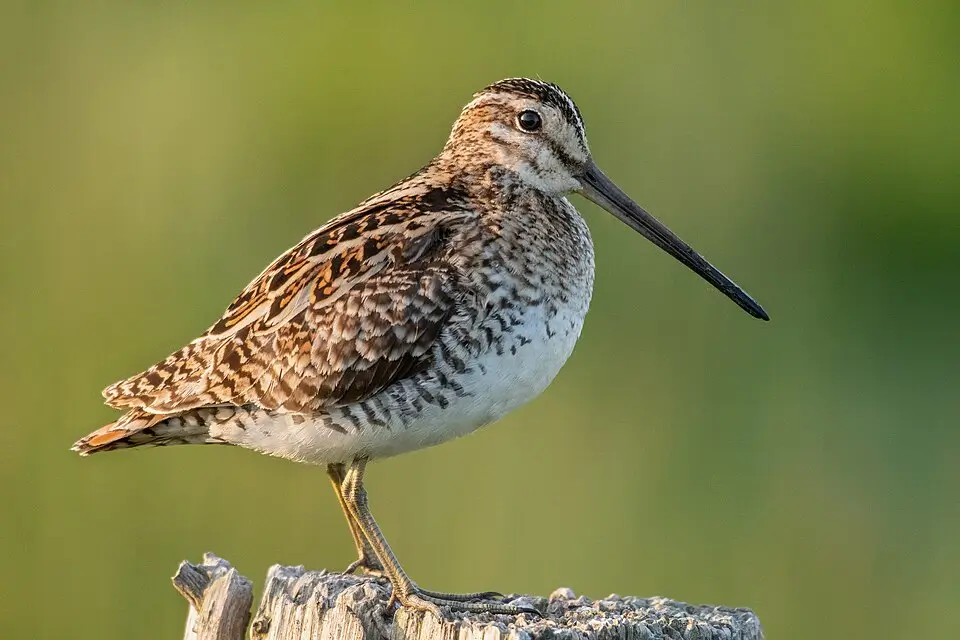
Physically, the common snipe is a medium-sized shorebird with a compact, robust body built for probing soft substrates in search of food. One of its most distinctive features is its extraordinarily long, straight bill — a sensitive, flexible tool that allows the bird to detect and extract invertebrates from mud and soft soil. The tip of the bill contains a dense concentration of nerve endings called Herbst corpuscles, which give the bird an almost tactile sense of what lies beneath the surface, allowing it to locate earthworms, insect larvae, and other invertebrates without even seeing them.
The plumage of the common snipe is a masterwork of natural camouflage. Browns, buffs, blacks, and creams are woven together in intricate streaked and barred patterns that render the bird nearly invisible against a backdrop of dead grass, sedges, and muddy ground. Bold pale stripes run along the crown and back, breaking up the bird's outline when it crouches motionless among vegetation. This cryptic patterning is so effective that a snipe can sit within arm's reach of a passing observer and remain completely undetected.
When flushed, the common snipe reveals a dramatically different side of its character. It erupts from cover with an explosive burst of speed, uttering a sharp, raspy call often described as "scaipe" as it zigzags unpredictably into the sky. This erratic, twisting flight — developed over millennia as a defense against predators — is precisely what makes the snipe such a challenging target for hunters. The bird's ability to change direction rapidly and climb steeply in a matter of seconds has humbled even the most experienced wing shooters.
One of the most celebrated displays in the avian world is the common snipe's "winnowing" — a haunting, trembling sound produced during its aerial courtship display. Rather than being a vocalization, this distinctive sound is created mechanically by air rushing over the bird's stiff outer tail feathers as it dives at speed during breeding displays. The result is an eerie, pulsating hum that carries across open marshes at dusk and dawn, a sound that has enchanted naturalists and hunters for centuries.
Common snipe are generally solitary outside of the breeding season, though loose aggregations known as "wisps" may gather in particularly productive feeding areas. The term "wisp" is the collective noun for snipe, a poetic label that suits these ghostly marsh birds perfectly.
Habitat & Range
The common snipe enjoys one of the broadest distributions of any shorebird species. It breeds across a vast swath of the Northern Hemisphere, from Iceland and the British Isles in the west, through continental Europe, Russia, and Siberia, all the way to the Kamchatka Peninsula in the far east. In North America, the common snipe — once considered a subspecies of the Wilson's snipe (Gallinago delicata) — has a presence in the northern and western portions of the continent, with Alaska representing a particularly important part of its North American range.
Alaska's mosaic of boggy tundra, sedge meadows, wet grasslands, river deltas, and boreal wetlands provides ideal conditions for common snipe during the breeding season. The state's vast and largely undisturbed wetland systems offer both nesting habitat and abundant food resources, making it a stronghold for the species in North America.
In general, common snipe are strongly associated with wet, open habitats. They favor the edges of marshes, bogs, wet meadows, river floodplains, and agricultural fields with waterlogged soils. The key requirement is soft, moist substrate that the bird can probe with its sensitive bill. Dense but low vegetation is also important, providing both cover from predators and nesting concealment.
During migration, common snipe can appear in a remarkably wide variety of wetland habitats, from coastal estuaries and inland marshes to flooded fields and the margins of ponds and streams. Their ability to exploit a diverse range of wetland types makes them resilient travelers, capable of fueling up almost anywhere suitable water and soft ground coincide.
In winter, common snipe move south to warmer latitudes, occupying similar wetland habitats across lower North America, Europe, Africa, and South Asia. They are famously secretive in all seasons, and even in wintering areas where birds are relatively numerous, actually seeing a snipe requires patience, keen eyes, and often a good deal of luck.
Hunting Information
The common snipe has a long and storied history as a game bird. In fact, the word "sniper" — used today to describe a skilled long-range marksman — is derived directly from snipe hunting. Soldiers who were skilled enough to shoot snipe in the field, given the bird's extraordinary evasiveness, were considered the finest marksmen of their time. This linguistic legacy speaks volumes about the challenge this small bird presents to those who pursue it.
Snipe hunting is a wing-shooting tradition that demands patience, persistence, and genuine skill. Unlike many upland game birds that hold well for pointing dogs, snipe are notorious for flushing wild and flying in unpredictable patterns. Hunters must be prepared for fast, instinctive shooting as the bird erupts from cover and begins its trademark zigzagging escape.
Hunting snipe typically involves working slowly through suitable wet habitat — boggy meadows, marsh edges, wet fields — and being ready for the explosive flush at any moment. Dogs, particularly spaniels and retrievers, can be valuable partners in snipe hunting, as they help locate and flush birds from dense cover and retrieve downed birds from wet or challenging terrain. The combination of demanding habitat, difficult shooting, and the sheer unpredictability of the quarry makes a successful snipe hunt a genuine accomplishment.
For hunters in Alaska and other states where snipe seasons are established, it is essential to consult the most current regulations from the relevant state or federal wildlife agency before heading afield. Bag limits, season dates, and licensing requirements can vary by region and year, and regulations are subject to change. Hunters should always verify current rules through official sources such as the Alaska Department of Fish and Game or the U.S. Fish & Wildlife Service prior to any hunting activity.
Appropriate equipment for snipe hunting typically includes an open-choked shotgun to allow for the wide, fast swings required by the bird's erratic flight. Light loads are commonly used, as snipe are not large birds, and heavy shot is generally unnecessary. Waterproof boots and clothing are strongly recommended, as snipe habitat is by definition wet and often muddy.
Conservation
The common snipe is currently listed as a species of Least Concern by the International Union for Conservation of Nature (IUCN), reflecting its large global population and wide distribution. Across much of its range, the species maintains healthy numbers, and there is no evidence of rapid or sustained population decline that would warrant a higher level of concern at this time.
That said, like virtually all wetland-dependent species, the common snipe faces ongoing pressures from habitat loss and degradation. Wetland drainage for agriculture, urban development, and water management has reduced available habitat in many parts of the bird's range, particularly in Europe and intensively farmed regions of North America. Changes in agricultural practices — such as the drainage of wet pastures and meadows — have also affected the availability of suitable breeding and foraging habitat in some areas.
Climate change represents an emerging and potentially significant concern for common snipe and other wetland species. Changes in precipitation patterns, permafrost thaw, and the timing of seasonal events could alter the character and availability of wetland habitats across the bird's breeding range, particularly in high-latitude areas like Alaska where the pace of environmental change is especially rapid.
Conservation efforts that benefit snipe include wetland protection and restoration programs, the maintenance of traditionally managed wet grasslands and meadows, and broader initiatives to address the root causes of wetland loss. In many regions, hunters and hunting organizations have been among the most active and financially significant supporters of wetland conservation, recognizing that healthy wetlands are essential not only for game birds but for the full spectrum of wildlife that depends on these critical ecosystems.
The common snipe's remarkable adaptability and broad habitat tolerance give it a degree of resilience that many more specialized species lack. With continued attention to wetland conservation and responsible wildlife management, this iconic marsh bird should remain a fixture of northern wetlands for generations to come.
Conclusion
The common snipe is far more than the punchline of a camping joke. It is a genuinely extraordinary bird — a master of camouflage, an athletic flier, a long-distance migrant, and a worthy quarry for dedicated hunters. Its haunting winnowing display, cryptic beauty, and association with wild, wet places make it one of the most compelling species in the avian world. Whether you encounter a common snipe as a birder, a hunter, or simply a curious observer of the natural world, the experience is one unlikely to be forgotten.