Common Pheasant (Phasianus colchicus): A Celebrated Game Bird of Field and Forest
Few birds in the world command as much recognition among hunters, wildlife enthusiasts, and casual observers alike as the Common pheasant (Phasianus colchicus). With its unmistakable flash of iridescent color, its explosive flushing behavior, and its deep cultural roots in hunting traditions spanning multiple continents, the Common pheasant occupies a truly unique place in the natural world and in the heritage of outdoor sporting life.
Originally native to Asia — stretching from the Caucasus region through China and into Southeast Asia — the Common pheasant has been introduced to nearly every corner of the globe. Today, it thrives across Europe, North America, Australia, New Zealand, and parts of South America, making it one of the most widely distributed game birds on the planet. Whether you encounter one strutting boldly across a farm field in the American Midwest, bursting from a hedgerow in the English countryside, or calling from the edges of a wetland marsh, the Common pheasant is a bird that never fails to captivate.
Its story is one of remarkable adaptability, biological elegance, and enduring appeal — to farmers, conservationists, and hunters alike. Understanding this bird more deeply only enriches the experience of observing or pursuing it in the wild.
Biological Traits
The Common pheasant is a member of the family Phasianidae, which includes turkeys, quail, grouse, and peacocks — a distinguished family of ground-dwelling birds renowned for their often spectacular plumage and their ecological importance worldwide.
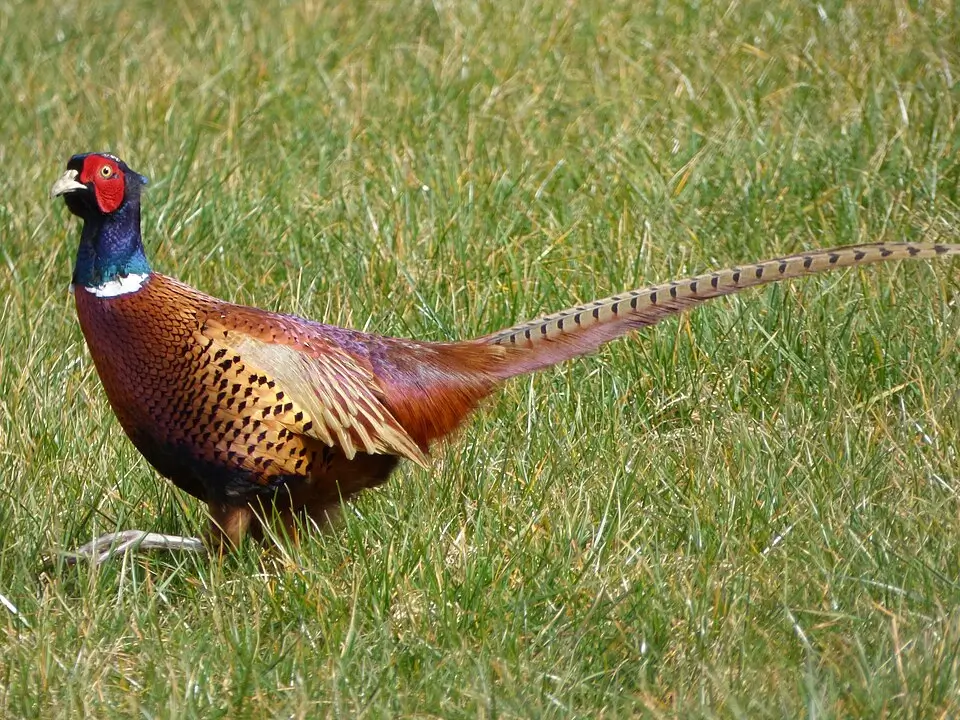
One of the most immediately striking features of the species is its profound sexual dimorphism, meaning that males and females look dramatically different from one another. Male Common pheasants — known as cocks or roosters — are among the most visually stunning birds found in any temperate landscape. They sport a rich tapestry of copper, gold, brown, and chestnut body feathers, often with intricate black scaling or spotting across the back and flanks. The head and neck gleam with deep greens and purples, accented by vivid red facial wattles that flush even more brilliantly during courtship displays. A white neck ring, present in many subspecies and introduced populations, adds a further bold accent to the male's appearance. Perhaps most iconic of all is the cock pheasant's extraordinarily long, barred tail, which can account for a substantial portion of the bird's total body length and sweeps elegantly behind the bird in flight.
Female pheasants, called hens, present a very different appearance. Their plumage is composed of muted tans, browns, and buffs, beautifully patterned with darker streaking and mottling. This cryptic coloration serves an essential survival function — a nesting hen must remain as invisible as possible while incubating eggs on the ground, and her earth-toned feathers allow her to blend seamlessly into grasses, leaf litter, and undergrowth.
The Common pheasant is a polygamous species, meaning that a single dominant male will typically mate with multiple hens within a territory during the breeding season. Males are highly territorial and vocal, producing their characteristic loud, sharp crow — a two-note call that carries impressively across open farmland and woodland edges. This calling behavior intensifies during the spring breeding season, as males work to attract females and deter rival cocks.
Hens are responsible for all nest construction and incubation duties. They build simple scrape nests on the ground, lined with grasses and leaves, typically concealed beneath dense vegetation. Clutch sizes can be substantial, often ranging from around eight to fifteen eggs, though larger clutches have been recorded. The incubation period lasts approximately three to four weeks, after which the precocial chicks hatch and are almost immediately capable of moving and foraging alongside their mother. Pheasant chicks grow rapidly and develop flight capability within just a few weeks of hatching — a critical survival adaptation given the many predators that threaten ground-nesting birds.
As omnivores, Common pheasants consume a wide and flexible diet. Seeds, grains, berries, and plant matter form the bulk of their food intake, particularly during fall and winter months. During spring and summer, they actively supplement their diet with insects, worms, snails, and other invertebrates — a behavior that also benefits chick development, as young pheasants require protein-rich insect prey during their early weeks of life. This dietary flexibility is one reason the species has proven so adept at colonizing and thriving in agricultural landscapes around the world.
Habitat & Range
The Common pheasant's native range spans an impressive geographic arc across Asia, from the foothills of the Caucasus Mountains in Georgia and Azerbaijan, across Central Asia, through China, Korea, and into the islands of Japan. Within this native range, the species inhabits a diverse array of environments, including forest edges, river valleys, scrublands, reed beds, and agricultural land.
However, it is the pheasant's introduced range that truly speaks to its remarkable adaptability. Beginning with introductions to Greece and Rome in antiquity, and accelerating dramatically through medieval and modern European history, the Common pheasant has been deliberately released and established on nearly every continent with a suitable temperate climate.
In North America, pheasants were successfully introduced in the late 19th century, with early populations establishing themselves in the Pacific Northwest before spreading across the continent. The species found particularly hospitable conditions across the agricultural heartland of the United States and Canada, where a mosaic of grain fields, grasslands, wetland margins, and brushy cover provides an ideal mix of food and shelter. States like South Dakota, Kansas, Nebraska, Iowa, and the Dakotas became legendary pheasant country, drawing hunters from across the country each fall.
The species shows a clear preference for landscapes that blend open agricultural areas with nearby cover. Hedgerows, woodland edges, shelterbelts, wetland fringes, tallgrass prairies, and ungrazed fence lines all serve as critical components of quality pheasant habitat. These cover features provide roosting sites, thermal protection during harsh winters, escape routes from predators, and nesting opportunities during the breeding season.
In regions with severe winter conditions, access to reliable food sources — such as standing corn, waste grain, and wild berries — and dense thermal cover like cattail marshes or conifer plantings can be decisive factors in determining pheasant population health and survival rates.
Hunting Information
The Common pheasant is one of the most pursued game birds in the world, and for good reason. Its combination of spectacular appearance, challenging behavior, and excellent table quality makes it a prized quarry for hunters across its introduced range. The bird's tendency to run ahead of hunters before eventually flushing with an explosive burst of wings and a loud cackle creates an adrenaline-charged hunting experience that is genuinely difficult to match.
Pheasant hunting is deeply embedded in the cultural traditions of many nations. In the United Kingdom, driven pheasant shoots have been a cornerstone of rural sporting life for centuries. In North America, the tradition of walking fields with pointing dogs — Pointers, Setters, Brittanys — or flushing breeds like Labrador Retrievers and Springer Spaniels is one of the most beloved rituals of the upland hunting calendar.
Because the source data and official state hunting information for Alaska were not retrievable at the time of writing, hunters interested in pursuing pheasants in Alaska or any other specific state or region are strongly encouraged to consult directly with their state or territorial wildlife agency for the most current and accurate season dates, licensing requirements, bag limits, and any applicable regulations. Hunting regulations vary significantly by location and are updated regularly to reflect current population assessments and management objectives.
Generally speaking, pheasant hunting seasons in temperate North America are timed to occur in the fall and early winter, after the breeding season has concluded and young birds have fully matured. Many states and provinces offer both resident and non-resident hunting licenses, and some public lands, wildlife management areas, and walk-in hunting access programs provide publicly accessible pheasant hunting opportunities alongside private land access.
Conservation
The Common pheasant, as a species, is currently classified as a species of Least Concern on the International Union for Conservation of Nature (IUCN) Red List, owing to its enormous global population and extraordinarily wide introduced range. In terms of sheer abundance, it ranks among the most numerous game birds in the world, with hundreds of millions of birds present across its combined native and introduced range.
That said, in many parts of its introduced range — including regions of North America and the United Kingdom — wild pheasant populations have experienced notable declines in recent decades. These declines are generally attributed to large-scale agricultural intensification, including the loss of hedgerows, reduction in winter stubble fields, increased use of pesticides that reduce insect availability for chicks, and the general homogenization of farmland landscapes that once offered diverse, pheasant-friendly habitat.
Conservation and habitat management efforts focused on improving conditions for wild pheasants frequently benefit a much broader community of farmland wildlife, including songbirds, pollinators, small mammals, and other ground-nesting bird species. Practices such as planting wildlife-friendly cover crops, maintaining hedgerows and field margins, reducing pesticide use, and establishing brushy shelterbelts contribute positively to overall farmland biodiversity.
Hunting organizations, conservation groups, and wildlife agencies have all played meaningful roles in supporting pheasant habitat through land management programs, research initiatives, and public education campaigns. The continued health of wild pheasant populations depends significantly on the stewardship of agricultural landscapes and the thoughtful management of both habitat and harvest.