Canada Goose (Branta canadensis): A Complete Guide to North America's Most Iconic Waterfowl
Few sights in the natural world are as immediately recognizable as a V-formation of Canada geese cutting across an autumn sky, their resonant honking carrying across fields and waterways below. The Canada goose (Branta canadensis) is arguably the most iconic waterfowl species in North America — a bird so deeply woven into the cultural and ecological fabric of the continent that its image has become synonymous with the changing of seasons. From the tundra breeding grounds of the far north to the sprawling urban parks of the southern United States, this species has demonstrated a remarkable adaptability that few other large birds can match.
Whether you are a passionate waterfowl hunter heading afield in waders on a cold October morning, a wildlife photographer seeking that perfect shot at sunrise, or simply a nature lover who pauses to watch a family of geese navigate a local pond, the Canada goose holds a special place in the outdoor experience. This article takes a comprehensive look at the biology, habitat, behavior, hunting traditions, and conservation story of one of North America's greatest wildlife success stories.
Biological Traits
The Canada goose belongs to the family Anatidae — the broad family that encompasses all ducks, geese, and swans. Within this family, it falls under the genus Branta, a group commonly referred to as the "black geese," which also includes the Brant (Branta bernicla) and the Barnacle goose (Branta leucopsis).
One of the most striking things about Branta canadensis as a species is the sheer variation it encompasses. Taxonomists have historically recognized multiple subspecies of the Canada goose, with some of the smaller subspecies at times being reclassified as a separate species altogether — the Cackling goose (Branta hutchinsii). The size difference between the largest and smallest forms of these birds is extraordinary, with the largest subspecies, such as the Giant Canada goose (B. c. maxima), capable of reaching weights of over 20 pounds and wingspans exceeding five feet. The smallest forms, by contrast, are barely larger than a Mallard duck.
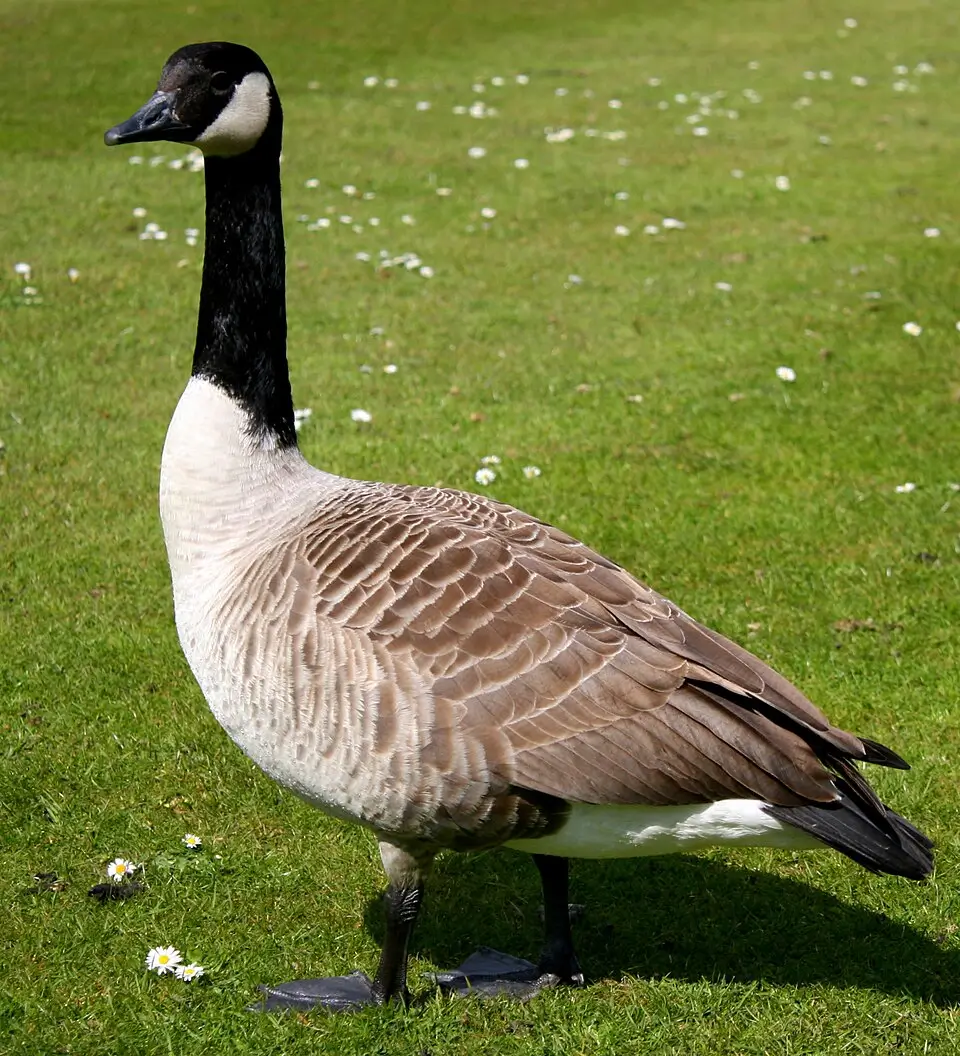
Despite this variation, all Canada geese share the same unmistakable plumage pattern that makes them so easy to identify in the field. The head and neck are jet black, with a distinctive white chin patch — often called a "chinstrap" — that extends across the cheeks. The body feathers range from rich brown on the back and wings to a lighter, often cream or tan coloration on the breast and flanks. The tail and rump are white, and the bill and feet are black. This bold, high-contrast pattern is consistent across all recognized subspecies, making the Canada goose one of the easiest waterfowl species to identify at a glance.
Canada geese are highly social animals. Outside of the breeding season, they congregate in large flocks that can number into the thousands, feeding together, roosting together, and traveling together on migration. They communicate using a variety of vocalizations, the most famous of which is the deep, resonant two-note "honk" that carries great distances. Within flocks, there is a complex social hierarchy, and individuals are capable of recognizing one another.
These geese are also well known for their strong pair bonds and devoted parental behavior. Canada geese are largely monogamous and will often mate for life. Breeding pairs return to the same nesting areas year after year, and both parents are intensely involved in raising their goslings. The female incubates the eggs while the male stands guard nearby, and both parents aggressively defend the nest and young against potential predators. Goslings are precocial — meaning they hatch fully covered in down and are capable of walking and swimming within hours of hatching. The family group typically remains together through the first year of the young birds' lives, with the parents guiding the juveniles through their first migration.
The diet of Canada geese is primarily herbivorous. They are grazers by nature, feeding heavily on grasses, sedges, agricultural grains, and aquatic vegetation. Their broad, serrated bills are well adapted for cropping grass close to the ground, and their strong necks allow them to reach vegetation both on land and in shallow water. This dietary flexibility is a key reason why Canada geese have been so successful in adapting to human-altered landscapes.
Habitat & Range
The Canada goose has one of the broadest ranges of any waterfowl species in North America. Breeding populations are found from the high Arctic tundra of northern Canada and Alaska all the way down through the temperate regions of the continental United States. Migratory populations travel impressive distances between their northern breeding grounds and their southern wintering areas, following well-established flyways that include the Atlantic, Mississippi, Central, and Pacific corridors.
In Alaska, Canada geese are a significant component of the waterfowl fauna. The state's vast wilderness — encompassing boreal forests, coastal wetlands, river deltas, and interior lake systems — provides outstanding breeding and staging habitat for these birds. River deltas, sedge meadows, and lakeshores offer the combination of open water, abundant vegetation, and nesting cover that Canada geese require during the breeding season.
Beyond their traditional migratory range, Canada geese have also established large, year-round resident populations throughout much of the lower 48 states. These so-called "resident" or "urban" populations have made use of golf courses, city parks, corporate campuses, and suburban retention ponds. The adaptability that makes this species so biologically successful is plainly evident in these urban populations, which have learned to thrive alongside dense human development.
Preferred habitats include freshwater lakes, rivers, marshes, agricultural fields, and coastal estuaries. Canada geese are equally at home feeding in a flooded cornfield as they are grazing on a grassy riverbank, and this dietary and habitat flexibility gives them a competitive advantage in a wide range of environments.
Hunting Information
Canada goose hunting is a beloved tradition across North America and represents one of the most popular forms of waterfowl hunting on the continent. The pursuit of Canada geese combines careful scouting, skilled calling, realistic decoy spreads, and the camaraderie of hunting with friends and family in the open air — often at the crack of dawn on a crisp autumn morning.
Hunters typically pursue Canada geese using layout blinds or pit blinds concealed in agricultural fields, or from blinds constructed along the edges of water bodies where geese are known to feed, loaf, or roost. Decoy spreads can range from a handful of full-body decoys to elaborate setups involving dozens of shells, full-bodies, and windsock decoys. Calling is an important skill, and experienced hunters use a variety of calls — from the classic two-note honk to clucks, moans, and feeding chuckles — to bring geese within range.
Because Canada geese are a migratory waterfowl species, their hunting seasons, bag limits, and licensing requirements in Alaska and throughout the United States are regulated under the framework of the Migratory Bird Treaty Act. Hunters are required to obtain the appropriate state and federal licenses and stamps before pursuing these birds. Regulations can vary significantly by zone, season type (early, regular, or late season), and subspecies. Hunters are strongly encouraged to consult the Alaska Department of Fish and Game and the U.S. Fish and Wildlife Service for the most current and location-specific regulations before heading afield.
Conservation
The conservation story of the Canada goose is one of the most remarkable wildlife management successes in North American history. By the early 20th century, market hunting, habitat loss, and egg collection had dramatically reduced populations across much of the continent. The Giant Canada goose (B. c. maxima) was at one point believed to be extinct.
Thanks to the combined efforts of wildlife managers, conservation organizations, and hunters — whose license fees and excise taxes on equipment fund critical habitat programs through mechanisms such as the Federal Duck Stamp and the Pittman-Robertson Act — Canada goose populations have rebounded spectacularly. Today, the species is abundant and widespread, and well-regulated hunting plays an active role in sustainable population management.