Also known as: Sand Bass, Barfish, Streaker, Silver Bass
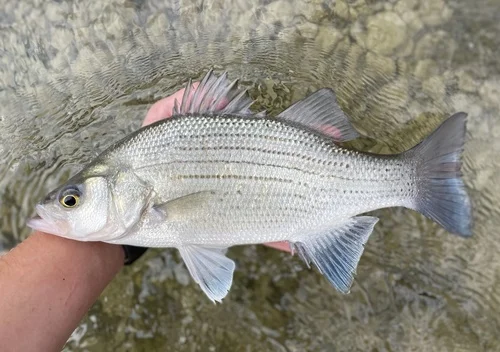
Game fish - see statewide bag & size limits and lake-specific exceptions Morone is of unknown derivation. The species epithet chrysops is Greek meaning "golden eye." As with other true basses, the dorsal fin is clearly double, separated into spiny and soft-rayed portions. White bass are silvery shading from dark-gray or black on the back to white on the belly. Several incomplete lines or stripes run horizontally on each side of the body. Adults resemble young striped bass, and the two are often confused. However, striped bass have two distinct tooth patches on the back of the tongue, and white bass have one tooth patch. Striped bass have two sharp points on each gill cover, as opposed to white bass which have one, and the second spine on the anal fin is about half the length of the third spine in striped bass, whereas it is about two-thirds the length of the third spine in white bass.
Life History: White bass are active early spring spawners. Schools of males migrate upstream to spawning areas as much as a month before females. There is no nest preparation. Spawning occurs either near the surface, or in midwater. Running water with a gravel or rock substrate is preferred. Females rise to the surface and several males crowd around as the eggs and sperm are released. Large females sometimes release nearly a million small eggs during the spawning season. After release eggs sink to the bottom and become attached to rocks, hatching in 2-3 days. Fry grow rapidly, feeding on small invertebrates. White bass may grow eight or nine inches during the first year. Adults are usually found in schools. Feeding occurs near the surface where fish, crustaceans, and emerging insects are found in abundance. Gizzard and threadfin shad are the preferred food items. White bass more than four years of age are rare.
Distribution: White bass are native to the the central US west of the Appalachians, including the Great Lakes, as well as river systems in the Ohio and Mississippi river valleys. In Texas the species is native to the Red River drainage.
Other: White bass are the fifth most preferred species among licensed Texas anglers. Schools of white bass feeding on shad generate much excitement in the fishing community. Once a school has been located, successful anglers often fish the surface with spoons or spinners. Bottom fishing at night with live bait may also produce great success. White bass are excellent fighters, and are considered superb table fare.
Life History
White bass are active early spring spawners. Schools of males migrate upstream to spawning areas as much as a month before females. There is no nest preparation. Spawning occurs either near the surface, or in midwater. Running water with a gravel or rock substrate is preferred. Females rise to the surface and several males crowd around as the eggs and sperm are released. Large females sometimes release nearly a million small eggs during the spawning season. After release eggs sink to the bottom and become attached to rocks, hatching in 2-3 days. Fry grow rapidly, feeding on small invertebrates. White bass may grow eight or nine inches during the first year. Adults are usually found in schools. Feeding occurs near the surface where fish, crustaceans, and emerging insects are found in abundance. Gizzard and threadfin shad are the preferred food items. White bass more than four years of age are rare.
License & Regulations
A valid Texas fishing license is required for anglers age 17 and older. Licenses are available for residents, non-residents, and short-term durations (1-day, 5-day, and annual). Freshwater and saltwater endorsements may be required for certain waters. Purchase online through the Texas Parks and Wildlife Department website or at authorized license retailers throughout the state.
Frequently Asked Questions
Life History
White bass are active early spring spawners. Schools of males migrate upstream to spawning areas as much as a month before females. There is no nest preparation. Spawning occurs either near the surface, or in midwater. Running water with a gravel or rock substrate is preferred. Females rise to the surface and several males crowd around as the eggs and sperm are released. Large females sometimes release nearly a million small eggs during the spawning season. After release eggs sink to the bottom and become attached to rocks, hatching in 2-3 days. Fry grow rapidly, feeding on small invertebrates. White bass may grow eight or nine inches during the first year. Adults are usually found in schools. Feeding occurs near the surface where fish, crustaceans, and emerging insects are found in abunda
Distribution
White bass are native to the the central US west of the Appalachians, including the Great Lakes, as well as river systems in the Ohio and Mississippi river valleys. In Texas the species is native to the Red River drainage.
Regulations
Texas fishing regulations apply to White Bass. A valid Texas fishing license is required for anglers 17 and older. Bag and size limits vary by species and water body. Some species have catch-and-release only restrictions or special tournament regulations. Check the Texas Parks and Wildlife Outdoor Annual for current regulations specific to your fishing location. Possession limits in Texas are twice the daily bag limit unless otherwise noted.
References
| State | Category | Directory | Subcategory | Content | Source |
|---|---|---|---|---|---|
| Texas | Fishing | License | License & Fees | A valid Texas fishing license is required for anglers age 17 and older. Licenses are available for residents, non-reside | Link |