Also known as: Hard Heads, King Billies, Grumblers
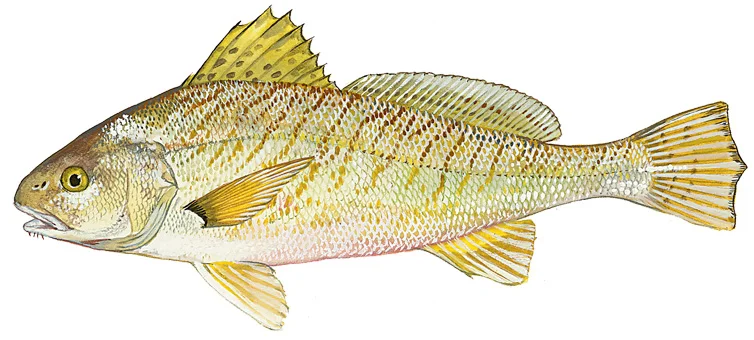
Atlantic croaker are about 12 inches (30 cm) long and weigh 1/2 to 2 pounds (226 g to 0.9 kg) on average. Its distinguishing characteristics include three to five pairs of small barbels or "whiskers" on their chins to help them feel for food on the sea floor; a lateral line that extends to the tip of its caudal (tail) fin; inferior mouth (located to the bottom of the head facing the ground), and brown vertical stripes on its sides. Adults are silver with a pinkish cast, while young are silvery and iridescent. Older fish are brassy in color with vertical brown streaks formed by spots that are on their scales.
Life History: The Atlantic croaker is a very important commercial fish. Millions of pounds are caught and sold every year in the United States and exported to other countries. The annual catch of croaker has declined in the past few years, probably due to over fishing. The best times for fishing for Atlantic croaker are from summer into the fall. They are easily caught on bait (dead shrimp) when fishing on the bottom. Small Atlantic croaker are used as a bait fish to catch other fish, especially spotted seatrout (Cynoscion nebulosis) and crabs. Atlantic croaker "croak" by vibrating their swim bladders with special muscles as part of their spawning ritual. A swim bladder is a pocket full of air inside the fish that helps keep it afloat and facing upright. This behavior attracts females. Along the Gulf Coast, they reach sexual maturity at about one year old. This varies in other areas. Spawning season is in the fall, with a peak between August and October. During spawning season, females will release between 100,000 and 2 million eggs, each about 0.35 mm in diameter. After hatching, the larvae (immature stage) drift toward land. They are abundant on soft bottoms, such as mud, where there are large amounts of detritus for them to feed on. The Atlantic croaker's diet includes shrimp, crabs, and detritus (dead and decomposing plant and animal matter). Atlantic croaker can live up to eight years. Their predators include striped bass, shark, spotted seatrout, other croakers, and humans. Croaker t
Distribution: The Atlantic croaker is found on the Atlantic coast from Massachusetts southward and throughout the Gulf of Mexico.
Other: The Atlantic croaker is one of the most abundant fishes in North American coastal waters. It is an important commercial fish as well as an important sport fish.
Habitat & Range
Atlantic croaker prefer estuaries and bays through the spring and summer, then travel offshore in the fall to breed.
Life History
The Atlantic croaker is a very important commercial fish. Millions of pounds are caught and sold every year in the United States and exported to other countries. The annual catch of croaker has declined in the past few years, probably due to over fishing. The best times for fishing for Atlantic croaker are from summer into the fall. They are easily caught on bait (dead shrimp) when fishing on the bottom. Small Atlantic croaker are used as a bait fish to catch other fish, especially spotted seatrout (Cynoscion nebulosis) and crabs. Atlantic croaker "croak" by vibrating their swim bladders with special muscles as part of their spawning ritual. A swim bladder is a pocket full of air inside the fish that helps keep it afloat and facing upright. This behavior attracts females. Along the Gulf Coast, they reach sexual maturity at about one year old. This varies in other areas. Spawning season is in the fall, with a peak between August and October. During spawning season, females will release between 100,000 and 2 million eggs, each about 0.35 mm in diameter. After hatching, the larvae (immature stage) drift toward land. They are abundant on soft bottoms, such as mud, where there are large amounts of detritus for them to feed on. The Atlantic croaker's diet includes shrimp, crabs, and detritus (dead and decomposing plant and animal matter). Atlantic croaker can live up to eight years. Their predators include striped bass, shark, spotted seatrout, other croakers, and humans. Croaker that live in the northern part of their range mature later and live longer than those in the southern part of their range. Because of predation, more than 95% of the Atlantic croaker population dies every year. Atlantic croaker should not be eaten raw because they may pass trematodes (parasites) to humans. The croaker is closely related to spotted seatrout and red drum.
License & Regulations
A valid Texas fishing license is required for anglers age 17 and older. Licenses are available for residents, non-residents, and short-term durations (1-day, 5-day, and annual). Freshwater and saltwater endorsements may be required for certain waters. Purchase online through the Texas Parks and Wildlife Department website or at authorized license retailers throughout the state.
Frequently Asked Questions
Life History
The Atlantic croaker is a very important commercial fish. Millions of pounds are caught and sold every year in the United States and exported to other countries. The annual catch of croaker has declined in the past few years, probably due to over fishing. The best times for fishing for Atlantic croaker are from summer into the fall. They are easily caught on bait (dead shrimp) when fishing on the bottom. Small Atlantic croaker are used as a bait fish to catch other fish, especially spotted seatrout (Cynoscion nebulosis) and crabs. Atlantic croaker "croak" by vibrating their swim bladders with special muscles as part of their spawning ritual. A swim bladder is a pocket full of air inside the fish that helps keep it afloat and facing upright. This behavior attracts females. Along the Gulf Co
Habitat
Atlantic croaker prefer estuaries and bays through the spring and summer, then travel offshore in the fall to breed.
Distribution
The Atlantic croaker is found on the Atlantic coast from Massachusetts southward and throughout the Gulf of Mexico.
Regulations
Texas fishing regulations apply to Atlantic Croaker. A valid Texas fishing license is required for anglers 17 and older. Bag and size limits vary by species and water body. Some species have catch-and-release only restrictions or special tournament regulations. Check the Texas Parks and Wildlife Outdoor Annual for current regulations specific to your fishing location. Possession limits in Texas are twice the daily bag limit unless otherwise noted.
References
| State | Category | Directory | Subcategory | Content | Source |
|---|---|---|---|---|---|
| Texas | Fishing | License | License & Fees | A valid Texas fishing license is required for anglers age 17 and older. Licenses are available for residents, non-reside | Link |