Also known as: Gator Gar
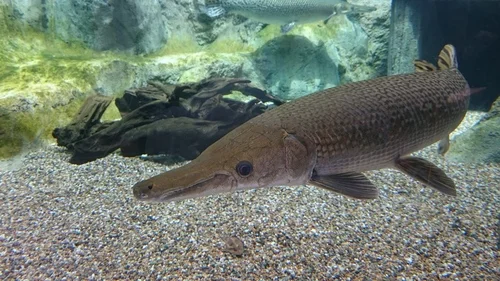
Regulated nongame species - see statewide bag limit and Special Restrictions Gars are easily distinguished from other freshwater species by their long, slender, cylindrical bodies, long snouts, and diamond-shaped interlocking (ganoid) scales. The tail fin is rounded. Dorsal and anal fins are placed well back on the body and nearly opposite each other. Alligator gar is the largest of the gar species. It can grow up to 8 feet long and weigh more than 300 pounds. Adults have two rows of large teeth on either side of the upper jaw. Coloration is generally brown or olive above and lighter underneath. The species name spatula is Latin for "spoon", referring to the creature's broad snout.
Life History: Alligator gar can live for many decades. They grow very fast when young, but growth slows with age. In general, for every additional foot the fish grows, its age doubles. A 3-foot gar is typically about 2.5 years old; a 4-foot gar about 5, and a 7-foot trophy catch might be 40 years old. The world record, caught in Mississippi in 2011, weighed 327 pounds and was probably at least 95. Alligator gar are slow to mature; they usually don't spawn until they are about 10 years old. Spawning typically takes place in shallow areas of flooded vegetation when springtime water temperatures exceed 68 degrees. In Texas, this generally occurs in April and May. Eggs hatch within a couple of days. Young fish feed on larval fishes and insects. Adults will eat whatever they can catch, consuming primarily fish, but occasionally taking birds, mammals and other animals.
Distribution: Alligator gar are present in the Gulf coastal plain from the Econfina River in Florida west and south to Veracruz, Mexico. The historic range extends north in the Mississippi River basin to the lower reaches of the Missouri and Ohio rivers. In Texas, alligator gar may be found in large rivers and reservoirs, as well as in coastal bays. Recent surveys indicate the species is declining or has disappeared in many areas of the southeastern United States. Texas populations are still strong.
Other: The Texas state record is 302 pounds, caught on a trotline in 1953. Bow fishers and rod and reel anglers have landed several specimens in excess of 200 pounds. Historically considered a "rough fish," the alligator gar has recently gained popularity as a sport fish, attracting national and international attention after being featured on several television shows. Texas has one of the best remaining fisheries for this unusual freshwater fish. To help ensure that high quality, recreational fisheries remain compatible with long-term conservation of the species, Texas Parks and Wildlife Department imposed a one-per-day bag limit on alligator gar beginning in 2009.
Life History
Alligator gar can live for many decades. They grow very fast when young, but growth slows with age. In general, for every additional foot the fish grows, its age doubles. A 3-foot gar is typically about 2.5 years old; a 4-foot gar about 5, and a 7-foot trophy catch might be 40 years old. The world record, caught in Mississippi in 2011, weighed 327 pounds and was probably at least 95. Alligator gar are slow to mature; they usually don't spawn until they are about 10 years old. Spawning typically takes place in shallow areas of flooded vegetation when springtime water temperatures exceed 68 degrees. In Texas, this generally occurs in April and May. Eggs hatch within a couple of days. Young fish feed on larval fishes and insects. Adults will eat whatever they can catch, consuming primarily fish, but occasionally taking birds, mammals and other animals.
License & Regulations
A valid Texas fishing license is required for anglers age 17 and older. Licenses are available for residents, non-residents, and short-term durations (1-day, 5-day, and annual). Freshwater and saltwater endorsements may be required for certain waters. Purchase online through the Texas Parks and Wildlife Department website or at authorized license retailers throughout the state.
Frequently Asked Questions
Life History
Alligator gar can live for many decades. They grow very fast when young, but growth slows with age. In general, for every additional foot the fish grows, its age doubles. A 3-foot gar is typically about 2.5 years old; a 4-foot gar about 5, and a 7-foot trophy catch might be 40 years old. The world record, caught in Mississippi in 2011, weighed 327 pounds and was probably at least 95. Alligator gar are slow to mature; they usually don't spawn until they are about 10 years old. Spawning typically takes place in shallow areas of flooded vegetation when springtime water temperatures exceed 68 degrees. In Texas, this generally occurs in April and May. Eggs hatch within a couple of days. Young fish feed on larval fishes and insects. Adults will eat whatever they can catch, consuming primarily fi
Distribution
Alligator gar are present in the Gulf coastal plain from the Econfina River in Florida west and south to Veracruz, Mexico. The historic range extends north in the Mississippi River basin to the lower reaches of the Missouri and Ohio rivers. In Texas, alligator gar may be found in large rivers and reservoirs, as well as in coastal bays. Recent surveys indicate the species is declining or has disappeared in many areas of the southeastern United States. Texas populations are still strong.
Regulations
Texas fishing regulations apply to Alligator Gar. A valid Texas fishing license is required for anglers 17 and older. Bag and size limits vary by species and water body. Some species have catch-and-release only restrictions or special tournament regulations. Check the Texas Parks and Wildlife Outdoor Annual for current regulations specific to your fishing location. Possession limits in Texas are twice the daily bag limit unless otherwise noted.
References
| State | Category | Directory | Subcategory | Content | Source |
|---|---|---|---|---|---|
| Texas | Fishing | License | License & Fees | A valid Texas fishing license is required for anglers age 17 and older. Licenses are available for residents, non-reside | Link |