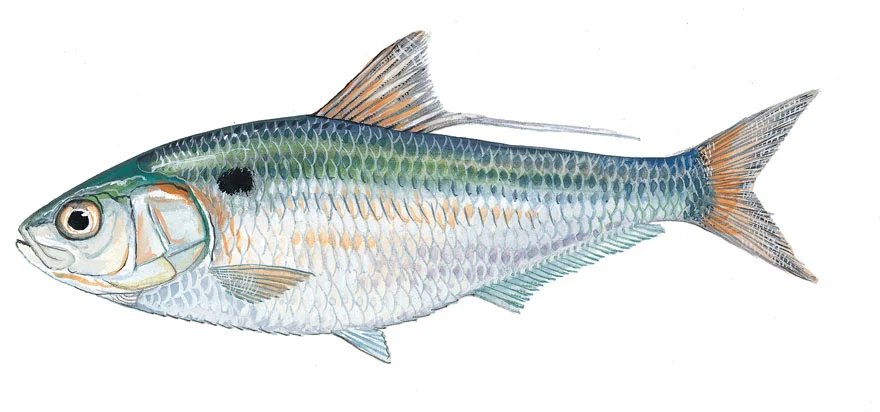
Dorosoma is Greek for "lance body", referring to the lance-like shape of young shad. The word petenense refers to Lake Peten in the Yucatan, the species type locality. Threadfin shad are usually easily distinguished from gizzard shad by the fact that the upper jaw does not project beyond the lower jaw. The anal fin usually has 20-25 rays, as opposed to 29-35 rays found in gizzard shad. The upper surface is silver-blue and grades to nearly white on the sides and belly. All fins have yellow tint except the dorsal. In this species, unlike gizzard shad, the chin and floor of the mouth is speckled with black pigment. Adults are considerably smaller than gizzard shad adults, rarely exceeding 6 inches in length.
Life History: Threadfin shad are more likely to be found in waters with a noticeable current and are usually in the upper five feet of water. They are quite temperature sensitive, with die-offs reported at temperatures below 45°F. Spawning begins in the spring when water temperatures reach approximately 70°F, and may continue into the summer. During spawning, one or more females are accompanied by several males.
Distribution: Threadfin shad naturally occur in waters west of the Appalachian Mountains, north to Kentucky, west to East Texas, south to the Rio Grande drainage, and east to Florida. The species has been widely introduced in California and Arizona, as well as Appalachian and southern Atlantic states. Threadfin shad are common in all East Texas streams and have been introduced as forage fish in many reservoirs statewide.
Other: Often used as a bait fish. Threadfin shad almost never bite on a hook.
Habitat & Range
Like gizzard shad, threadfin shad are most commonly found in large rivers and reservoirs.
Life History
Threadfin shad are more likely to be found in waters with a noticeable current and are usually in the upper five feet of water. They are quite temperature sensitive, with die-offs reported at temperatures below 45°F. Spawning begins in the spring when water temperatures reach approximately 70°F, and may continue into the summer. During spawning, one or more females are accompanied by several males.
License & Regulations
A valid Texas fishing license is required for anglers age 17 and older. Licenses are available for residents, non-residents, and short-term durations (1-day, 5-day, and annual). Freshwater and saltwater endorsements may be required for certain waters. Purchase online through the Texas Parks and Wildlife Department website or at authorized license retailers throughout the state.
Frequently Asked Questions
Life History
Threadfin shad are more likely to be found in waters with a noticeable current and are usually in the upper five feet of water. They are quite temperature sensitive, with die-offs reported at temperatures below 45°F. Spawning begins in the spring when water temperatures reach approximately 70°F, and may continue into the summer. During spawning, one or more females are accompanied by several males.
Habitat
Like gizzard shad, threadfin shad are most commonly found in large rivers and reservoirs.
Distribution
Threadfin shad naturally occur in waters west of the Appalachian Mountains, north to Kentucky, west to East Texas, south to the Rio Grande drainage, and east to Florida. The species has been widely introduced in California and Arizona, as well as Appalachian and southern Atlantic states. Threadfin shad are common in all East Texas streams and have been introduced as forage fish in many reservoirs statewide.
Regulations
Texas fishing regulations apply to Threadfin Shad. A valid Texas fishing license is required for anglers 17 and older. Bag and size limits vary by species and water body. Some species have catch-and-release only restrictions or special tournament regulations. Check the Texas Parks and Wildlife Outdoor Annual for current regulations specific to your fishing location. Possession limits in Texas are twice the daily bag limit unless otherwise noted.
References
| State | Category | Directory | Subcategory | Content | Source |
|---|---|---|---|---|---|
| Texas | Fishing | License | License & Fees | A valid Texas fishing license is required for anglers age 17 and older. Licenses are available for residents, non-reside | Link |