Also known as: Brown Bass, Brownie, Bronze Bass
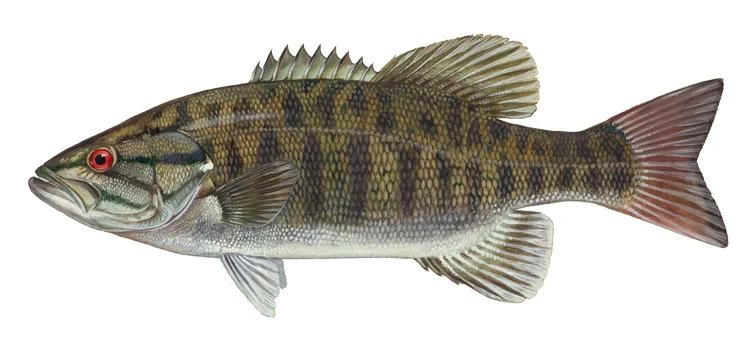
Game fish - see statewide bag & size limits and lake-specific exceptions The smallmouth bass is generally green with dark vertical bands rather than a horizontal band along the side. There are 13-15 soft rays in the dorsal fin, and the upper jaw never extends beyond the eye. Known maximum size in Texas exceeds 7.5 pounds. Micropterus is Greek meaning "small fin" [see Guadalupe bass for further explanation]. The species epithet dolomieu refers to the French mineralogist M. Dolomieu.
Life History: In small streams a fish's activity may be limited to just one stream pool or extend into several. Spawning occurs in the spring. When water temperatures approach 60°F males move into spawning areas. Nests are usually located near shore in lakes; downstream from boulders or some other obstruction that offers protection against strong current in streams. Mature females may contain 2000-15,000 golden yellow eggs. Males may spawn with several females on a single nest. On average each nest contains about 2,500 eggs, but nests may contain as many as 10,000 eggs. Eggs hatch in about 10 days if water temperatures are in the mid-50's (°F), but can hatch in 2-3 days if temperatures are in the mid-70's (°F). Males guard the nest from the time eggs are laid until fry begin to disperse, a period of up to a month. As in other black bass, fry begin to feed on zooplankton, switching to insect larvae and finally fish and crayfish as they grow.
Distribution: Smallmouth bass originally ranged north into Minnesota and southern Quebec, south to the Tennessee River in Alabama and west to eastern Oklahoma and southwestern Arkansas. Today there are few states, east or west of the Rocky Mountains, where populations have not become established. Florida and Louisiana are apparently free of smallmouth bass. In Texas the species has been stocked in numerous areas, particularly streams of the Edwards Plateau.
Habitat & Range
Smallmouth bass prefer large clear-water lakes (greater than 100 acres, more than 30 feet deep) and cool streams with clear water and gravel substrate.
Life History
In small streams a fish's activity may be limited to just one stream pool or extend into several. Spawning occurs in the spring. When water temperatures approach 60°F males move into spawning areas. Nests are usually located near shore in lakes; downstream from boulders or some other obstruction that offers protection against strong current in streams. Mature females may contain 2000-15,000 golden yellow eggs. Males may spawn with several females on a single nest. On average each nest contains about 2,500 eggs, but nests may contain as many as 10,000 eggs. Eggs hatch in about 10 days if water temperatures are in the mid-50's (°F), but can hatch in 2-3 days if temperatures are in the mid-70's (°F). Males guard the nest from the time eggs are laid until fry begin to disperse, a period of up to a month. As in other black bass, fry begin to feed on zooplankton, switching to insect larvae and finally fish and crayfish as they grow.
License & Regulations
A valid Texas fishing license is required for anglers age 17 and older. Licenses are available for residents, non-residents, and short-term durations (1-day, 5-day, and annual). Freshwater and saltwater endorsements may be required for certain waters. Purchase online through the Texas Parks and Wildlife Department website or at authorized license retailers throughout the state.
Frequently Asked Questions
Life History
In small streams a fish's activity may be limited to just one stream pool or extend into several. Spawning occurs in the spring. When water temperatures approach 60°F males move into spawning areas. Nests are usually located near shore in lakes; downstream from boulders or some other obstruction that offers protection against strong current in streams. Mature females may contain 2000-15,000 golden yellow eggs. Males may spawn with several females on a single nest. On average each nest contains about 2,500 eggs, but nests may contain as many as 10,000 eggs. Eggs hatch in about 10 days if water temperatures are in the mid-50's (°F), but can hatch in 2-3 days if temperatures are in the mid-70's (°F). Males guard the nest from the time eggs are laid until fry begin to disperse, a period of up
Habitat
Smallmouth bass prefer large clear-water lakes (greater than 100 acres, more than 30 feet deep) and cool streams with clear water and gravel substrate.
Distribution
Smallmouth bass originally ranged north into Minnesota and southern Quebec, south to the Tennessee River in Alabama and west to eastern Oklahoma and southwestern Arkansas. Today there are few states, east or west of the Rocky Mountains, where populations have not become established. Florida and Louisiana are apparently free of smallmouth bass. In Texas the species has been stocked in numerous areas, particularly streams of the Edwards Plateau.
Regulations
Texas fishing regulations apply to Smallmouth Bass. A valid Texas fishing license is required for anglers 17 and older. Bag and size limits vary by species and water body. Some species have catch-and-release only restrictions or special tournament regulations. Check the Texas Parks and Wildlife Outdoor Annual for current regulations specific to your fishing location. Possession limits in Texas are twice the daily bag limit unless otherwise noted.
References
| State | Category | Directory | Subcategory | Content | Source |
|---|---|---|---|---|---|
| Texas | Fishing | License | License & Fees | A valid Texas fishing license is required for anglers age 17 and older. Licenses are available for residents, non-reside | Link |