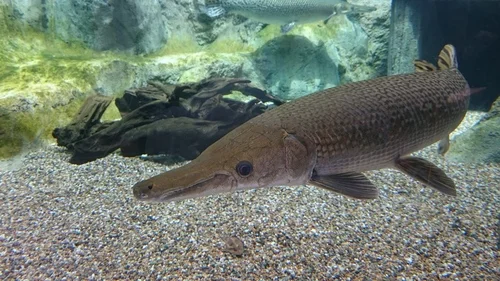
Also known as: Billy Gar, Short-billed Gar, Stub-nose Gar
Lepisosteus is Greek, meaning "bony scale", and platostomus is also Greek, meaning "broad mouth." Shortnose gar may be distinguished from other Texas species in that they lack the double row of teeth in the upper jaw of the alligator gar, the long snout of the longnose gar, and the spots of the spotted gar.
Life History: Shortnose gar spawning activity may occur from May into July. Females are often accompanied by more than one male. Yellow eggs are scattered in vegetation and other submerged structures, usually hatching within eight days of spawning. The fry remain in the yolk-sac phase for another week, at which time they begin to feed on insect larvae and small crustaceans. At little over an inch in length, fish appear in the diet. Sexual maturity is usually achieved when fish reach about 15 inches in length. Shortnose gar are more tolerant of high turbidity than other gar species.
Distribution: Shortnose gar are present in the Mississippi River drainage from the Gulf Coast as far north as Montana in the west, and the Ohio River in the east. In Texas, shortnose gar may be found in the Red River basin below Lake Texoma.
Other: As with alligator gar, shortnose gar may be captured by entangling the teeth in nylon threads or by bowfishing. Shortnose gar up to five pounds have been brought in by anglers. The Texas state record, captured with a bow and arrow in Lake Lavon, weighed in at 11.15 pounds and measured in excess of 37 inches.
Habitat & Range
They inhabit large rivers and their backwaters, as well as oxbow lakes and large pools.
Life History
Shortnose gar spawning activity may occur from May into July. Females are often accompanied by more than one male. Yellow eggs are scattered in vegetation and other submerged structures, usually hatching within eight days of spawning. The fry remain in the yolk-sac phase for another week, at which time they begin to feed on insect larvae and small crustaceans. At little over an inch in length, fish appear in the diet. Sexual maturity is usually achieved when fish reach about 15 inches in length. Shortnose gar are more tolerant of high turbidity than other gar species.
License & Regulations
A valid Texas fishing license is required for anglers age 17 and older. Licenses are available for residents, non-residents, and short-term durations (1-day, 5-day, and annual). Freshwater and saltwater endorsements may be required for certain waters. Purchase online through the Texas Parks and Wildlife Department website or at authorized license retailers throughout the state.
Frequently Asked Questions
Life History
Shortnose gar spawning activity may occur from May into July. Females are often accompanied by more than one male. Yellow eggs are scattered in vegetation and other submerged structures, usually hatching within eight days of spawning. The fry remain in the yolk-sac phase for another week, at which time they begin to feed on insect larvae and small crustaceans. At little over an inch in length, fish appear in the diet. Sexual maturity is usually achieved when fish reach about 15 inches in length. Shortnose gar are more tolerant of high turbidity than other gar species.
Habitat
They inhabit large rivers and their backwaters, as well as oxbow lakes and large pools.
Distribution
Shortnose gar are present in the Mississippi River drainage from the Gulf Coast as far north as Montana in the west, and the Ohio River in the east. In Texas, shortnose gar may be found in the Red River basin below Lake Texoma.
Regulations
Texas fishing regulations apply to Shortnose Gar. A valid Texas fishing license is required for anglers 17 and older. Bag and size limits vary by species and water body. Some species have catch-and-release only restrictions or special tournament regulations. Check the Texas Parks and Wildlife Outdoor Annual for current regulations specific to your fishing location. Possession limits in Texas are twice the daily bag limit unless otherwise noted.
References
| State | Category | Directory | Subcategory | Content | Source |
|---|---|---|---|---|---|
| Texas | Fishing | License | License & Fees | A valid Texas fishing license is required for anglers age 17 and older. Licenses are available for residents, non-reside | Link |