Also known as: Red-horse Minnow
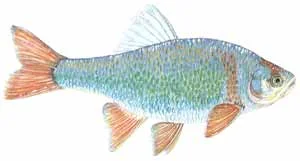
Cyprinella is Greek for "small carp" and lutrensis is derived from the Latin lutra which means "otter", a reference to Otter Creek, Arkansas, where the species was first captured. Coloration is similar to the blacktail shiner, olive green above and silver on the sides. Spawning males become bluish on the sides and the fins redden. There are 7-8 rays in the dorsal fin. The anal fin has 8-10 rays (usually 9). Maximum size is only about 3.5 inches. The species is sometimes confused with the golden shiner and exotic minnows such as the rudd and roach.
Life History: The red shiner spawns over an extended period of time from spring into fall months, with a peak from early to mid-summer. Spawning may occur on riffles, on or near submerged objects, over vegetation beds, or in association with sunfish nests. Adults typically school in midwater or near the surface. The species is thought to feed primarily on small invertebrates.
Distribution: The red shiner is native to central North America west of the Mississippi River drainage, ranging as far west as New Mexico. Latitudinally, the species ranges from central Mexico north to South Dakota. Clearly a plains species, red shiners range throughout Texas. One subspecies, Cyprinella lutrensis blairi, formerly found in the Big Bend region, is thought to be extinct.
Other: Often used as a bait fish
Life History
The red shiner spawns over an extended period of time from spring into fall months, with a peak from early to mid-summer. Spawning may occur on riffles, on or near submerged objects, over vegetation beds, or in association with sunfish nests. Adults typically school in midwater or near the surface. The species is thought to feed primarily on small invertebrates.
License & Regulations
A valid Texas fishing license is required for anglers age 17 and older. Licenses are available for residents, non-residents, and short-term durations (1-day, 5-day, and annual). Freshwater and saltwater endorsements may be required for certain waters. Purchase online through the Texas Parks and Wildlife Department website or at authorized license retailers throughout the state.
Frequently Asked Questions
Life History
The red shiner spawns over an extended period of time from spring into fall months, with a peak from early to mid-summer. Spawning may occur on riffles, on or near submerged objects, over vegetation beds, or in association with sunfish nests. Adults typically school in midwater or near the surface. The species is thought to feed primarily on small invertebrates.
Distribution
The red shiner is native to central North America west of the Mississippi River drainage, ranging as far west as New Mexico. Latitudinally, the species ranges from central Mexico north to South Dakota. Clearly a plains species, red shiners range throughout Texas. One subspecies, Cyprinella lutrensis blairi, formerly found in the Big Bend region, is thought to be extinct.
Regulations
Texas fishing regulations apply to Red Shiner. A valid Texas fishing license is required for anglers 17 and older. Bag and size limits vary by species and water body. Some species have catch-and-release only restrictions or special tournament regulations. Check the Texas Parks and Wildlife Outdoor Annual for current regulations specific to your fishing location. Possession limits in Texas are twice the daily bag limit unless otherwise noted.
References
| State | Category | Directory | Subcategory | Content | Source |
|---|---|---|---|---|---|
| Texas | Fishing | License | License & Fees | A valid Texas fishing license is required for anglers age 17 and older. Licenses are available for residents, non-reside | Link |