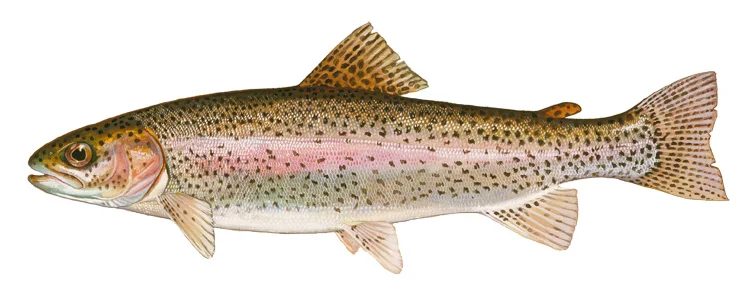
Game fish - see statewide bag limit and exceptions on Guadalupe River Oncorhynchus is Greek meaning "hook snout", and mykiss is the Kamchatkan name for rainbow trout. Rainbow trout have a characteristic salmon-like shape. Dark spots are clearly visible on the tail fin, which is slightly forked. The anal fin has 10-12 rays. The back is usually a dark olive color, shading to silvery white on the underside. The body is heavily speckled, and there is a pink to red stripe running lengthwise along the fish's sides.
Life History: Rainbow trout is an anadromous, cool- to cold-water fish species. Although rainbows have been known to tolerate higher temperatures, they do best in areas where the water remains below 70°F. Eggs are laid in shallow nests dug out by the female in gravel riffles. The eggs require continuous oxygenation. At temperatures of about 55°F, the eggs will hatch approximately 21 days after they are laid. Rainbow trout are carnivores, but not exclusively piscivorous. They feed on a wide variety of prey including insects, crustaceans, mollusks and fish. Rainbows with access to the sea have been known to exceed 42 pounds. The record size for those confined to freshwater is 31.27 pounds.
Distribution: Rainbow trout are native to North America west of the Rockies from Alaska into northwestern Mexico. Introductions have extended the range to include the Great Lakes region, south central Canada and portions of the Great Plains east of the Rockies, and southwestern Mexico. In Texas, high temperatures prevent reproduction or even over-summer survival in most areas, though some may survive in tailrace areas below large dams such as at Canyon Reservoir. The only self-sustaining population in the state exists in McKittrick Canyon in the Guadalupe Mountains.
Other: Since rainbow trout generally do not reproduce in Texas, and are unable to survive through the summer in most areas, the species is primarily used in winter put-and-take fisheries. Each winter, several hundred thousand rainbows are stocked in community fishing lakes around the state. Much enthusiasm is generated by the annual stockings. On occasion, banks are lined with anglers eager to catch their limit immediately after trout are stocked. The state record is 8.24 pounds and was taken from the Canyon Reservoir tailrace.
Life History
Rainbow trout is an anadromous, cool- to cold-water fish species. Although rainbows have been known to tolerate higher temperatures, they do best in areas where the water remains below 70°F. Eggs are laid in shallow nests dug out by the female in gravel riffles. The eggs require continuous oxygenation. At temperatures of about 55°F, the eggs will hatch approximately 21 days after they are laid. Rainbow trout are carnivores, but not exclusively piscivorous. They feed on a wide variety of prey including insects, crustaceans, mollusks and fish. Rainbows with access to the sea have been known to exceed 42 pounds. The record size for those confined to freshwater is 31.27 pounds.
License & Regulations
A valid Texas fishing license is required for anglers age 17 and older. Licenses are available for residents, non-residents, and short-term durations (1-day, 5-day, and annual). Freshwater and saltwater endorsements may be required for certain waters. Purchase online through the Texas Parks and Wildlife Department website or at authorized license retailers throughout the state.
Frequently Asked Questions
Life History
Rainbow trout is an anadromous, cool- to cold-water fish species. Although rainbows have been known to tolerate higher temperatures, they do best in areas where the water remains below 70°F. Eggs are laid in shallow nests dug out by the female in gravel riffles. The eggs require continuous oxygenation. At temperatures of about 55°F, the eggs will hatch approximately 21 days after they are laid. Rainbow trout are carnivores, but not exclusively piscivorous. They feed on a wide variety of prey including insects, crustaceans, mollusks and fish. Rainbows with access to the sea have been known to exceed 42 pounds. The record size for those confined to freshwater is 31.27 pounds.
Distribution
Rainbow trout are native to North America west of the Rockies from Alaska into northwestern Mexico. Introductions have extended the range to include the Great Lakes region, south central Canada and portions of the Great Plains east of the Rockies, and southwestern Mexico. In Texas, high temperatures prevent reproduction or even over-summer survival in most areas, though some may survive in tailrace areas below large dams such as at Canyon Reservoir. The only self-sustaining population in the state exists in McKittrick Canyon in the Guadalupe Mountains.
Regulations
Texas fishing regulations apply to Rainbow Trout. A valid Texas fishing license is required for anglers 17 and older. Bag and size limits vary by species and water body. Some species have catch-and-release only restrictions or special tournament regulations. Check the Texas Parks and Wildlife Outdoor Annual for current regulations specific to your fishing location. Possession limits in Texas are twice the daily bag limit unless otherwise noted.
References
| State | Category | Directory | Subcategory | Content | Source |
|---|---|---|---|---|---|
| Texas | Fishing | License | License & Fees | A valid Texas fishing license is required for anglers age 17 and older. Licenses are available for residents, non-reside | Link |