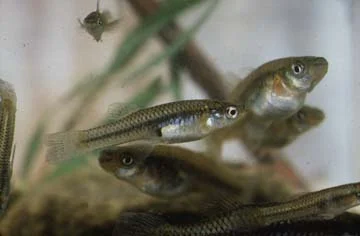
Pecos gambusia are about 2 inches in length when fully grown.
Life History: Small invertebrates and algae form the diet of the Pecos gambusia. It is primarily a surface feeder. Pecos gambusia bear live young. Females produce up to 40 young every 4 to 5 days. Their population numbers are believed to be stable at present.
Distribution: Historically, the Pecos gambusia was restricted to the Pecos River basin in southeastern New Mexico and western Texas. The populations that once existed at Leon Springs and Comanche Springs were lost when these springs went dry during the mid-1950's. Today, the Pecos gambusia is found in Jeff Davis and Pecos counties in west Texas. Presently in Texas, populations of Pecos gambusia occur near Balmorhea in aquatic habitat supported by nearby springs and at the man-made ciénega. A population also occurs in Leon Creek and in Diamond-Y Spring outflow north of Fort Stockton.
Other: As with the other endangered desert spring fishes, the primary threat to the survival of the Pecos Gambusia is the loss of the spring-fed waters that provide their habitat. In many parts of west Texas, more water is being withdrawn from aquifers by pumping than is being replaced by rainfall. Hybridization and competition with introduced species that have similar diet and habitat requirements pose especially serious threats. Predation by Green Sunfish and Largemouth Bass can become a major problem in areas where there is no submerged vegetation or shallow water to provide protection from predators.
Habitat & Range
Spring-fed pools and marshes with constant temperature are essential habitat for Pecos gambusia.
Life History
Small invertebrates and algae form the diet of the Pecos gambusia. It is primarily a surface feeder. Pecos gambusia bear live young. Females produce up to 40 young every 4 to 5 days. Their population numbers are believed to be stable at present.
License & Regulations
A valid Texas fishing license is required for anglers age 17 and older. Licenses are available for residents, non-residents, and short-term durations (1-day, 5-day, and annual). Freshwater and saltwater endorsements may be required for certain waters. Purchase online through the Texas Parks and Wildlife Department website or at authorized license retailers throughout the state.
Frequently Asked Questions
Life History
Small invertebrates and algae form the diet of the Pecos gambusia. It is primarily a surface feeder. Pecos gambusia bear live young. Females produce up to 40 young every 4 to 5 days. Their population numbers are believed to be stable at present.
Habitat
Spring-fed pools and marshes with constant temperature are essential habitat for Pecos gambusia.
Distribution
Historically, the Pecos gambusia was restricted to the Pecos River basin in southeastern New Mexico and western Texas. The populations that once existed at Leon Springs and Comanche Springs were lost when these springs went dry during the mid-1950's. Today, the Pecos gambusia is found in Jeff Davis and Pecos counties in west Texas. Presently in Texas, populations of Pecos gambusia occur near Balmorhea in aquatic habitat supported by nearby springs and at the man-made ciénega. A population also occurs in Leon Creek and in Diamond-Y Spring outflow north of Fort Stockton.
Regulations
Texas fishing regulations apply to Pecos Gambusia. A valid Texas fishing license is required for anglers 17 and older. Bag and size limits vary by species and water body. Some species have catch-and-release only restrictions or special tournament regulations. Check the Texas Parks and Wildlife Outdoor Annual for current regulations specific to your fishing location. Possession limits in Texas are twice the daily bag limit unless otherwise noted.
References
| State | Category | Directory | Subcategory | Content | Source |
|---|---|---|---|---|---|
| Texas | Fishing | License | License & Fees | A valid Texas fishing license is required for anglers age 17 and older. Licenses are available for residents, non-reside | Link |