Also known as: Spoonbill, Spoonbill Cat, Shovelnose Cat
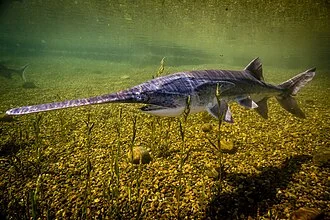
Paddlefish grow up to 87 inches (221 cm) long - that's over 7 feet long! They can weigh as much as 200 pounds, but most are usually between 10-15 pounds. Paddlefish have a gray, shark-like body with a deeply forked tail, and a long, flat blade-like snout (looks like a kitchen spatula) almost one third of its body's entire length. It opens its huge mouth when feeding. Paddlefish resemble sharks not only by shape, but by their skeletons as well. Both paddlefish and sharks have skeletons made of cartilage, not bone. Paddlefish have no scales. Their gill cover is long and comes to a point, and they have tiny eyes.
Life History: Paddlefish have no teeth and eat by swimming through the water with its mouth held wide open, scooping up tiny plants and animals in the water called plankton. They filter out the food with their gill rakers. The underside of the paddlefish's "paddle" is covered with taste buds (like the ones on your tongue) and probably helps it to find places where plankton is the most abundant. Male paddlefish are old enough to spawn when they are four to nine years. Females spawn when they are 6-12 years old. Spawning season is from March through June, when spring rains raise the water levels of rivers and water temperatures reach 50-60 degrees. Males and females gather in schools and release their eggs over gravel or sandbars. This is called "broadcast spawning." By the end of their first year, baby paddlefish grow about 10 to 12 inches. They can live up to 30 years. Paddlefish are sometimes called a spoonbill, spoonbill cat, or shovelnose cat because some have mistaken the paddlefish as a member of the Catfish family. It is one of only four cartilaginous fish native to Texas. The chestnut lamprey, brook lamprey and shovelnose sturgeon are the others. Paddlefish were first seen by Europeans in the 16th century, when Hernando De Soto explored the Mississippi River.
Distribution: The native range of paddlefish includes the Mississippi River basin from New York to Montana and south to the Gulf of Mexico. Historically in Texas, paddlefish lived in the Red River's tributaries, Sulphur River, Big Cypress Bayou, Sabine River, Neches River, Angelina River, Trinity River, and San Jacinto River.
Other: Paddlefish are the oldest surviving animal species in North America. Fossil records indicate that it is older than dinosaurs (300 million years). Females may spawn only once every 4 to 7 years. The paddlefish has only one other relative in the world, another paddlefish that lives in China. Polyodon is Greek for "many teeth" and refers to the paddlefish's gill rakers, even though they have no teeth at all. The word spathula is Latin for "spatula" or "blade." The State of Texas has protected the paddlefish since 1977. It is considered a threatened species. It is unlawful to catch, kill or harm paddlefish in Texas. Paddlefish face a number of problems in Texas. They need large amounts of flowing water in order to reproduce. The construction of dams and reservoirs along Texas rivers decreases water flow and interrupts spawning. The eggs of paddlefish can be used to make palatable caviar. When caviar becomes difficult, and expensive, to get from Russia paddlefish are often taken illegally (
Habitat & Range
Paddlefish like to live in slow moving water of large rivers or reservoirs, usually in water deeper than four feet (130cm).
Life History
Paddlefish have no teeth and eat by swimming through the water with its mouth held wide open, scooping up tiny plants and animals in the water called plankton. They filter out the food with their gill rakers. The underside of the paddlefish's "paddle" is covered with taste buds (like the ones on your tongue) and probably helps it to find places where plankton is the most abundant. Male paddlefish are old enough to spawn when they are four to nine years. Females spawn when they are 6-12 years old. Spawning season is from March through June, when spring rains raise the water levels of rivers and water temperatures reach 50-60 degrees. Males and females gather in schools and release their eggs over gravel or sandbars. This is called "broadcast spawning." By the end of their first year, baby paddlefish grow about 10 to 12 inches. They can live up to 30 years. Paddlefish are sometimes called a spoonbill, spoonbill cat, or shovelnose cat because some have mistaken the paddlefish as a member of the Catfish family. It is one of only four cartilaginous fish native to Texas. The chestnut lamprey, brook lamprey and shovelnose sturgeon are the others. Paddlefish were first seen by Europeans in the 16th century, when Hernando De Soto explored the Mississippi River.
License & Regulations
A valid Texas fishing license is required for anglers age 17 and older. Licenses are available for residents, non-residents, and short-term durations (1-day, 5-day, and annual). Freshwater and saltwater endorsements may be required for certain waters. Purchase online through the Texas Parks and Wildlife Department website or at authorized license retailers throughout the state.
Frequently Asked Questions
Life History
Paddlefish have no teeth and eat by swimming through the water with its mouth held wide open, scooping up tiny plants and animals in the water called plankton. They filter out the food with their gill rakers. The underside of the paddlefish's "paddle" is covered with taste buds (like the ones on your tongue) and probably helps it to find places where plankton is the most abundant. Male paddlefish are old enough to spawn when they are four to nine years. Females spawn when they are 6-12 years old. Spawning season is from March through June, when spring rains raise the water levels of rivers and water temperatures reach 50-60 degrees. Males and females gather in schools and release their eggs over gravel or sandbars. This is called "broadcast spawning." By the end of their first year, baby p
Habitat
Paddlefish like to live in slow moving water of large rivers or reservoirs, usually in water deeper than four feet (130cm).
Distribution
The native range of paddlefish includes the Mississippi River basin from New York to Montana and south to the Gulf of Mexico. Historically in Texas, paddlefish lived in the Red River's tributaries, Sulphur River, Big Cypress Bayou, Sabine River, Neches River, Angelina River, Trinity River, and San Jacinto River.
Regulations
Texas fishing regulations apply to Paddlefish. A valid Texas fishing license is required for anglers 17 and older. Bag and size limits vary by species and water body. Some species have catch-and-release only restrictions or special tournament regulations. Check the Texas Parks and Wildlife Outdoor Annual for current regulations specific to your fishing location. Possession limits in Texas are twice the daily bag limit unless otherwise noted.
References
| State | Category | Directory | Subcategory | Content | Source |
|---|---|---|---|---|---|
| Texas | Fishing | License | License & Fees | A valid Texas fishing license is required for anglers age 17 and older. Licenses are available for residents, non-reside | Link |