Also known as: Needlenose Gar, Billfish, Billy Gar
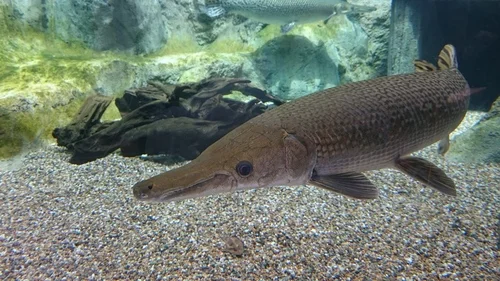
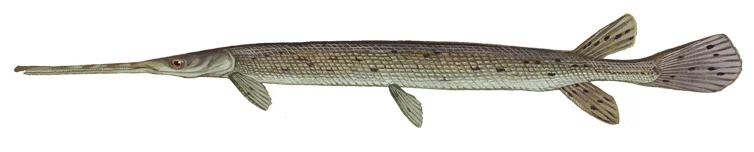
Lepisosteus is Greek, meaning "bony scale", and osseus is Latin, meaning "of bone." Longnose gar are distinguished from other gar species found in Texas by the long snout whose length is at least 10 times the minimum width.
Life History: Spawning activity occurs as early as April, in shallow riffle areas. Females, typically the larger sex, may be accompanied by one or many males. Although nests are not prepared, gravel is swept somewhat by the spawning action itself. Each female may deposit a portion of her eggs at several different locations. The adhesive eggs are mixed in the gravel, hatching in six to eight days. Yolk-sac fry have an adhesive disc on their snouts by which they attach themselves to submerged objects until the yolk sac is absorbed. Fry feed primarily on insect larvae and small crustaceans such as water fleas. Fish appear in the diet very early.
Distribution: Longnose gar range widely throughout the eastern US and north into southern Quebec. The species is especially common in the Mississippi River drainage and in the Carolinas. It may be found as far south and west as the Rio Grande drainage in Mexico, Texas and New Mexico. Longnose gar appear in most Texas rivers.
Other: Longnose gar may be captured by entangling the teeth in nylon threads, or by bowfishing. In Texas, specimens in excess of 80 pounds have been landed using a bow and arrow.
Habitat & Range
Longnose gar are typically associated with backwaters, low inflow pools and moderately clear streams. They often do very well in man-made impoundments.
Life History
Spawning activity occurs as early as April, in shallow riffle areas. Females, typically the larger sex, may be accompanied by one or many males. Although nests are not prepared, gravel is swept somewhat by the spawning action itself. Each female may deposit a portion of her eggs at several different locations. The adhesive eggs are mixed in the gravel, hatching in six to eight days. Yolk-sac fry have an adhesive disc on their snouts by which they attach themselves to submerged objects until the yolk sac is absorbed. Fry feed primarily on insect larvae and small crustaceans such as water fleas. Fish appear in the diet very early.
License & Regulations
A valid Texas fishing license is required for anglers age 17 and older. Licenses are available for residents, non-residents, and short-term durations (1-day, 5-day, and annual). Freshwater and saltwater endorsements may be required for certain waters. Purchase online through the Texas Parks and Wildlife Department website or at authorized license retailers throughout the state.
Frequently Asked Questions
Life History
Spawning activity occurs as early as April, in shallow riffle areas. Females, typically the larger sex, may be accompanied by one or many males. Although nests are not prepared, gravel is swept somewhat by the spawning action itself. Each female may deposit a portion of her eggs at several different locations. The adhesive eggs are mixed in the gravel, hatching in six to eight days. Yolk-sac fry have an adhesive disc on their snouts by which they attach themselves to submerged objects until the yolk sac is absorbed. Fry feed primarily on insect larvae and small crustaceans such as water fleas. Fish appear in the diet very early.
Habitat
Longnose gar are typically associated with backwaters, low inflow pools and moderately clear streams. They often do very well in man-made impoundments.
Distribution
Longnose gar range widely throughout the eastern US and north into southern Quebec. The species is especially common in the Mississippi River drainage and in the Carolinas. It may be found as far south and west as the Rio Grande drainage in Mexico, Texas and New Mexico. Longnose gar appear in most Texas rivers.
Regulations
Texas fishing regulations apply to Longnose Gar. A valid Texas fishing license is required for anglers 17 and older. Bag and size limits vary by species and water body. Some species have catch-and-release only restrictions or special tournament regulations. Check the Texas Parks and Wildlife Outdoor Annual for current regulations specific to your fishing location. Possession limits in Texas are twice the daily bag limit unless otherwise noted.
References
| State | Category | Directory | Subcategory | Content | Source |
|---|---|---|---|---|---|
| Texas | Fishing | License | License & Fees | A valid Texas fishing license is required for anglers age 17 and older. Licenses are available for residents, non-reside | Link |