Also known as: Fathead
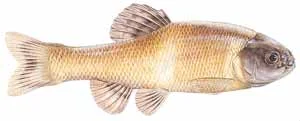
Pimephales and promelas are both Greek words, meaning "fathead" and "before black", respectively. The fathead minnow has a rounded snout and short rounded fins. There is a dark spot at the base of the tail fin, and sometimes a blotch on the anterior portion of the dorsal fin. As with many other minnows, there is a darkening along the midline of the back. The anal fin has 7 rays.
Life History: Fatheads school either in midwater or near the bottom, and feed primarily on plant material, although invertebrates are sometimes consumed. Spawning is prolonged from late spring through midsummer. Eggs are deposited over submerged objects and guarded by males. Nests may contain as many as 12,000 eggs, and females may spawn as many as 12 times in a single summer. Some individuals may mature and spawn during their first summer of life, but spawning is usually delayed until the second summer. Because of its prolific nature in the absence of competition, fathead minnows are often raised in ponds for sale as a bait fish, or as forage in hatchery production ponds.
Distribution: The fathead minnow may be found throughout much of North America east of the Rocky Mountains from Mexico into the Great Slave Lake drainage of northern Canada, with the notable exception of southern portions of the Atlantic coastal plain. The species is found nearly statewide in Texas, presumably as a result of bait releases.
Other: Often used as a bait fish
Habitat & Range
The fathead minnow is a stream fish, able to tolerate a wide range of environmental conditions including high temperatures, low oxygen levels, and high turbidities. The species seems to be most abundant in small streams where competition with other species is limited.
Life History
Fatheads school either in midwater or near the bottom, and feed primarily on plant material, although invertebrates are sometimes consumed. Spawning is prolonged from late spring through midsummer. Eggs are deposited over submerged objects and guarded by males. Nests may contain as many as 12,000 eggs, and females may spawn as many as 12 times in a single summer. Some individuals may mature and spawn during their first summer of life, but spawning is usually delayed until the second summer. Because of its prolific nature in the absence of competition, fathead minnows are often raised in ponds for sale as a bait fish, or as forage in hatchery production ponds.
License & Regulations
A valid Texas fishing license is required for anglers age 17 and older. Licenses are available for residents, non-residents, and short-term durations (1-day, 5-day, and annual). Freshwater and saltwater endorsements may be required for certain waters. Purchase online through the Texas Parks and Wildlife Department website or at authorized license retailers throughout the state.
Frequently Asked Questions
Life History
Fatheads school either in midwater or near the bottom, and feed primarily on plant material, although invertebrates are sometimes consumed. Spawning is prolonged from late spring through midsummer. Eggs are deposited over submerged objects and guarded by males. Nests may contain as many as 12,000 eggs, and females may spawn as many as 12 times in a single summer. Some individuals may mature and spawn during their first summer of life, but spawning is usually delayed until the second summer. Because of its prolific nature in the absence of competition, fathead minnows are often raised in ponds for sale as a bait fish, or as forage in hatchery production ponds.
Habitat
The fathead minnow is a stream fish, able to tolerate a wide range of environmental conditions including high temperatures, low oxygen levels, and high turbidities. The species seems to be most abundant in small streams where competition with other species is limited.
Distribution
The fathead minnow may be found throughout much of North America east of the Rocky Mountains from Mexico into the Great Slave Lake drainage of northern Canada, with the notable exception of southern portions of the Atlantic coastal plain. The species is found nearly statewide in Texas, presumably as a result of bait releases.
Regulations
Texas fishing regulations apply to Fathead Minnow. A valid Texas fishing license is required for anglers 17 and older. Bag and size limits vary by species and water body. Some species have catch-and-release only restrictions or special tournament regulations. Check the Texas Parks and Wildlife Outdoor Annual for current regulations specific to your fishing location. Possession limits in Texas are twice the daily bag limit unless otherwise noted.
References
| State | Category | Directory | Subcategory | Content | Source |
|---|---|---|---|---|---|
| Texas | Fishing | License | License & Fees | A valid Texas fishing license is required for anglers age 17 and older. Licenses are available for residents, non-reside | Link |