Also known as: Willow Cat, Forked-tail Cat, Fiddler, Spotted Cat, Lady Cat
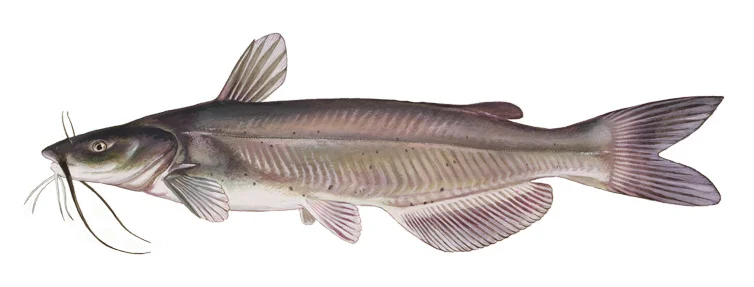
Game fish - see statewide bag & size limits and lake-specific exceptions Ictalurus is Greek and punctatus is Latin, meaning "fish cat" and "spotted", respectively. Channel catfish are easily distinguished from all others, except blue catfish, by their deeply forked tail fin. Unlike flathead catfish, the upper jaw projects beyond the lower jaw. Coloration is olive-brown to slate-blue on the back and sides, shading to silvery-white on the belly. Typically, numerous small, black spots are present, but may be obscured in large adults. The anal fin has 24-29 soft rays, in contrast to the blue catfish which always has 30 or more rays in the anal fin.
Life History: Channel catfish spawn in late spring or early summer when water temperatures reach 75°F. Males select nest sites which are normally dark secluded areas such as cavities in drift piles, logs, undercut banks, rocks, cans, etc. A golden-yellow gelatinous egg mass is deposited in the bottom of the nest. Males guard the nest, and may actually eat some of the eggs if they are disturbed. The eggs, if not devoured, typically hatch in about a week. Fry remain in the nest, under the guardianship of the male, for about another week. In clear water, young fish appear to be much more susceptible to predation and survival rates during the first year of life are much lower. Channel catfish less than 4 inches in length feed primarily on small insects. Adults are largely omnivorous, feeding on insects, mollusks, crustaceans, fish, and even some plant material. Sexual maturity is reached in two or three years in captivity, whereas data from natural populations indicates channel catfish in Texas reach sexual maturity in 3-6 years. Most are mature by the time they reach 12 inches in length.
Distribution: Channel catfish are native to North America east of the Rockies from southern Canada, south into northeastern Mexico, and east of the Appalachians with the exception of much of the coastal plain north of Florida. The species has been widely introduced in other areas as far west as California. Today channel catfish range throughout Texas, however, it is believed that the species was not native to the upper Rio Grande and Pecos basins.
Other: Channel catfish ranks behind only bass and crappie as the most preferred fish to catch in Texas. Popular with trotliners as well as rod-and-reel anglers, channel cats may be captured on a wide variety of baits including liver, worms, grasshoppers, shrimp, chicken, cheese and stinkbait, among others. Undoubtedly, part of the reason for their popularity is their delicious flavor when cooked. Channel catfish in excess of 36 pounds have been landed in Texas waters. The North American record stands at 58 pounds.
Habitat & Range
Channel catfish are most abundant in large streams with low or moderate current.
Life History
Channel catfish spawn in late spring or early summer when water temperatures reach 75°F. Males select nest sites which are normally dark secluded areas such as cavities in drift piles, logs, undercut banks, rocks, cans, etc. A golden-yellow gelatinous egg mass is deposited in the bottom of the nest. Males guard the nest, and may actually eat some of the eggs if they are disturbed. The eggs, if not devoured, typically hatch in about a week. Fry remain in the nest, under the guardianship of the male, for about another week. In clear water, young fish appear to be much more susceptible to predation and survival rates during the first year of life are much lower. Channel catfish less than 4 inches in length feed primarily on small insects. Adults are largely omnivorous, feeding on insects, mollusks, crustaceans, fish, and even some plant material. Sexual maturity is reached in two or three years in captivity, whereas data from natural populations indicates channel catfish in Texas reach sexual maturity in 3-6 years. Most are mature by the time they reach 12 inches in length.
License & Regulations
A valid Texas fishing license is required for anglers age 17 and older. Licenses are available for residents, non-residents, and short-term durations (1-day, 5-day, and annual). Freshwater and saltwater endorsements may be required for certain waters. Purchase online through the Texas Parks and Wildlife Department website or at authorized license retailers throughout the state.
Frequently Asked Questions
Life History
Channel catfish spawn in late spring or early summer when water temperatures reach 75°F. Males select nest sites which are normally dark secluded areas such as cavities in drift piles, logs, undercut banks, rocks, cans, etc. A golden-yellow gelatinous egg mass is deposited in the bottom of the nest. Males guard the nest, and may actually eat some of the eggs if they are disturbed. The eggs, if not devoured, typically hatch in about a week. Fry remain in the nest, under the guardianship of the male, for about another week. In clear water, young fish appear to be much more susceptible to predation and survival rates during the first year of life are much lower. Channel catfish less than 4 inches in length feed primarily on small insects. Adults are largely omnivorous, feeding on insects, mol
Habitat
Channel catfish are most abundant in large streams with low or moderate current.
Distribution
Channel catfish are native to North America east of the Rockies from southern Canada, south into northeastern Mexico, and east of the Appalachians with the exception of much of the coastal plain north of Florida. The species has been widely introduced in other areas as far west as California. Today channel catfish range throughout Texas, however, it is believed that the species was not native to the upper Rio Grande and Pecos basins.
Regulations
Texas fishing regulations apply to Channel Catfish. A valid Texas fishing license is required for anglers 17 and older. Bag and size limits vary by species and water body. Some species have catch-and-release only restrictions or special tournament regulations. Check the Texas Parks and Wildlife Outdoor Annual for current regulations specific to your fishing location. Possession limits in Texas are twice the daily bag limit unless otherwise noted.
References
| State | Category | Directory | Subcategory | Content | Source |
|---|---|---|---|---|---|
| Texas | Fishing | License | License & Fees | A valid Texas fishing license is required for anglers age 17 and older. Licenses are available for residents, non-reside | Link |