Also known as: Grindle, Dogfish, Grinnel, Cypress Trout, Mud Fish
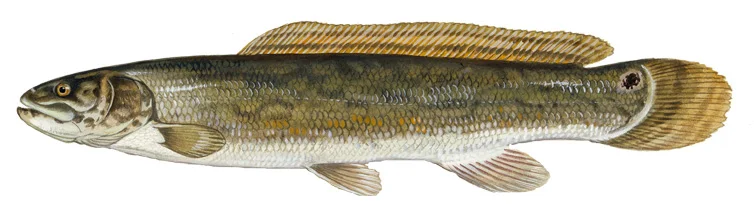
Amia is a Greek name for an unidentified fish, probably the bonito, and calva is Latin meaning "smooth," referring perhaps to the fish's scaleless head. The bowfin has a large mouth equipped with many sharp teeth. Its large head has no scales. The dorsal fin is long, extending more than half the length of the back, and contains more than 45 rays. None of the fins have spines. The tail is rounded, and the backbone extends part way into it. There is a barbel-like flap associated with each nostril. The back is mottled olive green shading to lighter green on the belly. There is a difference in color among the fins. The dorsal is dark green, while all others are light green (coinciding perhaps with overall body color changes). Young fish have a distinctive black spot near the base of the upper portions of the tail fin. The spot is usually margined with yellow or orange. Although it persists in adult fish, it is less prominent in females.
Life History: Bowfins spawn in the late spring. Nests are constructed by males in shallow, weedy areas. Vegetation and silt are removed from the nest by males and the adhesive eggs attach to any hard structure that is left, such as roots, gravel, wood, etc. Eggs hatch in 8-10 days. Males guard both incubating eggs and fry which may remain in the nest for about nine days after hatching. Initially, bowfin young feed on small invertebrates such as cladocerans (water fleas). By the time they reach about four inches in length they are primarily piscivorous, although crayfish can make up a substantial proportion of the diet, and frogs are also consumed. Young fish may grow as much as 12-14 inches during their first year. Bowfins tend to be found in deeper water during the day, and migrate into shallower areas used to feed at night. Their swim bladder is used as a lung and they may be seen surfacing to renew their air supply from time to time. In general, the average size in Texas is six to eight pounds.
Distribution: With the exception of the Appalachian Mountains, the bowfin is native to the eastern US, ranging from extreme southeastern Canada to the Gulf Coast. In Texas the species is found in the Red River, San Jacinto River and Sabine River systems, as well as the downstream reaches of the Brazos and Colorado rivers.
Other: Although bowfins are not usually sought after in Texas, it is generally acknowledged that once hooked they are excellent fighters. Indeed, some anglers relish the thought of hooking a bowfin. Relative to consumption, bowfins are typically considered a rough fish rather than one for the table.
Life History
Bowfins spawn in the late spring. Nests are constructed by males in shallow, weedy areas. Vegetation and silt are removed from the nest by males and the adhesive eggs attach to any hard structure that is left, such as roots, gravel, wood, etc. Eggs hatch in 8-10 days. Males guard both incubating eggs and fry which may remain in the nest for about nine days after hatching. Initially, bowfin young feed on small invertebrates such as cladocerans (water fleas). By the time they reach about four inches in length they are primarily piscivorous, although crayfish can make up a substantial proportion of the diet, and frogs are also consumed. Young fish may grow as much as 12-14 inches during their first year. Bowfins tend to be found in deeper water during the day, and migrate into shallower areas used to feed at night. Their swim bladder is used as a lung and they may be seen surfacing to renew their air supply from time to time. In general, the average size in Texas is six to eight pounds.
License & Regulations
A valid Texas fishing license is required for anglers age 17 and older. Licenses are available for residents, non-residents, and short-term durations (1-day, 5-day, and annual). Freshwater and saltwater endorsements may be required for certain waters. Purchase online through the Texas Parks and Wildlife Department website or at authorized license retailers throughout the state.
Frequently Asked Questions
Life History
Bowfins spawn in the late spring. Nests are constructed by males in shallow, weedy areas. Vegetation and silt are removed from the nest by males and the adhesive eggs attach to any hard structure that is left, such as roots, gravel, wood, etc. Eggs hatch in 8-10 days. Males guard both incubating eggs and fry which may remain in the nest for about nine days after hatching. Initially, bowfin young feed on small invertebrates such as cladocerans (water fleas). By the time they reach about four inches in length they are primarily piscivorous, although crayfish can make up a substantial proportion of the diet, and frogs are also consumed. Young fish may grow as much as 12-14 inches during their first year. Bowfins tend to be found in deeper water during the day, and migrate into shallower areas
Distribution
With the exception of the Appalachian Mountains, the bowfin is native to the eastern US, ranging from extreme southeastern Canada to the Gulf Coast. In Texas the species is found in the Red River, San Jacinto River and Sabine River systems, as well as the downstream reaches of the Brazos and Colorado rivers.
Regulations
Texas fishing regulations apply to Bowfin. A valid Texas fishing license is required for anglers 17 and older. Bag and size limits vary by species and water body. Some species have catch-and-release only restrictions or special tournament regulations. Check the Texas Parks and Wildlife Outdoor Annual for current regulations specific to your fishing location. Possession limits in Texas are twice the daily bag limit unless otherwise noted.
References
| State | Category | Directory | Subcategory | Content | Source |
|---|---|---|---|---|---|
| Texas | Fishing | License | License & Fees | A valid Texas fishing license is required for anglers age 17 and older. Licenses are available for residents, non-reside | Link |