Also known as: Channel Cat, Hump-back Blue
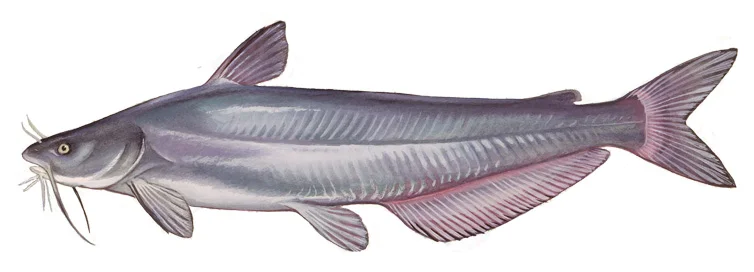
Game fish - see statewide bag & size limits and lake-specific exceptions Ictalurus is Greek meaning "fish cat", and furcatus is Latin, meaning "forked", a reference to the species' forked tail fin. Blue catfish have a forked tail, and are sometimes very similar to channel catfish. However, only the Rio Grande population has dark spots on the back and sides. The number of rays in the anal fin is typically 30-35, and coloration is usually slate blue on the back, shading to white on the belly.
Life History: The spawning behavior of blue catfish appears to be similar to that of channel catfish. However, most blue catfish are not sexually mature until they reach about 24 inches in length. Like channel catfish, the blue catfish pursues a varied diet, but it tends to eat fish earlier in life. Although invertebrates still comprise the major portion of the diet, blue catfish as small as four inches in length have been known to consume fish. Individuals larger than eight inches eat fish and large invertebrates. Blue catfish commonly attain weights of 20 to 40 pounds, and may reach weights well in excess of 100 pounds. It is reported that fish exceeding 350 pounds were landed from the Mississippi River during the late 1800's.
Distribution: Blue catfish are native to major rivers of the Ohio, Missouri, and Mississippi river basins. The range also extends south through Texas, Mexico, and into northern Guatemala. In Texas it is absent from the northwestern portions of the state including the Panhandle, but present elsewhere in larger rivers.
Other: The blue catfish is the largest freshwater sportfish in Texas. Where mature populations exist, 50-pounders are not unusual. Typically, the largest fish are caught by trotliners, some of whom have landed specimens in excess of 115 pounds. The Texas rod-and-reel record is 121.5 pounds. Catfish is the second most preferred group of fish among licensed Texas anglers, and blues rank third behind channel and flathead catfish. Like the channel cat, the blue catfish is considered an excellent food fish.
Habitat & Range
Blue catfish are primarily large-river fish, occurring in main channels, tributaries, and impoundments of major river systems. They tend to move upstream in the summer in search of cooler temperatures, and downstream in the winter in order to find warmer water.
Life History
The spawning behavior of blue catfish appears to be similar to that of channel catfish. However, most blue catfish are not sexually mature until they reach about 24 inches in length. Like channel catfish, the blue catfish pursues a varied diet, but it tends to eat fish earlier in life. Although invertebrates still comprise the major portion of the diet, blue catfish as small as four inches in length have been known to consume fish. Individuals larger than eight inches eat fish and large invertebrates. Blue catfish commonly attain weights of 20 to 40 pounds, and may reach weights well in excess of 100 pounds. It is reported that fish exceeding 350 pounds were landed from the Mississippi River during the late 1800's.
License & Regulations
A valid Texas fishing license is required for anglers age 17 and older. Licenses are available for residents, non-residents, and short-term durations (1-day, 5-day, and annual). Freshwater and saltwater endorsements may be required for certain waters. Purchase online through the Texas Parks and Wildlife Department website or at authorized license retailers throughout the state.
Frequently Asked Questions
Life History
The spawning behavior of blue catfish appears to be similar to that of channel catfish. However, most blue catfish are not sexually mature until they reach about 24 inches in length. Like channel catfish, the blue catfish pursues a varied diet, but it tends to eat fish earlier in life. Although invertebrates still comprise the major portion of the diet, blue catfish as small as four inches in length have been known to consume fish. Individuals larger than eight inches eat fish and large invertebrates. Blue catfish commonly attain weights of 20 to 40 pounds, and may reach weights well in excess of 100 pounds. It is reported that fish exceeding 350 pounds were landed from the Mississippi River during the late 1800's.
Habitat
Blue catfish are primarily large-river fish, occurring in main channels, tributaries, and impoundments of major river systems. They tend to move upstream in the summer in search of cooler temperatures, and downstream in the winter in order to find warmer water.
Distribution
Blue catfish are native to major rivers of the Ohio, Missouri, and Mississippi river basins. The range also extends south through Texas, Mexico, and into northern Guatemala. In Texas it is absent from the northwestern portions of the state including the Panhandle, but present elsewhere in larger rivers.
Regulations
Texas fishing regulations apply to Blue Catfish. A valid Texas fishing license is required for anglers 17 and older. Bag and size limits vary by species and water body. Some species have catch-and-release only restrictions or special tournament regulations. Check the Texas Parks and Wildlife Outdoor Annual for current regulations specific to your fishing location. Possession limits in Texas are twice the daily bag limit unless otherwise noted.
References
| State | Category | Directory | Subcategory | Content | Source |
|---|---|---|---|---|---|
| Texas | Fishing | License | License & Fees | A valid Texas fishing license is required for anglers age 17 and older. Licenses are available for residents, non-reside | Link |