Also known as: White Perch, Calico Bass
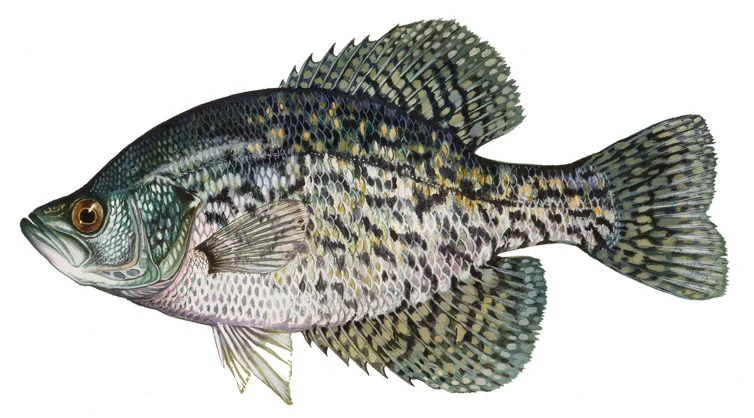
Game fish - see statewide bag & size limits and lake-specific exceptions Pomoxis is Greek for "opercle sharp", and refers to the fact that the fish's gill covers have spines. The species epithet nigromaculatus is Latin and means "black spotted." The black crappie is easily confused with the white crappie. However, it is deeper bodied than the white crappie, and silvery-green in color. There are no distinct vertical bars, rather there are irregular black blotches. The dorsal fin has seven or eight spines. Males do not develop specialized breeding coloration during spawning season.
Life History: Like other members of the sunfish family, black crappie are nest builders. They nest in the spring, generally when water temperatures reach 60°F. The biology of black crappie is very similar to that of white crappie. Growth in terms of weight is very similar between the two species. White crappie tend to have higher growth rates in terms of length, but black crappie are more robust in body construction. Black crappie adults feed on fewer fish, and more insects and crustaceans, than do white crappie.
Distribution: The native range of the species was very similar to that of the white crappie, except that it extended slightly further north into Canada and east to the coastal plain south of Virginia. Currently, populations of black crappie can be found in each of the 48 contiguous United States. In Texas, black crappie are native to the central portions of the state exclusive of the Edwards Plateau, and have been widely introduced. However, black crappie are abundant primarily in clear, acidic waters of east Texas.
Other: Black crappie predominate in the acidic waters of east and northeast Texas. Black crappie over 3.5 pounds and almost 4.5 pounds have been captured from Texas public waters and private waters, respectively.
Life History
Like other members of the sunfish family, black crappie are nest builders. They nest in the spring, generally when water temperatures reach 60°F. The biology of black crappie is very similar to that of white crappie. Growth in terms of weight is very similar between the two species. White crappie tend to have higher growth rates in terms of length, but black crappie are more robust in body construction. Black crappie adults feed on fewer fish, and more insects and crustaceans, than do white crappie.
License & Regulations
A valid Texas fishing license is required for anglers age 17 and older. Licenses are available for residents, non-residents, and short-term durations (1-day, 5-day, and annual). Freshwater and saltwater endorsements may be required for certain waters. Purchase online through the Texas Parks and Wildlife Department website or at authorized license retailers throughout the state.
Frequently Asked Questions
Life History
Like other members of the sunfish family, black crappie are nest builders. They nest in the spring, generally when water temperatures reach 60°F. The biology of black crappie is very similar to that of white crappie. Growth in terms of weight is very similar between the two species. White crappie tend to have higher growth rates in terms of length, but black crappie are more robust in body construction. Black crappie adults feed on fewer fish, and more insects and crustaceans, than do white crappie.
Distribution
The native range of the species was very similar to that of the white crappie, except that it extended slightly further north into Canada and east to the coastal plain south of Virginia. Currently, populations of black crappie can be found in each of the 48 contiguous United States. In Texas, black crappie are native to the central portions of the state exclusive of the Edwards Plateau, and have been widely introduced. However, black crappie are abundant primarily in clear, acidic waters of east Texas.
Regulations
Texas fishing regulations apply to Black Crappie. A valid Texas fishing license is required for anglers 17 and older. Bag and size limits vary by species and water body. Some species have catch-and-release only restrictions or special tournament regulations. Check the Texas Parks and Wildlife Outdoor Annual for current regulations specific to your fishing location. Possession limits in Texas are twice the daily bag limit unless otherwise noted.
References
| State | Category | Directory | Subcategory | Content | Source |
|---|---|---|---|---|---|
| Texas | Fishing | License | License & Fees | A valid Texas fishing license is required for anglers age 17 and older. Licenses are available for residents, non-reside | Link |