Also known as: Polliwog, Chucklehead Cat
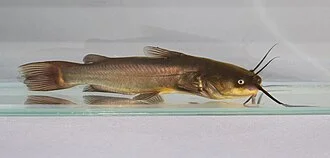
Ameiurus is Greek and means "primitive" or "curtailed" in reference to the slight notch in the caudal fin; melas is also Greek and means "black." Black bullheads are typically black to greenish-black on the back, ranging to gray or white on the belly. However, in muddy water the back may be yellowish-brown. Chin barbels are dark or black, never white. The anal fin has 17-21 rays.
Life History: During late spring or early summer black bullheads excavate nests in mud bottoms and spawn. Areas with some sort of cover are preferred. Nests contain golden-yellow egg masses which are guarded by both parents (at least one is present at all times). Eggs hatch in four to six days. Fry begin to school in compact balls which are guarded by adults until individuals reach about one inch in length. Black bullheads are omnivorous, feeding primarily from the bottom on a wide range of plant and animal material, both live and dead. Fingerlings feed almost exclusively on crustaceans. Immature aquatic insects and crustaceans often comprise a considerable proportion of the adult diet. The average life span is usually less than five years, and most adults are less than one pound. However, some individuals may live more than 10 years and reach eight pounds.
Distribution: The original distribution of the black bullhead included the central plains west of the Appalachians and east of the Rockies, extending north into Saskatchewan and Manitoba, and south into south Texas and New Mexico. Today artificial introductions have extended the range west of the Rockies in isolated pockets including areas of British Columbia, Alberta, Mexico, California, Arizona, Nevada, and Idaho. In Texas the black bullhead is distributed statewide with the exception of the Trans-Pecos drainage.
Other: Black bullheads are not considered gamefish in Texas, though they are readily fished for by anglers in the Panhandle, and in far East Texas. A variety of baits may be used to catch them, but worms are usually the best. The largest specimen reported to date in Texas was 5.15 pounds.
Life History
During late spring or early summer black bullheads excavate nests in mud bottoms and spawn. Areas with some sort of cover are preferred. Nests contain golden-yellow egg masses which are guarded by both parents (at least one is present at all times). Eggs hatch in four to six days. Fry begin to school in compact balls which are guarded by adults until individuals reach about one inch in length. Black bullheads are omnivorous, feeding primarily from the bottom on a wide range of plant and animal material, both live and dead. Fingerlings feed almost exclusively on crustaceans. Immature aquatic insects and crustaceans often comprise a considerable proportion of the adult diet. The average life span is usually less than five years, and most adults are less than one pound. However, some individuals may live more than 10 years and reach eight pounds.
License & Regulations
A valid Texas fishing license is required for anglers age 17 and older. Licenses are available for residents, non-residents, and short-term durations (1-day, 5-day, and annual). Freshwater and saltwater endorsements may be required for certain waters. Purchase online through the Texas Parks and Wildlife Department website or at authorized license retailers throughout the state.
Frequently Asked Questions
Life History
During late spring or early summer black bullheads excavate nests in mud bottoms and spawn. Areas with some sort of cover are preferred. Nests contain golden-yellow egg masses which are guarded by both parents (at least one is present at all times). Eggs hatch in four to six days. Fry begin to school in compact balls which are guarded by adults until individuals reach about one inch in length. Black bullheads are omnivorous, feeding primarily from the bottom on a wide range of plant and animal material, both live and dead. Fingerlings feed almost exclusively on crustaceans. Immature aquatic insects and crustaceans often comprise a considerable proportion of the adult diet. The average life span is usually less than five years, and most adults are less than one pound. However, some individu
Distribution
The original distribution of the black bullhead included the central plains west of the Appalachians and east of the Rockies, extending north into Saskatchewan and Manitoba, and south into south Texas and New Mexico. Today artificial introductions have extended the range west of the Rockies in isolated pockets including areas of British Columbia, Alberta, Mexico, California, Arizona, Nevada, and Idaho. In Texas the black bullhead is distributed statewide with the exception of the Trans-Pecos drainage.
Regulations
Texas fishing regulations apply to Black Bullhead. A valid Texas fishing license is required for anglers 17 and older. Bag and size limits vary by species and water body. Some species have catch-and-release only restrictions or special tournament regulations. Check the Texas Parks and Wildlife Outdoor Annual for current regulations specific to your fishing location. Possession limits in Texas are twice the daily bag limit unless otherwise noted.
References
| State | Category | Directory | Subcategory | Content | Source |
|---|---|---|---|---|---|
| Texas | Fishing | License | License & Fees | A valid Texas fishing license is required for anglers age 17 and older. Licenses are available for residents, non-reside | Link |