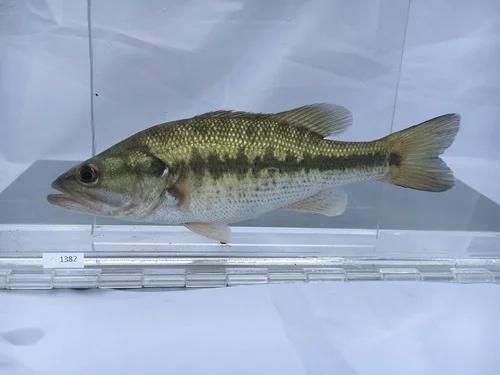
Description: Common in both the Arkansas and Red river systems, spotted bass prefer clear lakes and streams in eastern Oklahoma. Although an important game fish in Oklahoma, spotted bass have not been widely cultured or stocked. The black bass is a general term referring to largemouth, spotted, and smallmouth bass and their hybrids. The three species are similar but can be easily identified. Since water clarity can affect the color of a fish, color is not a reliable way to tell the basses apart. The most objective way to tell these species apart is by the relationship of the eye and the mouth hinge. On a spotted bass, the mouth hinge lines up vertically with the back edge of the eye; on smallmouth bass, the mouth hinge vertically lines up in front of the back edge of the eye; and on largemouth bass, the mouth hinges vertically lines up behind the back edge of the eye. The spotted bass can also be identified by rows of spots on the belly with an iridescent green pattern along the back and it has a sandpaper-like tooth patch on the tongue. The dorsal fin is not deeply notched. • Eyes are sometimes red. • Also called “Kentuckies,” or “redeye bass.” Facts: Spotted bass are usually caught much deeper than largemouth bass and are more inclined to school. They are taken frequently from streams, sharing stringers with green sunfish and smallmouth bass.
Habitat: Spotted bass inhabit flowing streams in eastern Oklahoma and are more tolerant of slow, warm, turbid water than smallmouth. In lakes, spotted bass are found in deeper water. They prefer rocky bottom areas as well as areas with steeply sloping sides. Food sources: Crayfish and immature insects make up the bulk of their diet. They also eat small fish such as bluegill.
Habitat & Range
Spotted bass inhabit flowing streams in eastern Oklahoma and are more tolerant of slow, warm, turbid water than smallmouth. In lakes, spotted bass are found in deeper water. They prefer rocky bottom areas as well as areas with steeply sloping sides. Food sources: Crayfish and immature insects make up the bulk of their diet. They also eat small fish such as bluegill.
Life History
Spawning takes place in the spring when water temperatures reach 63 to 68 degrees F. Males clean out a nest on a gravel or rock bottom, usually near heavy cover. After the eggs are laid and fertilized, males guard the nest similar to the largemouth bass males, remaining with the fry until they are about one month old. Explore more Oklahoma Fish ODWC Photo Banded Darter Photo by: USGS , US Geological Survey Carp, Silver Photo by: Andrew Zimmerman Photography Banded Sculpin Previous Next
License & Regulations
A valid Oklahoma fishing license is required for anglers age 16 and older. Licenses are available for residents, non-residents, and short-term durations (1-day, 3-day, and annual). An Oklahoma fishing license also includes the privilege to fish for all species. Purchase online through the Oklahoma Department of Wildlife Conservation website or at authorized license retailers.
Frequently Asked Questions
Description
Common in both the Arkansas and Red river systems, spotted bass prefer clear lakes and streams in eastern Oklahoma. Although an important game fish in Oklahoma, spotted bass have not been widely cultured or stocked. The black bass is a general term referring to largemouth, spotted, and smallmouth bass and their hybrids. The three species are similar but can be easily identified. Since water clarity can affect the color of a fish, color is not a reliable way to tell the basses apart. The most objective way to tell these species apart is by the relationship of the eye and the mouth hinge. On a spotted bass, the mouth hinge lines up vertically with the back edge of the eye; on smallmouth bass, the mouth hinge vertically lines up in front of the back edge of the eye; and on largemouth bass, th...
Habitat
Spotted bass inhabit flowing streams in eastern Oklahoma and are more tolerant of slow, warm, turbid water than smallmouth. In lakes, spotted bass are found in deeper water. They prefer rocky bottom areas as well as areas with steeply sloping sides. Food sources: Crayfish and immature insects make up the bulk of their diet. They also eat small fish such as bluegill.
Life Cycle
Spawning takes place in the spring when water temperatures reach 63 to 68 degrees F. Males clean out a nest on a gravel or rock bottom, usually near heavy cover. After the eggs are laid and fertilized, males guard the nest similar to the largemouth bass males, remaining with the fry until they are about one month old. Explore more Oklahoma Fish ODWC Photo Banded Darter Photo by: USGS , US Geological Survey Carp, Silver Photo by: Andrew Zimmerman Photography Banded Sculpin Previous Next
Regulations
Oklahoma fishing regulations apply to Spotted Bass. A valid Oklahoma fishing license is required for anglers 16 and older. Bag and size limits vary by species and water body. Check the Oklahoma Department of Wildlife Conservation Fishing Regulations for current rules.
References
| State | Category | Directory | Subcategory | Content | Source |
|---|---|---|---|---|---|
| Oklahoma | Fishing | License | License & Fees | A valid Oklahoma fishing license is required for anglers age 16 and older. Licenses are available for residents, non-res | Link |