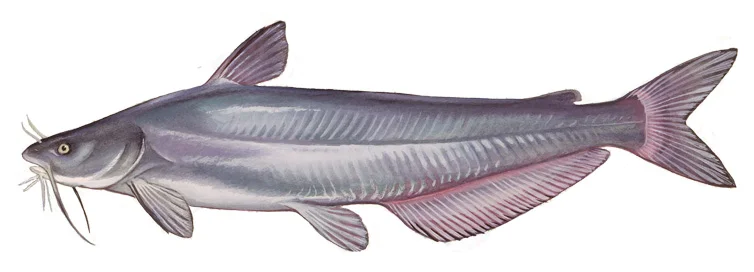
Description: Originally restricted to the Red River, blue catfish are now found in most sections of the state due to transplanting. They have adapted well to the Arkansas River System. Blue catfish have a forked tail as does the channel catfish. The anal fin will be straight across the bottom of a blue catfish. Facts: Blue catfish are a favorite of many anglers. Catfish feed more by taste and touch than by sight. Blues can exceed 100 pounds.
Habitat: Found in large rivers and major reservoirs, blue catfish generally prefer areas with sand, gravel or rock bottoms. Food sources: Blue catfish feed primarily on fish, mussels, snails, insects and crayfish.
Habitat & Range
Found in large rivers and major reservoirs, blue catfish generally prefer areas with sand, gravel or rock bottoms. Food sources: Blue catfish feed primarily on fish, mussels, snails, insects and crayfish.
Life History
Spawning usually takes place in late May or early June when the water temperature reaches 75 degrees F. Hollow logs, overhanging underwater ledges or holes under mud banks are typical nesting places. Females lay about 10,000 eggs each. Males guard the eggs against intruders, including the female. The eggs hatch in six to 10 days as determined by temperature. After hatching, fry are attended for a short time by the male as they feed in a dense school. Explore more Oklahoma Fish Photo by: Duane Raver Sunfish, Green Photo by: Duane Raver Catfish, Blue ODWC Photo Carp, Grass Previous Next
License & Regulations
A valid Oklahoma fishing license is required for anglers age 16 and older. Licenses are available for residents, non-residents, and short-term durations (1-day, 3-day, and annual). An Oklahoma fishing license also includes the privilege to fish for all species. Purchase online through the Oklahoma Department of Wildlife Conservation website or at authorized license retailers.
Frequently Asked Questions
Description
Originally restricted to the Red River, blue catfish are now found in most sections of the state due to transplanting. They have adapted well to the Arkansas River System. Blue catfish have a forked tail as does the channel catfish. The anal fin will be straight across the bottom of a blue catfish. Facts: Blue catfish are a favorite of many anglers. Catfish feed more by taste and touch than by sight. Blues can exceed 100 pounds.
Habitat
Found in large rivers and major reservoirs, blue catfish generally prefer areas with sand, gravel or rock bottoms. Food sources: Blue catfish feed primarily on fish, mussels, snails, insects and crayfish.
Life Cycle
Spawning usually takes place in late May or early June when the water temperature reaches 75 degrees F. Hollow logs, overhanging underwater ledges or holes under mud banks are typical nesting places. Females lay about 10,000 eggs each. Males guard the eggs against intruders, including the female. The eggs hatch in six to 10 days as determined by temperature. After hatching, fry are attended for a short time by the male as they feed in a dense school. Explore more Oklahoma Fish Photo by: Duane Raver Sunfish, Green Photo by: Duane Raver Catfish, Blue ODWC Photo Carp, Grass Previous Next
Regulations
Oklahoma fishing regulations apply to Blue Catfish. A valid Oklahoma fishing license is required for anglers 16 and older. Bag and size limits vary by species and water body. Check the Oklahoma Department of Wildlife Conservation Fishing Regulations for current rules.
References
| State | Category | Directory | Subcategory | Content | Source |
|---|---|---|---|---|---|
| Oklahoma | Fishing | License | License & Fees | A valid Oklahoma fishing license is required for anglers age 16 and older. Licenses are available for residents, non-res | Link |