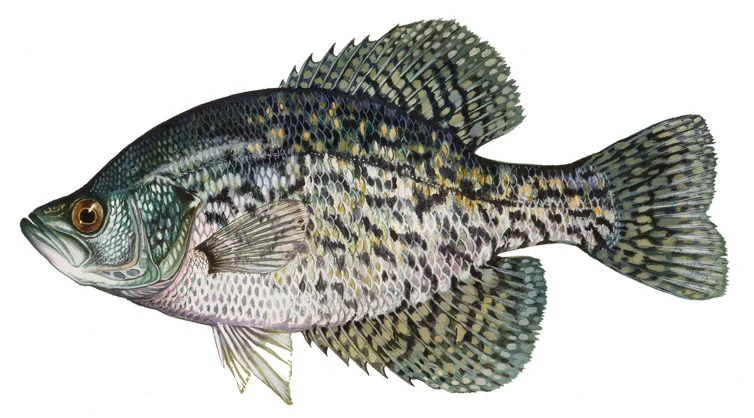
Description: Now found statewide in many lakes and rivers, crappie was originally a stream fish in Oklahoma. Both black crappie and white crappie do well in lakes of at least 500 acres. While black crappie requires clear lakes, white crappie has adapted to slightly turbid lakes. Neither species is suited for farm ponds because they tend to overpopulate these small bodies of water. The most distinguishing characteristic is the marking patterns or spots on the sides of the fish. White crappie, the most prevalent crappie in the state, will have distinct vertical bands of blue/gray spots, whereas black crappie will have only a sporadic, unrecognizable pattern to its black spots. There is also a difference in the number of bony spines in the dorsal fin. White crappie will have 5 to 6, whereas, black crappie will have 7 or 8. Facts: Crappie are a favorite winter fish in Oklahoma. They form loose schools and often when you find a school, others can be located close by. Crappie can be caught year-round and its sweet meat makes exquisite table fare. The average crappie caught in Oklahoma weighs between a half and one and a half pounds. Fishing Tips Click here for Crappie Angler Guide: Top Tips & Area Highlights
Habitat: Crappie is usually associated with standing timber and brushy cover in lakes. In the spring they inhabit the shallow ends of coves, later moving to water 15 or more feet deep. Food sources: Minnows, shad, crayfish, mollusks, and insects.
Habitat & Range
Crappie is usually associated with standing timber and brushy cover in lakes. In the spring they inhabit the shallow ends of coves, later moving to water 15 or more feet deep. Food sources: Minnows, shad, crayfish, mollusks, and insects.
Life History
Spawning habits of white crappie are similar to other sunfishes except they usually nest in deeper water. Black crappie constructs their nests and deposits their eggs at even greater depths than white crappie. Females of both species deposit from 3,000 to 15,000 eggs. Spawning occurs shortly after water temperatures reach 55 to 65 degrees F. After spawning, males guard the eggs and fry. Explore more Oklahoma Fish Photo by: Duane Raver Crappie, Black ODWC Photo Western Mosquitofish Photo by: Duane Raver Bass, White Previous Next
License & Regulations
A valid Oklahoma fishing license is required for anglers age 16 and older. Licenses are available for residents, non-residents, and short-term durations (1-day, 3-day, and annual). An Oklahoma fishing license also includes the privilege to fish for all species. Purchase online through the Oklahoma Department of Wildlife Conservation website or at authorized license retailers.
Frequently Asked Questions
Description
Now found statewide in many lakes and rivers, crappie was originally a stream fish in Oklahoma. Both black crappie and white crappie do well in lakes of at least 500 acres. While black crappie requires clear lakes, white crappie has adapted to slightly turbid lakes. Neither species is suited for farm ponds because they tend to overpopulate these small bodies of water. The most distinguishing characteristic is the marking patterns or spots on the sides of the fish. White crappie, the most prevalent crappie in the state, will have distinct vertical bands of blue/gray spots, whereas black crappie will have only a sporadic, unrecognizable pattern to its black spots. There is also a difference in the number of bony spines in the dorsal fin. White crappie will have 5 to 6, whereas, black crappie...
Habitat
Crappie is usually associated with standing timber and brushy cover in lakes. In the spring they inhabit the shallow ends of coves, later moving to water 15 or more feet deep. Food sources: Minnows, shad, crayfish, mollusks, and insects.
Life Cycle
Spawning habits of white crappie are similar to other sunfishes except they usually nest in deeper water. Black crappie constructs their nests and deposits their eggs at even greater depths than white crappie. Females of both species deposit from 3,000 to 15,000 eggs. Spawning occurs shortly after water temperatures reach 55 to 65 degrees F. After spawning, males guard the eggs and fry. Explore more Oklahoma Fish Photo by: Duane Raver Crappie, Black ODWC Photo Western Mosquitofish Photo by: Duane Raver Bass, White Previous Next
Regulations
Oklahoma fishing regulations apply to Black Crappie. A valid Oklahoma fishing license is required for anglers 16 and older. Bag and size limits vary by species and water body. Check the Oklahoma Department of Wildlife Conservation Fishing Regulations for current rules.
References
| State | Category | Directory | Subcategory | Content | Source |
|---|---|---|---|---|---|
| Oklahoma | Fishing | License | License & Fees | A valid Oklahoma fishing license is required for anglers age 16 and older. Licenses are available for residents, non-res | Link |