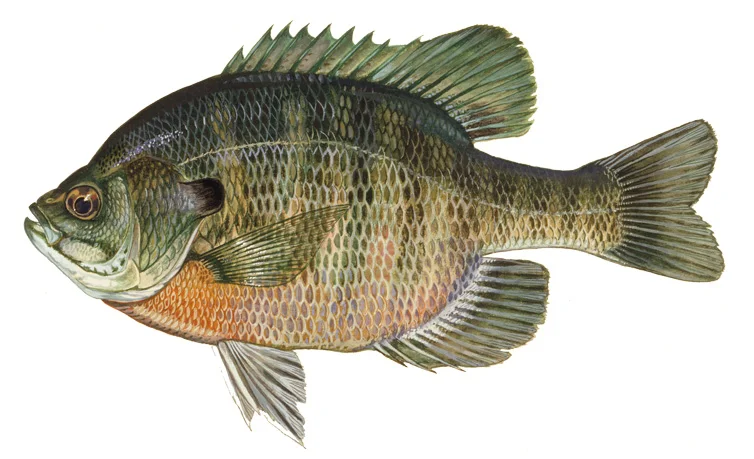
Description: Due to widespread hatchery stockings, bluegill are found statewide in all types of water. Bluegill, redear, and green sunfish are without a doubt the most common fish in Oklahoma and can be found in about any lake. A relatively large, deep-bodied sunfish with a small mouth, black opercular (ear) flap, and a black spot at the rear base of the dorsal fin. Sunfish are almost always willing to bite. Because of these characteristics, sunfish are the perfect choice for introducing a youngster to the sport of fishing. May and June are top months to fish for spawning sunfish. Try using worms along shallow shorelines in areas protected from wind and boat traffic. If the action turns fast and you suddenly find yourself out of bait, try cutting small pieces of fillet from the back of one of your catches. Sunfish love these. Weedbeds are ideal habitat for really big bluegill and redear sunfish. So for the ones that hide here, try using small minnows throughout the spawning season in June. Stilwell City Lake is a top producer of large sunfish where anglers often latch onto bluegill weighing more than 1/2 pound. Later in the summer, slip-bobber rigs can be used to fish deeper waters. Although sunfish will feed throughout the day, peak activity often occurs early in the morning and later in the evening. Facts: Young bluegill are important farm pond forage fish for bass and catfish. However, the high reproductive rate of bluegill often results in overcrowded populations of stunted fish. This problem can be controlled by restricting harvest of largemouth bass. Bluegill seldom exceed 12 inches in length and a one–pound fish is considered large.
Habitat: Young bluegill frequent shallow, weedy areas near shore, while adults prefer deeper water during the day and shallows in the morning and evening. Food sources: Insects, crustaceans, larvae, and snails. Occasionally bluegill eat aquatic plants.
Habitat & Range
Young bluegill frequent shallow, weedy areas near shore, while adults prefer deeper water during the day and shallows in the morning and evening. Food sources: Insects, crustaceans, larvae, and snails. Occasionally bluegill eat aquatic plants.
Life History
Spawning occurs throughout the summer after temperatures reach 75 degrees F. Bluegill are gregarious spawners, constructing colonies of nests on the spawning grounds. Males prepare a nest by excavating a small depression in sand or gravel in water one to three feet deep. Females produce an average of 40,000 eggs per season. After eggs are deposited and fertilized, the males drive the females from the nest and guard the eggs, leaving the young a few days after hatching. Explore more Oklahoma Fish Photo by: Duane Raver Catfish, Flathead ODWC Photo Cardinal Shiner Photo by: Duane Raver Gar, Alligator Previous Next
License & Regulations
A valid Oklahoma fishing license is required for anglers age 16 and older. Licenses are available for residents, non-residents, and short-term durations (1-day, 3-day, and annual). An Oklahoma fishing license also includes the privilege to fish for all species. Purchase online through the Oklahoma Department of Wildlife Conservation website or at authorized license retailers.
Frequently Asked Questions
Description
Due to widespread hatchery stockings, bluegill are found statewide in all types of water. Bluegill, redear, and green sunfish are without a doubt the most common fish in Oklahoma and can be found in about any lake. A relatively large, deep-bodied sunfish with a small mouth, black opercular (ear) flap, and a black spot at the rear base of the dorsal fin. Sunfish are almost always willing to bite. Because of these characteristics, sunfish are the perfect choice for introducing a youngster to the sport of fishing. May and June are top months to fish for spawning sunfish. Try using worms along shallow shorelines in areas protected from wind and boat traffic. If the action turns fast and you suddenly find yourself out of bait, try cutting small pieces of fillet from the back of one of your catc...
Habitat
Young bluegill frequent shallow, weedy areas near shore, while adults prefer deeper water during the day and shallows in the morning and evening. Food sources: Insects, crustaceans, larvae, and snails. Occasionally bluegill eat aquatic plants.
Life Cycle
Spawning occurs throughout the summer after temperatures reach 75 degrees F. Bluegill are gregarious spawners, constructing colonies of nests on the spawning grounds. Males prepare a nest by excavating a small depression in sand or gravel in water one to three feet deep. Females produce an average of 40,000 eggs per season. After eggs are deposited and fertilized, the males drive the females from the nest and guard the eggs, leaving the young a few days after hatching. Explore more Oklahoma Fish Photo by: Duane Raver Catfish, Flathead ODWC Photo Cardinal Shiner Photo by: Duane Raver Gar, Alligator Previous Next
Regulations
Oklahoma fishing regulations apply to Bluegill. A valid Oklahoma fishing license is required for anglers 16 and older. Bag and size limits vary by species and water body. Check the Oklahoma Department of Wildlife Conservation Fishing Regulations for current rules.
References
| State | Category | Directory | Subcategory | Content | Source |
|---|---|---|---|---|---|
| Oklahoma | Fishing | License | License & Fees | A valid Oklahoma fishing license is required for anglers age 16 and older. Licenses are available for residents, non-res | Link |