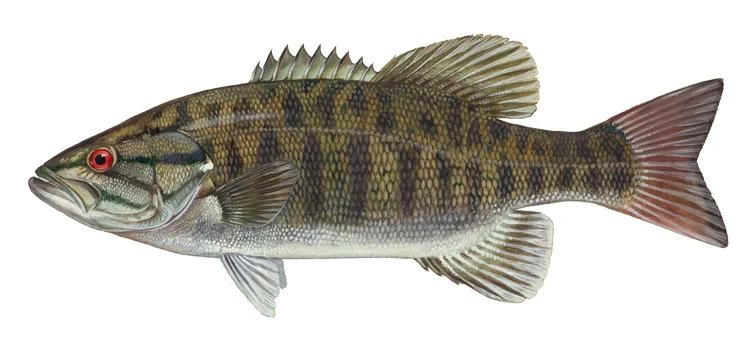
Description: Smallmouth bass occurs naturally in many eastern Oklahoma Ozark and Ouachita streams and tributaries. Fishable lake populations exist in Grand, Tenkiller, Murray, Eufaula, Texoma, and Broken Bow. The black bass is a general term referring to largemouth, spotted, and smallmouth bass and their hybrids. The three species are similar but can be easily identified. Since water clarity can affect the color of a fish, color is not a reliable way to tell the basses apart. The most objective way to tell these species apart is by the relationship of the eye and the mouth hinge. On a spotted bass, the mouth hinge lines up vertically with the back edge of the eye; on smallmouth bass, the mouth hinge vertically lines up in front of the back edge of the eye; and on largemouth bass, the mouth hinges vertically lines up behind the back edge of the eye. Facts: During the day, smallmouth seek the refuge of underwater cover. In the morning and evening they are often found prowling the shoreline of a "home" pool. Many people consider smallmouth one of Oklahoma's feistiest freshwater sport fish. Once you catch one on light tackle, you will be anxious for your next encounter.
Habitat: Smallmouth inhabits clear, gravel-bottom-streams in Oklahoma. The best areas to fish for smallmouth within streams are in riffles, pools, and the shallows above rapids. In manmade impoundments, smallmouth seeks clear, clean water usually with a rocky substrate. Weedy areas along the shoreline, flats off channels, and shelves are all good areas to find smallmouth. Food sources: Crayfish, small fish, aquatic and terrestrial insects, worms, frogs, and tadpoles.
Habitat & Range
Smallmouth inhabits clear, gravel-bottom-streams in Oklahoma. The best areas to fish for smallmouth within streams are in riffles, pools, and the shallows above rapids. In manmade impoundments, smallmouth seeks clear, clean water usually with a rocky substrate. Weedy areas along the shoreline, flats off channels, and shelves are all good areas to find smallmouth. Food sources: Crayfish, small fish, aquatic and terrestrial insects, worms, frogs, and tadpoles.
Life History
Spawning takes place in the spring when water temperatures reach 60 to 75 degrees F. Nests are built on gravel bars in three to 20 feet of water. The male drives a ripe female to the nest. After she lays her eggs, he searches out another, and then frequently a third female. Each female lays from 2,000 to 7,000 eggs per pound of body weight. Little or no parental care is provided after hatching. Explore more Oklahoma Fish Photo by: Michael Gatlin Longnose Darter Photo by: Duane Raver Gar, Alligator Photo by: Duane Raver Golden Shiner Previous Next
License & Regulations
A valid Oklahoma fishing license is required for anglers age 16 and older. Licenses are available for residents, non-residents, and short-term durations (1-day, 3-day, and annual). An Oklahoma fishing license also includes the privilege to fish for all species. Purchase online through the Oklahoma Department of Wildlife Conservation website or at authorized license retailers.
Frequently Asked Questions
Description
Smallmouth bass occurs naturally in many eastern Oklahoma Ozark and Ouachita streams and tributaries. Fishable lake populations exist in Grand, Tenkiller, Murray, Eufaula, Texoma, and Broken Bow. The black bass is a general term referring to largemouth, spotted, and smallmouth bass and their hybrids. The three species are similar but can be easily identified. Since water clarity can affect the color of a fish, color is not a reliable way to tell the basses apart. The most objective way to tell these species apart is by the relationship of the eye and the mouth hinge. On a spotted bass, the mouth hinge lines up vertically with the back edge of the eye; on smallmouth bass, the mouth hinge vertically lines up in front of the back edge of the eye; and on largemouth bass, the mouth hinges verti...
Habitat
Smallmouth inhabits clear, gravel-bottom-streams in Oklahoma. The best areas to fish for smallmouth within streams are in riffles, pools, and the shallows above rapids. In manmade impoundments, smallmouth seeks clear, clean water usually with a rocky substrate. Weedy areas along the shoreline, flats off channels, and shelves are all good areas to find smallmouth. Food sources: Crayfish, small fish, aquatic and terrestrial insects, worms, frogs, and tadpoles.
Life Cycle
Spawning takes place in the spring when water temperatures reach 60 to 75 degrees F. Nests are built on gravel bars in three to 20 feet of water. The male drives a ripe female to the nest. After she lays her eggs, he searches out another, and then frequently a third female. Each female lays from 2,000 to 7,000 eggs per pound of body weight. Little or no parental care is provided after hatching. Explore more Oklahoma Fish Photo by: Michael Gatlin Longnose Darter Photo by: Duane Raver Gar, Alligator Photo by: Duane Raver Golden Shiner Previous Next
Regulations
Oklahoma fishing regulations apply to Smallmouth Bass. A valid Oklahoma fishing license is required for anglers 16 and older. Bag and size limits vary by species and water body. Check the Oklahoma Department of Wildlife Conservation Fishing Regulations for current rules.
References
| State | Category | Directory | Subcategory | Content | Source |
|---|---|---|---|---|---|
| Oklahoma | Fishing | License | License & Fees | A valid Oklahoma fishing license is required for anglers age 16 and older. Licenses are available for residents, non-res | Link |