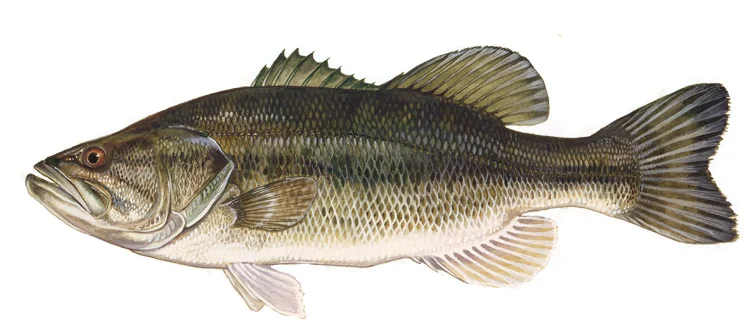
Description: Found throughout the state in ponds, lakes, rivers and streams. Both state and federal hatcheries stock most Oklahoma waters with these powerful fighters. The Florida subspecies of largemouth bass have been stocked in many reservoirs and will interbreed with native largemouth bass. These hybrids grow rapidly and produce trophy-size fish. Black bass is a general term referring to largemouth, spotted and smallmouth bass and their hybrids. The three species are similar, but can be easily identified. Since water clarity can affect the color of a fish , color is not a reliable way to tell the basses apart. The most objective way to tell these species apart is by the relationship of the eye and the mouth hinge. On a spotted bass, the mouth hinge lines up vertically with the back edge of the eye; on a smallmouth bass, the mouth hinge vertically lines up in front of the back edge of the eye; and on a largemouth bass, the mouth hinge vertically lines up behind the back edge of the eye. Largemouth bass Identification: - Mouth hinge is well behind eye - Most do not have a tooth patch on their tongue - The first and second dorsal fins are barely connected. Facts: The largemouth bass is the most sought-after game fish in Oklahoma. A highly predatory fish that will strike an assortment of artificial lures as well as natural bait. Because they help control smaller sunfish populations, the "overharvest" of bass (removing too many), especially on small lakes and ponds, should be avoided. Some Oklahoma lakes have size limits on bass to protect them from overharvesting. Check local as well as state regulations for possible size limits before fishing an unfamiliar lake. Oklahoma Making Monsters
Habitat: During the spring, largemouth bass is found in the shallow, weedy habitats where food and cover are available. During the hot days of summer and cold winter months, these fish move to deeper water. Food Sources: Crustaceans, insects, crayfish, frogs, and fish.
Habitat & Range
During the spring, largemouth bass is found in the shallow, weedy habitats where food and cover are available. During the hot days of summer and cold winter months, these fish move to deeper water. Food Sources: Crustaceans, insects, crayfish, frogs, and fish.
Life History
Spawning activities begin as water temperatures reach 62 to 65 degrees F. (April and May in Oklahoma). Nests are fanned out by males, usually within 10 feet of the shoreline. Females then deposit 2,000 to 7,000 eggs per pound of body weight in the nest. After fertilization, the male drives the female and any other intruders from the nest until the eggs hatch and the fry leave. Fry swim in schools until reaching a length of approximately one inch. Explore more Oklahoma Fish Photo by: Duane Raver Walleye Photo by: USGS , US Geological Survey Carp, Silver Photo by: Duane Raver, USFWS Brown Bullhead Catfish Previous Next
License & Regulations
A valid Oklahoma fishing license is required for anglers age 16 and older. Licenses are available for residents, non-residents, and short-term durations (1-day, 3-day, and annual). An Oklahoma fishing license also includes the privilege to fish for all species. Purchase online through the Oklahoma Department of Wildlife Conservation website or at authorized license retailers.
Frequently Asked Questions
Description
Found throughout the state in ponds, lakes, rivers and streams. Both state and federal hatcheries stock most Oklahoma waters with these powerful fighters. The Florida subspecies of largemouth bass have been stocked in many reservoirs and will interbreed with native largemouth bass. These hybrids grow rapidly and produce trophy-size fish. Black bass is a general term referring to largemouth, spotted and smallmouth bass and their hybrids. The three species are similar, but can be easily identified. Since water clarity can affect the color of a fish , color is not a reliable way to tell the basses apart. The most objective way to tell these species apart is by the relationship of the eye and the mouth hinge. On a spotted bass, the mouth hinge lines up vertically with the back edge of the eye;...
Habitat
During the spring, largemouth bass is found in the shallow, weedy habitats where food and cover are available. During the hot days of summer and cold winter months, these fish move to deeper water. Food Sources: Crustaceans, insects, crayfish, frogs, and fish.
Life Cycle
Spawning activities begin as water temperatures reach 62 to 65 degrees F. (April and May in Oklahoma). Nests are fanned out by males, usually within 10 feet of the shoreline. Females then deposit 2,000 to 7,000 eggs per pound of body weight in the nest. After fertilization, the male drives the female and any other intruders from the nest until the eggs hatch and the fry leave. Fry swim in schools until reaching a length of approximately one inch. Explore more Oklahoma Fish Photo by: Duane Raver Walleye Photo by: USGS , US Geological Survey Carp, Silver Photo by: Duane Raver, USFWS Brown Bullhead Catfish Previous Next
Regulations
Oklahoma fishing regulations apply to Largemouth Bass. A valid Oklahoma fishing license is required for anglers 16 and older. Bag and size limits vary by species and water body. Check the Oklahoma Department of Wildlife Conservation Fishing Regulations for current rules.
References
| State | Category | Directory | Subcategory | Content | Source |
|---|---|---|---|---|---|
| Oklahoma | Fishing | License | License & Fees | A valid Oklahoma fishing license is required for anglers age 16 and older. Licenses are available for residents, non-res | Link |