Overview
Few birds in North America captivate the imagination quite like the Wood duck (Aix sponsa). Known widely as one of the most visually stunning waterfowl on the continent, the Wood duck has earned a special place in the hearts of birdwatchers, wildlife enthusiasts, and hunters alike. With its iridescent plumage, unique nesting habits, and remarkable comeback story from the brink of population collapse, the Wood duck stands as a living testament to what thoughtful wildlife conservation can achieve.
For hunters and outdoor enthusiasts in North Dakota and across the broader Upper Midwest, the Wood duck represents both a prized game bird and a symbol of thriving wetland ecosystems. Whether you encounter this bird gliding silently through a wooded creek bottom, perched high in a cavity nest, or bursting from the surface of a marsh in a flash of color, the experience is one that leaves a lasting impression. This article explores everything you need to know about the Wood duck — from its remarkable biology and habitat preferences to its place in North American hunting culture and ongoing conservation efforts.
Biological Traits
The Wood duck, Aix sponsa, belongs to the family Anatidae and is a member of the perching duck group — a distinctive subset of waterfowl adapted for life in forested wetland environments. The scientific name Aix sponsa translates loosely from Latin as "water bird in bridal dress," a poetic nod to the species' breathtaking appearance.
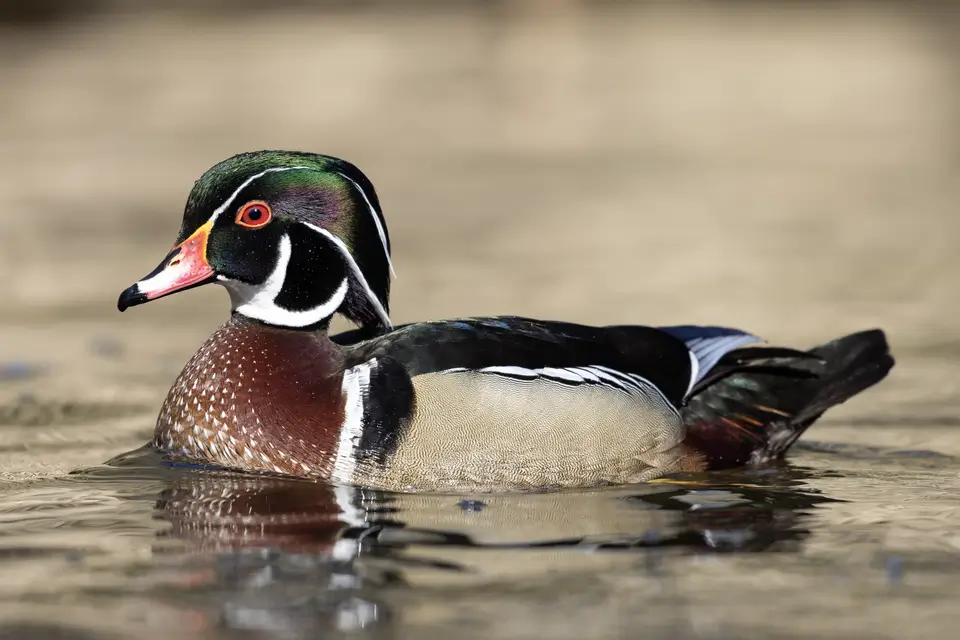
The male Wood duck in breeding plumage is arguably the most ornate duck in North America. His head is adorned with a crested pattern of iridescent greens and purples, accented by bold white stripes along the face and neck. His chest is a rich chestnut brown, peppered with white spots, while his flanks display buff-yellow tones bordered by black and white. His bill features red, white, and black markings, and his eyes are a vivid, striking red. This extraordinary combination of colors makes the male Wood duck instantly recognizable in the field.
The female Wood duck, while more subdued in coloration, is nonetheless a beautifully marked bird. She wears a grayish-brown body plumage with a distinctive white teardrop-shaped eye ring — a reliable field mark for identification. Her underparts are lighter, and she shares the species' characteristic crested head shape, though her crest is less pronounced than the male's.
One of the Wood duck's most fascinating biological adaptations is its sharp, hooked claws — an unusual feature among ducks that allows it to perch and grip tree branches and nest cavity openings with ease. This arboreal ability sets Wood ducks apart from most other waterfowl species, which rarely venture into the treetops. Their feet are designed to cling to bark and rough wood surfaces, making them uniquely suited to their forested habitat.
Wood duck hens are renowned for nesting in tree cavities, often at considerable heights above the ground or water. Shortly after hatching, the downy ducklings must make a remarkable leap of faith — sometimes falling more than 50 feet from their nest cavity to the ground or water below. Their lightweight, fluffy bodies allow them to survive this extraordinary plunge without injury, and they immediately follow their mother to the nearest water.
The species is also notable for a behavior known as "egg dumping" or brood parasitism, where females may lay eggs in the nests of other Wood ducks, resulting in nests that can contain far more eggs than a single hen would typically produce. Clutch sizes for a single hen generally range from around 7 to 15 eggs, with incubation lasting approximately 28 to 37 days. The ducklings are precocial, meaning they are active and mobile almost immediately after hatching.
Wood ducks are omnivorous, feeding on a wide variety of plant and animal matter. Their diet includes acorns, seeds, aquatic vegetation, berries, insects, and invertebrates. Acorns, in particular, are a critical food source during the fall season, and Wood ducks are often found foraging in flooded timber and bottomland forests where oak trees drop their mast into the shallow water below.
Habitat & Range
The Wood duck is primarily a bird of forested wetlands, river bottomlands, swamps, beaver ponds, and wooded lakes and streams. Unlike many other duck species that favor open water and treeless marshes, the Wood duck thrives where mature trees meet still or slow-moving water. Forested riparian corridors, flooded timber, and shrubby swamps are among its preferred haunts.
The species is found across a broad range in North America, with breeding populations occurring throughout the eastern United States, the Pacific Coast, and portions of the Upper Midwest. Wood ducks are year-round residents in parts of the Southeast, while northern populations are migratory, moving south and southeast in the fall to winter in warmer regions.
In North Dakota, a state characterized by its broad prairies, grasslands, river valleys, and abundant wetlands, Wood ducks occupy riparian corridors and wooded wetland areas, particularly along river systems and in the forested pockets that break up the state's expansive agricultural landscape. The Missouri River corridor, the Sheyenne River valley, and wooded lake margins provide important habitat for Wood ducks in the region. While North Dakota is not typically considered the heart of Wood duck range, the species does breed and migrate through the state, making it a part of the waterfowl hunting experience in the Upper Midwest.
The Wood duck's dependence on tree cavities for nesting means that mature forests with large, cavity-bearing trees — particularly those near water — are essential habitat components. The loss of old-growth trees and the removal of dead snags from riparian areas historically reduced nesting opportunities for this species. The widespread adoption of artificial nest boxes has helped offset this loss in many areas, and Wood duck boxes are now a common sight along waterways throughout their range.
Hunting Information
The Wood duck holds a cherished place in North American waterfowl hunting culture. It is one of the most pursued perching ducks on the continent, prized both for the challenge of hunting it in wooded, intimate settings and for the sheer beauty of the bird itself. Wood duck hunting tends to be a close-quarters, fast-action pursuit — often conducted from a canoe or small boat in forested creek bottoms, backwater sloughs, or flooded timber, where shots can come suddenly and at close range.
Early morning flights of Wood ducks filtering through the treetops and dropping into secluded pools are among the most memorable experiences in waterfowl hunting. Hunters often use mallard and Wood duck decoys placed in flooded timber or along wooded stream edges to attract birds. Calling with a Wood duck call — a distinctive whistling "oo-eek" sound — can also be effective in drawing birds into range.
In North Dakota, waterfowl hunting falls under the regulatory framework established by the North Dakota Game and Fish Department, which sets season dates, bag limits, and licensing requirements for all waterfowl species, including Wood ducks. Wood ducks are typically included in the general duck season framework, though hunters should always consult the most current regulations published by the North Dakota Game and Fish Department before heading afield, as season dates, bag limits, and licensing requirements can change from year to year. The state's waterfowl hunting opportunities are managed in conjunction with the U.S. Fish and Wildlife Service and the frameworks established under the Migratory Bird Treaty Act, which governs all migratory waterfowl hunting in the United States and Canada.
Hunters pursuing Wood ducks in North Dakota's wooded river corridors and wetland areas should be prepared for shooting in tight, forested conditions. A shotgun choked for close to moderate distances, combined with non-toxic shot as required by federal law for waterfowl hunting, is appropriate for this type of hunting. Scouting productive roost sites and feeding areas in the days before the season opens is a valuable strategy for success.
Conservation
The Wood duck's conservation story is one of the most inspiring chapters in North American wildlife management. By the late 19th and early 20th centuries, populations had been severely reduced by unregulated market hunting and widespread habitat loss, primarily through the clearing of mature bottomland forests and the draining of wetlands. At one point, the species was feared to be heading toward extinction.
The passage of the Migratory Bird Treaty Act in 1918 was a turning point, providing federal protection for Wood ducks and other migratory birds. Combined with regulated hunting seasons, habitat restoration efforts, and the widespread installation of artificial nest boxes, Wood duck populations recovered dramatically over the course of the 20th century. Today, the Wood duck is considered a conservation success story and a symbol of what science-based wildlife management can accomplish.
Nest box programs have been particularly impactful for this species. Hundreds of thousands of artificial nest boxes have been installed along waterways across North America by conservation organizations, state wildlife agencies, and private landowners. These boxes provide critical nesting cavities in areas where large, hollow trees have been removed, and they have played a direct role in supporting robust Wood duck populations.
Continued investment in wetland conservation — through programs like the federal Wetlands Reserve Program and initiatives supported by organizations such as Ducks Unlimited — remains essential for Wood duck habitat security. In North Dakota, where wetland health is a cornerstone of waterfowl abundance across the entire Central Flyway, protecting and restoring forested riparian corridors and pothole wetlands benefits Wood ducks along with dozens of other species.