Overview
Few birds command the same level of admiration, respect, and sporting tradition as the wild turkey (Meleagris gallopavo). A true symbol of American wilderness, the wild turkey has woven itself into the cultural and ecological fabric of North America for thousands of years. From the dense hardwood forests of the Eastern Seaboard to the rolling prairies and river breaks of the Great Plains, this remarkable bird has demonstrated a resilience and adaptability that has made it one of the great conservation success stories in American wildlife management history.
Whether you know the wild turkey as the centerpiece of a Thanksgiving table, the wary adversary that outwits even the most seasoned hunters, or simply as a breathtaking creature spotted along a rural road at dawn, there is no denying that Meleagris gallopavo occupies a special place in the hearts and minds of outdoor enthusiasts across the continent. In states like North Dakota, where vast prairies, wooded river corridors, and agricultural landscapes converge, the wild turkey thrives as both a prized game species and a fascinating subject of wildlife study.
This article explores the biology, habitat, range, hunting traditions, and conservation history of the wild turkey, with particular attention to how this magnificent bird fits into the landscape and sporting culture of North Dakota.
Biological Traits
The wild turkey is the largest native game bird in North America and one of the most visually striking. As a member of the family Phasianidae — which also includes pheasants, grouse, and peacocks — the wild turkey shares many characteristics with its relatives, including strong legs built for ground travel, relatively short wings suited to burst flight, and elaborate plumage used in courtship displays.
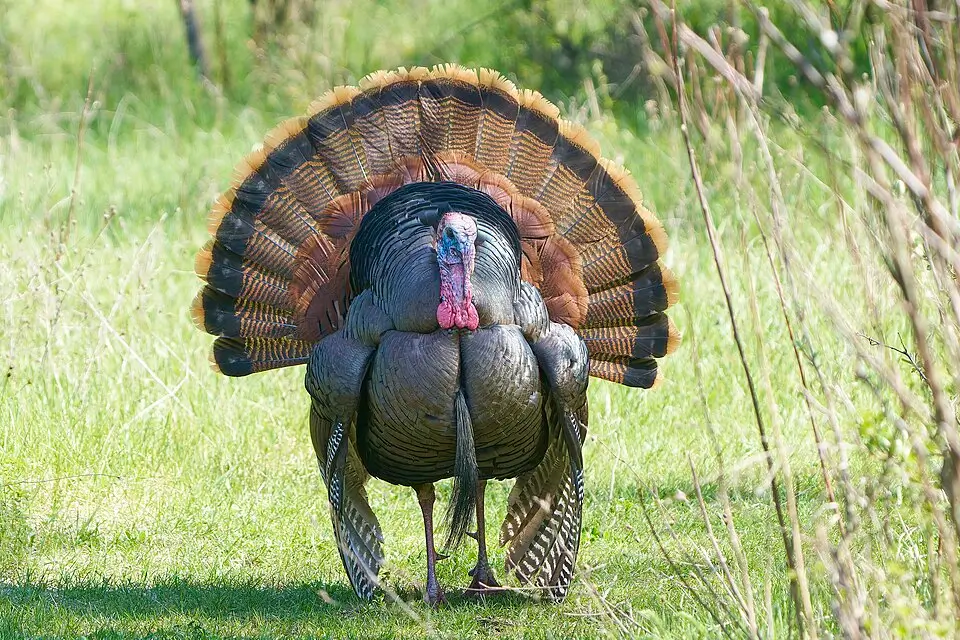
Adult male turkeys, known as toms or gobblers, are among the most visually dramatic birds on the continent. They are characterized by iridescent feathers that shimmer with bronze, copper, green, and gold tones depending on the angle of light. Gobblers possess a fleshy, ornate head adorned with red, white, and blue coloration that intensifies during periods of excitement or courtship. A prominent fleshy appendage called a snood hangs over the bill, and a distinctive tuft of coarse, hair-like feathers called a beard projects from the chest. Some exceptional toms can grow beards exceeding ten inches in length, making beard length one of the most celebrated trophies in turkey hunting.
Gobblers are also known for their iconic gobble — a loud, resonant vocalization used to attract hens during the spring breeding season. This call can carry over a mile in optimal conditions and is the primary reason spring turkey hunting is so deeply embedded in American sporting tradition. Hunters spend countless hours learning to mimic the various calls of hens — yelps, clucks, purrs, and cuts — in hopes of luring a responding gobbler into range.
Female turkeys, called hens, are considerably smaller than toms and are dressed in more subdued, mottled brown plumage that provides exceptional camouflage during nesting. Hens are the primary caregivers for young turkeys, known as poults, which hatch in a highly precocial state — meaning they are mobile and capable of feeding themselves within hours of hatching. A hen's clutch typically consists of around 10 to 12 eggs, though she may lay more depending on conditions. The nesting period is a critical and vulnerable time for the species, as ground nests are susceptible to predation by foxes, raccoons, skunks, and other opportunistic predators.
Wild turkeys are omnivores with a broad and opportunistic diet. They consume acorns, seeds, berries, insects, small reptiles, and agricultural grains. This dietary flexibility is one of the key reasons the species has been so successful in colonizing diverse landscapes, from dense eastern forests to the agricultural river valleys of the Great Plains. During winter, turkeys rely heavily on mast crops such as acorns and on waste grain left in harvested fields — a food source that is particularly abundant in agricultural states like North Dakota.
Wild turkeys are also remarkably intelligent and possess extraordinarily keen eyesight, capable of detecting movement and color with a precision that humbles even experienced hunters. Their vision is often cited as one of the primary challenges in hunting them successfully.
Habitat & Range
The wild turkey is native to North America and has an extensive range that spans much of the continental United States, parts of Canada, and into Mexico. There are six recognized subspecies of Meleagris gallopavo, each adapted to specific regional environments. The Eastern wild turkey (M. g. silvestris) is the most abundant and widely distributed subspecies. The Rio Grande wild turkey (M. g. intermedia) is common across the southern plains and into the southwestern states. The Merriam's wild turkey (M. g. merriami) is found in mountainous regions of the West, while the Osceola, Gould's, and South Mexican subspecies occupy more limited ranges.
In North Dakota, the dominant subspecies present are the Eastern wild turkey and the Rio Grande wild turkey, with some hybridization occurring between the two populations in areas of overlapping range. North Dakota's landscape — characterized by broad prairies, the Missouri River corridor, the Killdeer Mountains, and a patchwork of agricultural land and riparian woodland — provides surprisingly productive turkey habitat. Wild turkeys in North Dakota are commonly found in wooded river breaks, shelterbelts, and the transitional zones where grasslands meet timbered draws.
The Missouri River system and its tributaries serve as critical corridors for turkey movement and population expansion across the state. Turkeys roost in large trees — cottonwoods, elms, and ash trees are common choices — and use nearby open ground for foraging during the day. The combination of tall riparian trees for roosting, open fields for feeding, and brush for cover creates ideal conditions for sustainable turkey populations.
North Dakota's climate presents challenges for wild turkeys during severe winters, but the birds are resilient. Deep snow can limit access to food, making agricultural areas with waste grain particularly valuable during harsh conditions. As wild turkey populations have expanded and management has improved, turkeys have successfully colonized many areas of the state where they were historically absent.
Hunting Information
The wild turkey is one of North America's premier upland game birds, and hunting it is a deeply cherished tradition that has grown dramatically in popularity over the past several decades. Turkey hunting is typically divided into two primary seasons: spring and fall.
Spring turkey hunting is the most widely practiced and celebrated form of turkey hunting. It takes place during the breeding season, when gobblers are actively gobbling and seeking hens. Hunters use calls to mimic hen vocalizations, attempting to draw lovesick toms within shooting range. The intimacy and challenge of calling in a wary gobbler at close range — often within 30 to 40 yards — makes spring turkey hunting one of the most exciting and skill-intensive pursuits in all of upland hunting.
Fall turkey hunting offers a different but equally rewarding experience. Hunters in the fall often focus on locating turkey flocks, scattering them, and then calling them back together using assembly calls. Fall hunting allows pursuit of both hens and toms in many jurisdictions, depending on local regulations.
In North Dakota, the wild turkey is recognized as an upland game species managed by the North Dakota Game and Fish Department. According to official state hunting information, North Dakota offers hunting seasons for wild turkey as part of its upland game program. Hunters interested in pursuing wild turkeys in North Dakota should consult the current regulations published by the North Dakota Game and Fish Department, as season dates, bag limits, and licensing requirements are subject to change from year to year and vary by unit and season type.
Hunters pursuing turkeys in North Dakota should be well-versed in the state's licensing and lottery systems, as some special permits and season structures may be allocated through controlled processes. The North Dakota Game and Fish Department's official website is the most reliable source for up-to-date licensing information, season structures, and legal shooting hours.
For equipment, most turkey hunters use 12-gauge or 20-gauge shotguns loaded with heavyweight turkey loads, though archery equipment and crossbows are also widely used and add an additional layer of challenge to the pursuit. Camouflage clothing is essential, given the turkey's exceptional eyesight. Decoys, friction calls, box calls, diaphragm calls, and locator calls are all standard tools of the turkey hunter's trade.
Scouting before the season is critical to success. Identifying roost sites, strut zones, feeding areas, and travel corridors dramatically increases the likelihood of a successful hunt. In North Dakota's river breaks and prairie landscapes, understanding how turkeys move between roosting, feeding, and loafing areas can mean the difference between a memorable morning afield and a long, quiet sit.
Conservation
The wild turkey's conservation story is one of the most inspiring in North American wildlife management. By the early 20th century, unregulated hunting and widespread habitat destruction had reduced wild turkey populations to dangerously low numbers. The species had been eliminated from many states, including large portions of its northern range.
The recovery of the wild turkey stands as a monument to the power of science-based wildlife management, hunter funding through license fees and excise taxes, and collaborative conservation efforts. The National Wild Turkey Federation (NWTF), founded in 1973, has been instrumental in wild turkey restoration, working alongside state and federal agencies to trap and transplant wild-caught birds into suitable but unoccupied habitat across the country. This trap-and-transfer program ultimately restored wild turkeys to all of the lower 48 states and expanded populations into Canada and beyond.
Today, wild turkey populations across North America number in the millions, and the species is considered a conservation success by virtually every measure. In North Dakota, continued habitat management, responsible hunting regulations, and ongoing monitoring by the North Dakota Game and Fish Department help ensure that wild turkey populations remain healthy and sustainable for future generations of hunters and wildlife enthusiasts alike.
The wild turkey's recovery also serves as a powerful reminder of what is possible when hunters, conservationists, land managers, and government agencies work together toward a common goal. The funding generated through hunting licenses, stamps, and excise taxes on sporting equipment — a system formalized under the Pittman-Robertson Act of 1937 — has been a cornerstone of wildlife conservation funding in the United States, directly benefiting species like the wild turkey and the habitats they depend upon.