Overview
Few birds capture the imagination of upland hunters and wildlife enthusiasts quite like the ruffed grouse (Bonasa umbellus). Known affectionately as "the king of game birds" among devoted followers, the ruffed grouse is a forest-dwelling upland bird that has earned its place as one of North America's most celebrated and sought-after wild game species. Whether encountered along a wooded trail in the early morning light or flushed dramatically from a thicket beneath the feet of a pointing dog, the ruffed grouse never fails to make an impression. Its legendary speed, camouflaged plumage, and thrilling flush make it a perennial favorite for hunters and birders alike.
In North Dakota, the ruffed grouse represents a special opportunity for upland game hunters willing to venture into the wooded river bottoms and forested regions of the state. While North Dakota is perhaps better known for its vast prairies and world-class waterfowl hunting, the ruffed grouse adds a unique dimension to the state's rich outdoor heritage. This article explores the biology, habitat, hunting tradition, and conservation of this remarkable bird — the drummer of the forest.
Biological Traits
The ruffed grouse, Bonasa umbellus, belongs to the family Phasianidae, the same broad family that includes pheasants, turkeys, and other grouse species. The genus name Bonasa is derived from the Latin word for "bison," a reference to the bird's thunderous drumming display, while umbellus refers to the umbrella-like ruff of dark feathers around the bird's neck — feathers that give the species its common name.
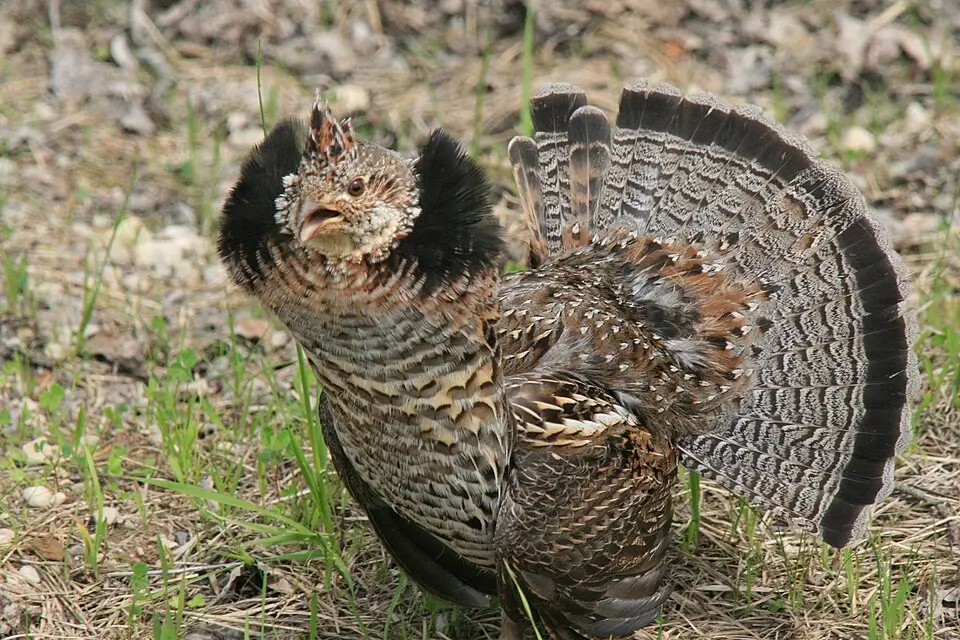
One of the most iconic characteristics of the ruffed grouse is its remarkable drumming behavior. Male grouse produce this deep, resonant sound not through vocalization but by rapidly beating their wings against the air while perched on a favored log or stump. The sound begins slowly, like a distant engine turning over, then accelerates into a rapid, muffled thunder. This drumming serves as both a territorial declaration and a courtship display, carrying impressively through the dense forest understory. It is a sound that, once heard, is never forgotten — a true hallmark of the deep woods.
The ruffed grouse exhibits two primary color morphs: a gray phase and a brown (or rufous) phase. The gray phase tends to be more common in the northern portions of the species' range, while the brown phase appears more frequently in the south. In both forms, the bird's cryptic, bark-like patterning of browns, tans, blacks, and grays makes it extraordinarily difficult to spot against a forest floor. A horizontal black band near the tip of the tail fan is a reliable field identification mark in both color phases.
Adult ruffed grouse are medium-sized birds, stocky in build with relatively short, rounded wings designed for explosive, short-distance flight through dense woodland. When flushed, they erupt from cover with a startling burst of wingbeats and navigate through timber with impressive agility. Their legs are feathered partway down the tarsus, and in winter, grouse grow pectinations — comb-like projections along the sides of their toes — that function essentially as snowshoes, allowing them to walk across soft snow and even roost by diving beneath its surface for warmth and insulation.
The ruffed grouse is also notable for population cycles that have long fascinated wildlife biologists. Across much of its northern range, grouse populations experience roughly 10-year boom-and-bust cycles, likely tied to the population dynamics of predators and prey in a complex ecological web. During peak years, grouse can be remarkably abundant; during low years, even skilled hunters may go entire outings without flushing a bird.
Habitat & Range
The ruffed grouse is fundamentally a bird of forested landscapes. Across its range — which spans much of the northern and eastern United States as well as a broad swath of Canada from the Atlantic coast to the Pacific — it favors young, mixed deciduous and coniferous forests with dense understory cover. Aspen stands are particularly important throughout much of its range, as aspen provides both food (buds, catkins, and leaves) and dense, shrubby cover ideal for nesting and brood-rearing. Alder, birch, and various fruiting shrubs also figure prominently in grouse habitat.
In North Dakota, ruffed grouse occupy a narrower slice of suitable habitat compared to heavily forested states to the east. The state's landscape is dominated by open prairies, agricultural fields, and wetlands, but wooded corridors along rivers such as the Pembina, Turtle, and Sheyenne — as well as the Turtle Mountains in the north-central part of the state — provide the forested habitat that ruffed grouse require. The Turtle Mountains, a rolling region of mixed forest and lakes near the Canadian border, represent some of the best ruffed grouse habitat in North Dakota.
Because North Dakota sits near the western and southern edge of the ruffed grouse's range in this part of the continent, populations here are naturally lower and more localized than in core range states like Minnesota, Wisconsin, or Michigan. Hunters seeking ruffed grouse in North Dakota should focus their efforts on these forested refuges, where the birds concentrate in the cover that sustains them.
Hunting Information
The ruffed grouse is widely regarded as among the finest upland birds to hunt in North America — a sentiment shared by generations of dedicated woodcock and grouse hunters who pursue them with flushing dogs, pointing breeds, or simply on foot through the timber. The explosive flush, dense cover, and elusive nature of the bird demand both patience and skill.
Hunting ruffed grouse is traditionally a close-range affair. Birds are typically taken at relatively short distances as they burst from underbrush, requiring quick reflexes and an open-choke shotgun to maximize pattern spread. Many seasoned grouse hunters favor lightweight, open-bored shotguns in 20-gauge or 28-gauge for their maneuverability in dense forest. Early season hunting, when foliage is still thick, is notoriously challenging; as leaves drop in autumn, visibility improves and hunting can become more productive.
Dogs are a beloved and effective tool for grouse hunting. Pointing breeds such as the English setter, Brittany, and German shorthaired pointer are popular choices, as they allow the hunter time to get into position before a bird flushes. Flushing breeds like the springer spaniel are also effective in dense cover. A well-trained grouse dog working through the timber is a sight — and an experience — that defines the upland hunting tradition for many enthusiasts.
In North Dakota, hunters interested in pursuing ruffed grouse should consult the North Dakota Game and Fish Department for current season dates, bag limits, and licensing requirements, as regulations can change from year to year. The state offers general small game hunting licenses that typically cover upland species, but hunters are always encouraged to verify current regulations before heading afield. The North Dakota Game and Fish Department's official resources — available at the agency's website — are the authoritative source for up-to-date hunting information in the state.
Scouting ahead of the season is highly recommended, particularly in North Dakota where suitable habitat is more fragmented than in core range states. Locating active drumming logs in spring, identifying stands of mature aspen, and finding areas where birds have been leaving tracks and feathers can make the difference between a productive outing and a long walk in the woods.
Conservation
The ruffed grouse is not currently listed as a threatened or endangered species, and across much of its core range it remains a huntable game bird with sustainable populations. However, like many forest birds, it is sensitive to large-scale changes in forest composition, age, and structure. The species requires a mosaic of forest ages — from young, dense regenerating stands to mature timber — to meet its year-round needs for food, cover, nesting, and brood-rearing.
Forest management practices, including timber harvesting that mimics natural disturbance and encourages young aspen regeneration, have proven effective in maintaining and improving grouse habitat on a landscape scale. Organizations such as the Ruffed Grouse Society have long advocated for active forest management as a conservation tool, working with landowners, state agencies, and federal land managers to create and maintain the early successional forest habitat that grouse — and a host of other wildlife species — depend upon.
In North Dakota, where suitable habitat is naturally limited and fragmented, thoughtful land stewardship along river corridors and in forested regions like the Turtle Mountains is especially important for maintaining viable grouse populations. The North Dakota Game and Fish Department actively monitors upland game bird populations and works to ensure sustainable hunting opportunities for future generations.
Whether you are a dedicated grouse hunter with a seasoned bird dog at your side or simply a wildlife enthusiast hoping to hear the hollow thunder of a drumming male on a quiet spring morning, the ruffed grouse is a species well worth knowing, appreciating, and protecting. It is, in every sense, the drummer of the forest.